Application of Chemistry
Radio
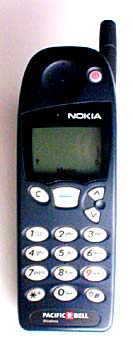
"Radio waves" transmit music, conversations, pictures and data invisibly through the air, often over millions of miles -- it happens every day in thousands of different ways! Even though radio waves are invisible and completely undetectable to humans, they have totally changed society. Whether we are talking about a cell phone, a baby monitor, a cordless phone or any one of the thousands of other wireless technologies, all of them use radio waves to communicate.
AM and FM radio broadcasts
Each different radio signal uses a different sine wave frequency, and that is how they are all separated.
Any radio setup has two parts: The transmitter and the receiver
The transmitter takes some sort of message (it could be the sound of someone's voice, pictures for a TV set, data for a radio modem or whatever), encodes it onto a sine wave and transmits it with radio waves. The receiver receives the radio waves and decodes the message from the sine wave it receives. Both the transmitter and receiver use antennas to radiate and capture the radio signal. Sine wave transmits across and modulation contains information that you want to send across.
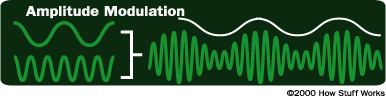
Amplitude Modulation - Both AM radio stations and the picture part of a TV signal use amplitude modulation to encode information. In amplitude modulation, the amplitude of the sine wave (its peak-to-peak voltage) changes. So, for example, the sine wave produced by a person's voice is overlaid onto the transmitter's sine wave to vary its amplitude.
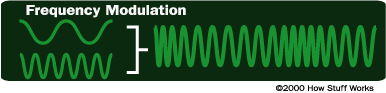
Frequency Modulation - FM radio stations and hundreds of other wireless technologies (including the sound portion of a TV signal, cordless phones, cell phones, etc.) use frequency modulation. The advantage to FM is that it is largely immune to static. In FM, the transmitter's sine wave frequency changes very slightly based on the information signal.
Here's a real world example. When you tune your car's AM radio to a station -- for example, 680 on the AM dial -- the transmitter's sine wave is transmitting at 680,000 hertz (the sine wave repeats 680,000 times per second). The DJ's voice is modulated onto that carrier wave by varying the amplitude of the transmitter's sine wave. An amplifier amplifies the signal to something like 50,000 watts for a large AM station. Then the antenna sends the radio waves out into space.
Unless you are sitting right beside the transmitter, your radio receiver needs an antenna to help it pick the transmitter's radio waves out of the air. An AM antenna is simply a wire or a metal stick that increases the amount of metal the transmitter's waves can interact with.
Your radio receiver needs a tuner. The antenna will receive thousands of sine waves. The job of a tuner is to separate one sine wave from the thousands of radio signals that the antenna receives. In this case, the tuner is tuned to receive the 680,000-hertz signal. Tuners work using a principle called resonance. That is, tuners resonate at, and amplify, one particular frequency and ignore all the other frequencies in the air. It is easy to create a resonator with a capacitor and an inductor.
The tuner causes the radio to receive just one sine wave frequency (in this case, 680,000 hertz). Now the radio has to extract the DJ's voice out of that sine wave. This is done with a part of the radio called a detector or demodulator. In the case of an AM radio, the detector is made with an electronic component called a diode. A diode allows current to flow through in one direction but not the other, so it clips off one side of the wave, like this: The radio next amplifies the clipped signal and sends it to the speakers (or a headphone). The amplifier is made of one or more transistors (more transistors means more amplification and therefore more power to the speakers).
In an FM radio, the detector is different, but everything else is the same. In FM, the detector turns the changes in frequency into sound, but the antenna, tuner and amplifier are largely the same.
You have probably noticed that almost every radio you see (like your cell phone, the radio in your car, etc.) has an antenna. Antennas come in all shapes and sizes, depending on the frequency the antenna is trying to receive. The antenna can be anything from a long, stiff wire (as in the AM/FM radio antennas on most cars) to something as bizarre as a satellite dish. Radio transmitters also use extremely tall antenna towers to transmit their signals.
The idea behind an antenna in a radio transmitter is to launch the radio waves into space. In a receiver, the idea is to pick up as much of the transmitter's power as possible and supply it to the tuner. For satellites that are millions of miles away, NASA uses huge dish antennas up to 200 feet (60 meters ) in diameter.
The size of an optimum radio antenna is related to the frequency of the signal that the antenna is trying to transmit or receive. The reason for this relationship has to do with the speed of light, and the distance electrons can travel as a result. The speed of light is 186,000 miles per second (300,000 kilometers per second).
Microwave--A high-frequency electromagnetic wave, one millimeter to one meter in wavelength, intermediate between infrared and short-wave radio wavelengths. Unlike the more dangerous ionizing range like gamma rays down until visible light, microwaves are considered to be a part of the non-ionizing range of radiation due to its lower frequency and less damaging characteristics.
The most common use of it is the microwave oven or in colloquial terms “the microwave?
Here is now it works:
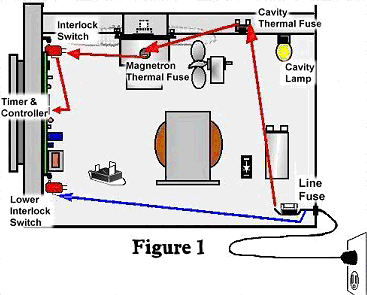
* Electricity from the wall outlet travels through the cord wires.
* It enters the microwave oven through a series of safety fuse protection circuits. These fuses and safety circuits are designed to deactivate the microwave oven if an electrical short or overheating occurs.
* The electricity passes through the interlock and timer circuits. These set the oven timer and pass the electricity onto the control circuits.
* In the control circuits, an electronic relay called the triac authorizes the continuation of the electricity through the circuit into the high-voltage section.
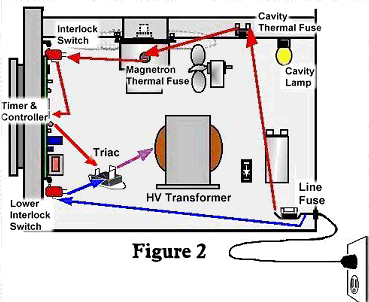
* In the high voltage section, the high voltage transformer converts the usual 115 volts of electricity to around 3000 volts that are needed for the magnetron tube to convert into microwave energy.
* The microwaves are then transferred into a metal tube called the waveguide. The waveguide feeds the energy into the cooking chamber through a revolving metal blade called the stirrer blade. This is used to disperse the microwaves evenly throughout the chamber evenly cooking food.
* The waves go in all directions but the walls of the cooking chamber reflect the microwaves so that most all of the waves are absorbed by the food. The reason why the microwaves do not leak out the door window is that the window is covered by a special metal screen that also reflects microwaves.
* Once the timer is up and the door is open the microwave oven stops the production of microwave energy.

So how is electricity converted into microwave energy?
The Magnetron~

The magnetron is composed of basically four parts:
1. ANODE: An ANode is an electron receptor making up the outer ring of the magnetron. It has cavities called resonance cavities that are separated by the anode vane.
2. FILAMENT/CATHODE: The filament or the CAthode produces the electrons and consists of the inner ring of the magnetron.
3. ANTENNA: the antenna is a loop that connects the magnetron to the waveguide.
4. MAGNETIC FIELD: two permanent magnets are placed above and below the magnetron.
How does the magnetron work?

1. FiG 3A: The force exerted from the electric field is proportional to the strength of the field. And electrons tend to move from the negative cathode to the positive anode.
2. As the temperature rises in the cathode it begins to emit more electrons analogous to how water releases steam when boiling.
3. With the momentum from the transformer which intensified the electric voltage and the basic repulsion of the electrons from each other, they begin moving towards the cathode. With the interference of the two magnetic fields the electrons tend to circle to the anode rather than go straight. (FiG 3C)
4. The spinning electrons soon form a wheel like formation around the cathode resembling the spokes of a wheel (FIG 4)
5. The spinning electrons brush past the anode vane they cause a slight negative charge in some while causing a slight positive in the next.
6. This causes an alternating current creating waves in the resonance cavities.
7. The waves are then transported into the cooking chamber
Ultraviolet Lights
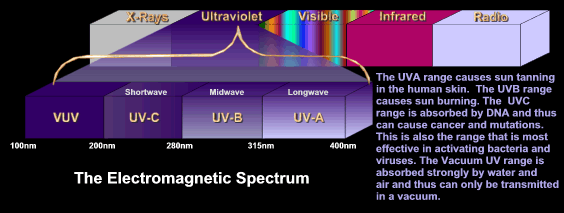
Probably the first thing most people think of when they think of Ultra Violet Light of UV Rays is our sun. Even though there are definitely different sources of this light the most common and the most abundant source is our sun. These UV rays are harmful to our skin and to our eyes. Over the years people have come up with recipe after recipe to protect ourselves from these rays. These rays that, over time, help produce skin cancer and other harmful diseases. UV rays are made up of UVA, UVB, and UVC. The UVC is supposedly the most harmful of them all. They also have the shortest wavelength. However because it is shielded by our ozone layer we are not yet greatly effected by this ray, but as the ozone layer is destroyed the risk increases. UVB rays are the rays that cause sunburns. These rays with a longer wavelength penetrate the epidermis and activate melanocyte cells that release melanin and cause a darker skin complexion, or a tan. Also there is a depressive effect from the UVB rays to the immune system. UVA rays have the longest wavelength of the UV rays and are the causers of premature aging including wrinkles, age spots, and loss of elasticity. The UVA rays are the most penetrative rays of the UV rays and are 10 to 100 times more numerous than UVB rays. However even though all cause problems within the human body these rays can be repelled. Modern day sunscreens repel the rays in different quantities according to the different UV protection numbers; the higher the number the greater the protection. However they repel only the UVA and UVB rays. The “active ingredients?in the sunscreen are the ones that actually do the repelling of the UV rays. These ingredients are usually ethylhexyl plus methoxycinnamate, 2-ethylhexyl salicylate, oxybenzone, and homosalate. There are also protective contact lenses to protect the radiation from reaching the cornea and sunglasses like the contact lenses help to protect from UV over exposure. Over all the UV ray is dangerous over time and in large quantities, but you can protect yourself from damage as long as you are careful.