
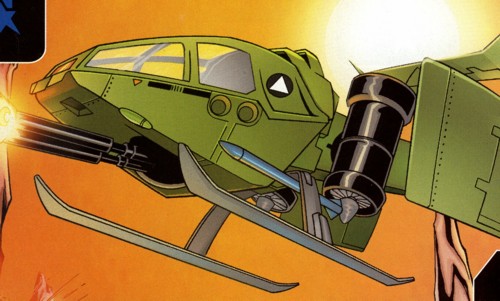
Sky Hawk
Control: Ex
Speed: Mn
Body: Rm
Protection: Gd
Weapons System:
-Flight: the primary feature of the Sky Hawk, the vehicle can achieve flight by means of two powerful, twin SK-34 Series 1 high bypass turbofan engines, mounted immediately behind the cockpit of this small craft. These engines allow the Sky Hawk to fly at 510 miles per hour (Mn airspeed).
-Levitation: the secondary feature of the Sky Hawk is its ability to take off and land vertically, thanks to its ability to pivot its SK-34 engines in a vertical orientation. This allows it to levitate with Fe rank; not all that effective, but definitely enough to suspend it over an area for quite some time.
-S.P.A.T.S. Rockets: mounted under the Sky Hawk's cockpit are these two signal processing air to surface (S.P.A.T.S.) rockets. These missiles track their targets with a radar lock once the Sky Hawk's pilot can achieve one, and are possessed of these vehicular statistics:
--Control: Ex Speed: Mn Body: Ex Damage: Rm Edge
-Titanium-Alloy Fuselage Skin: the Sky Hawk is built with 'light' in mind, and it only weighs in at 7,300 lbs. Nonetheless, the thing is built from a titanium alloy fuselage, which makes it highly resistant to small-arms fire (great for air support of ground troops), and provides the Sky Hawk's Body and Protection.
-Twin 20mm "Thunderclap" Cannons: mounted on a chin turret immediately beneath the Sky Hawk's pilot, this set of two 20mm cannons can inflict serious damage in combat. They can fire a short burst of lead to inflict Ex Shooting, or +1cs damage in a sustained stream of fire.
-Vulcan 20mm Rotary Cannons: these secondary, rotary cannons are mounted in recessed cavities on both sides of the Sky Hawk. They can only point at whatever's directly in front of the Sky Hawk, but their high rate of fire allows them to inflict Ex Armor Piercing Shooting.
The Sky Hawk is a very small, lightweight vertical take-off and landing aircraft that the G.I. Joe team has made good use of in the past when ordinary air support is impractical.
