
|
You are here: HOME > BIO > DAVE COWENS กก | ||||||||||||
| กก
18 Dave Cowens
| ||||||||||||
|
1. Bio from celtics.com 2. Bio from hoophall.com DAVE COWENS
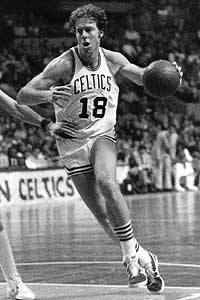
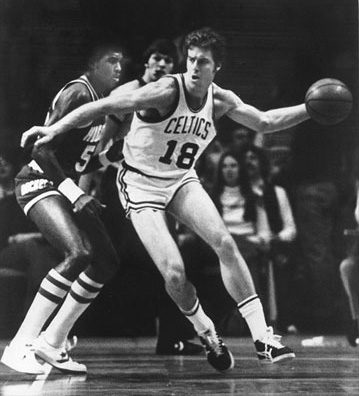
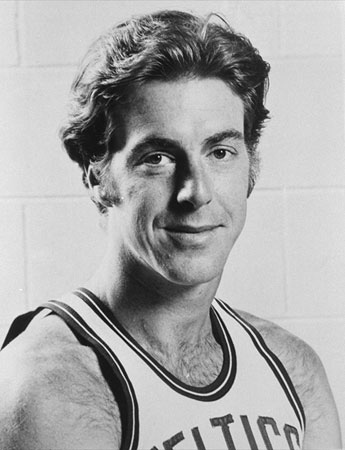
The Celtics picked Cowens in the 1970 NBA draft with their first pick, 4th overall. Red Auerbach, who at the time was General Manager, thought Cowens would help turnaround a franchise that just had one of its worst seasons going 34-48 in 1969-70, the year after the legendary center Bill Russell retired. Cowens made an immediate impact and the team improved to 44-38. The redheaded lefty was named Co-Rookie of the Year that season. Cowens won the MVP award in 1973 and captured his first NBA title in 1974 when he went against Abdul-Jabbar and the Milwaukee Bucks. He outplayed Abdul-Jabbar to lead the Celtics to its 12th NBA championship. He scored 28 points and 14 rebounds and help contain Abdul-Jabbar, holding him scoreless for 18 minutes in that decisive seventh game of the NBA Finals. Even with players like Paul Silas, Jo Jo White, Charlie Scott and John Havlicek, Cowens was the foundation of the 1975-76 Celtics. He led the team in scoring during the regular season with 19.0 points a game, including a season team-high 39 points. Cowens led the team in field goal percentage at 46.8 and in rebounds, averaging 16.0 a contest, which was second in the league. And rebounding was indeed Cowens's forte. In his first two seasons, none of his teammates came within 500 rebounds of his total. The wide-bodied Paul Silas joined the C's in 1972 and help immensely on the boards. But that didn't affect Cowens' totals, only adding to it and the Celtics front court dominance. Thanks to his reputation for getting good position in the post, an effective hook-shot, and other outstanding athletic abilities (Celtics scout Mal Graham said Cowens was, "the best jumping white man I ever saw") he grabbed over 1000 boards six times during his career, including 1246 in 1975-76. Not to be overlooked, Cowens was also a great passer, contributing 4.2 assists a game. Along with Havilcek and Silas, Cowens was named to the NBA All-Defensive Team in 1975-76, a feat that no other team has matched in NBA history. This was a squad that held a New York Knicks team to just three assists in a Celtics 100-94 Celtics win on March 28, 1976. For the season, they held opponents to 100.8 points a game, the club's lowest total since the 1956-57 season. Boston Celtics fans in attendance at the Garden on June 4, 1976 got to witness what is considered by many to be the greatest game is the NBA history, which the Celtics won 128-126 in triple overtime in Game 5 against the Phoenix Suns in the 1976 finals. Cowens scored 26 points and grabbed eight boards in 55 minutes of play, but fouled out in the third overtime period. The Celtics went on to win their 13th NBA championship, second in three years, as they closed out the series in Phoenix in Game 6. Cowens finished the 1975-76 playoffs averaging 21.0 points and 16.4 rebounds over 18 contests, helping him attain his second and final championship ring. The season was special as it brought closure to an era. In that time, Cowens and his teammates proved that "defense wins championships" and team unity is a remarkable factor for success in the NBA. Cowens was the type of player who "took one for the team," whether it was battling for a rebound, taking a hard foul or giving a hard foul. "My whole reputation was based on giving maximum effort," said Cowens, "That's the way I want to be remembered as a player. I always had the desire to work hard and do my part, or more, If necessary." Before the Larry Bird/Kevin McHale/Robert Parish teams were formed and after the Bill Russell/Bob Cousy squads retired, the Cowens lead the 1975-76 Championship and it was just as spectacular. He was the central player in continuing the string of titles. Today, if you look up in the rafters of the FleetCenter, the number 18 serves as a reminder of his legacy.
What Dave Cowens lacked in size as a 6-foot-9
center, he made up for with an aggressive desire to win. Rather than
follow the traditional notion of a basketball center as a
back-to-the-basket pivot man, Cowens roamed the outside, shooting soft
jumpers or driving to the basket. Although the "Redhead" didn't
begin playing basketball until his junior year in high school, he wound up
with a scholarship to Florida State University. In his collegiate career,
Cowens averaged 19 point On the recommendation of Hall of Famer and former
great Celtics center Bill Russell, the Celtics drafted Cowens fourth
overall in the 1970 NBA draft. Considered by his critics as too small to
play center, Cowens quickly silenced those doubters. During the preseason
annual Maurice Stokes Benefit Game in August 1970, Cowens scored 32
points, grabbed 12 rebounds and was named the game's MVP During his rookie
year he averaged 17 points and 15 rebounds a game and shared the NBA
Rookie-of-the-Year Award with Portland's Geoff Petrie. His playing credo
was all-out intensity at both ends of the court, a style that never
wavered during his entire 11-year NBA career. Cowens played aggressively,
often recklessly and with great passion. He always gave fans their money's
worth. Cowens spent the entire 1970s with the Boston Celtics, serving as player/coach during the 1978-1979 season. The coaching role was short-lived, and he returned to strictly playing in the 1979-1980 season before calling it quits. Cowens was coaxed out of retirement to play 40 games with the Milwaukee Bucks in the 1982-83 season before retiring for good. During his pro career, Cowens averaged 17.6 points and 13.6 rebounds per game, was selected to seven All-Star Games and was named to the All-NBA Defensive First Team in 1976. In 1973, Cowens averaged 20.5 ppg and 16.2 rpg, and was chosen league MVP as well as MVP of the All-Star Game. He was a member of the Celtics' 1974 and 1976 championship teams. Prior to the 1994-95 NBA season, Cowens returned to the court as an assistant coach with the San Antonio Spurs. In 1996, Cowens began the first of three seasons as head coach of the Charlotte Hornets. กก | ||||||||||||
Copyright 2002 celtics.onchina.net. All rights reserved.
Contact me at nathan7long@hotmail.com
|
|


 s
and 17 rebounds per game and shot 52 percent from the field.
s
and 17 rebounds per game and shot 52 percent from the field.