|
|
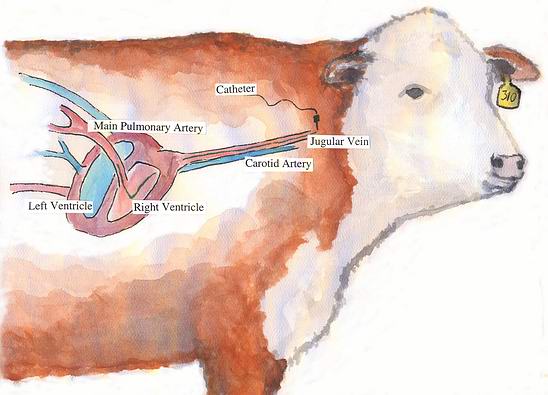
Relating High Altitude Pulmonary Edema in Cattle to Birthplace By Kristin Goff Fort Lewis College, April 2000 Abstract High Altitude Pulmonary Edema (HAPE), is known in the cattle industry as Brisket disease. Pulmonary arterial pressure (PAP) has been correlated with the cause of HAPE. Evidence has shown that the breed of animal plays a large role in the animal’s PAP score. One hundred twenty-four yearling bulls of five different breeds came to Hesperus, Colorado to participate in the 2000 Four Corners Bull Test, at an altitude of 7600 feet. The Four Corners Bull Test Station has been testing bulls for breeding soundness, average daily gain, and their PAP since 1949. This study explores the relationship between PAP and altitude. This experiment found that there is little correlation between where the animal was born and it’s PAP score. However, there is a significant difference in PAP between breeds of cattle. Introduction High altitude can cause major stresses on cattle unrelated to weather and terrain. One problem that arises frequently is that of potentially deadly High Altitude Pulmonary Edema. There have been many studies in humans regarding High Altitude Pulmonary Edema (HAPE), but relatively few in cattle. Pulmonary edema in cattle is commonly referred to as Brisket disease. Environmental stresses such as a change in altitude can cause one to five per cent of cattle grazing at high altitude, usually above 7000 feet, to develop Brisket disease (Taylor, 1995). By studying human pulmonary disorders and the results of studies done on them, we can hopefully develop a better understanding of this costly disease in cattle. Comparison of the animal’s home altitude and the altitude that Brisket disease occurs is the goal of this study. Pulmonary Arterial Pressure (PAP) can be used as a guide for determination of HAPE. The correlation between the animal’s PAP score and their home altitude will hopefully show me that as the altitude decreases, the PAP score will increase. PAP will be taken to learn the pressure in the pulmonary artery creating elevated pressure in the animal’s lungs. There have been recorded incidences of Brisket disease since the sixteenth century, during South American expeditions at high altitudes (LeValley, 1978). Brisket disease affects both sexes and all breeds of cattle. Natural selection is believed to have a major role in the survival rate of animals at high altitude today (Schimmel, 1981). Incidence of brisket disease occurs more often in the spring, summer and fall, when ranchers graze their cattle at higher altitudes (LeValley, 1978). High altitudes create a decrease in the partial pressure of oxygen, which can result in pulmonary hypertension (Enns et al, 1992). Low atmospheric oxygen tension constricts the pulmonary vessels, which increases the resistance of blood flow through the constricted vessels (Schimmel, 1981). Pulmonary Edema causes the pulmonary interstitial spaces or alveoli to develop excessive fluid, 500 to 1000 per cent higher than the normal (Guyton, 1982). This can cause the heart to have an increase in pressure that can lead to myocardial infraction (heart attack). This inability to aerate the blood can result in death if the animal is not moved to a lower elevation promptly. Brisket disease is characterized as right heart failure, since the right ventricle is the only part of the heart that appears to be overworked (Taylor, 1995). Autopsies have shown bloody foamy fluid in the airways, with no evidence of left ventricular failure (Bartsch, 1999). The right ventricle produces elevated blood pressures to force the blood through the pulmonary system, which can lead to heart failure (Enns et al, 1992). Symptoms of HAPE can include restlessness, anxiety, rales, shortness of breath, wheezing, cough, excessive sweating, pale skin and swollen briskets in cattle. Less common symptoms include nasal flaring, coughing up blood, dark fluid diarrhea, and death (Schimmel, 1981). As the case develops, a straw colored fluid may accumulate in the body cavities until the abdomen is distended and breathing labored (Hull, 1978). The animal may become recumbent, reluctant to move and if forced to exert any energy, collapse and die (LeValley, 1978). Determination of these symptoms before they occur is a complex process, and certainly not an exact science. The decreased barometric pressure and decreased density of air must be taken into account when measuring PAP at high altitude (Cogo, et al, 1997). The barometric pressure at altitudes lower than 5000 feet does not usually disturb the pulmonary pressure, as altitudes above 5000 feet do. Cases of Brisket disease have been reported in every area of Colorado where cattle are grazed at high altitudes (Schimmel, 1981). Measurement of the Pulmonary arterial pressure in humans is done with a Swan-Ganz catheter, which is inserted into the sub-clavian vein, through the superior vena cava, into the right ventricle and up through the pulmonic valve into the pulmonary artery, following the blood flow through the heart (Darovic, 1995). Pressure is taken here and a pulse contour curve displays the readings, while the catheter is within the subject. The procedure in cattle varies slightly for this. Cattle are held in a normal standing position with a halter holding their heads to the side so that the procedure can be performed. A cardiac catheter filled with heparinized saline is thread through a thirteen-gauge two and one half-inch needle in the external jugular, through the right side of the heart into the pulmonary artery. Characteristic pressure patterns show the location of the catheter. Readings come out on a physiological pressure transducer positioned at the level of the olecron (Schimmel, 1981). Range of a healthy pulmonary arterial pressure can vary from animal to animal, but generally any measurement over fifty mm Hg can be considered life threatening. Some animals can have a measurement of fifty mm Hg or above and show no clinical signs of Brisket disease. The cause of this is still unknown, but possibly these animals are stronger and more fit to handle stresses in their life. Tests of HAPE in humans of the same age group were made of children born at the Lausanne University Hospital, in Lausanne, Switzerland. Half of these people were born healthy and the other half had a history of perinatal complications within the first thirty-four weeks of life. These subjects were all taken to a higher altitude together, and fed the same diets while participating in the test. The tests showed that the subjects who had complications as children tested higher in their PAP. (Sartori et al, 1999). It is believed that if a subject had any lung complication younger in life, it can affect their ability to undergo stress on their bodies at higher altitude. A retrospective analysis suggested that an increase in susceptibility to High Altitude Pulmonary Edema can occur after infectious diseases, predominantly those located in the upper respiratory tract (Bartsch, 1999). The Four Corners Bull Test Station is located in Hesperus, Colorado at an altitude of 7600 feet. They have put bulls from around the country on this performance test since 1946. The bulls are all approximately the same age; they are fed the same diet, and weighed on the same days so the stresses the animals are exposed to are uniform throughout the tests. This performance test brings bull buyers from all over the country, in search for outstanding genetics. Since we have knowledge that genetics and breed have an influence on PAP, many buyers want to purchase bulls that test low in their PAP scores so they can start or continue to breed their animals at high altitude. Studies have shown that it is better to have a gradual increase in altitude rather than a rapid increase, due to the changes the body will have to undergo. Researchers have also observed that exercise should be limited in the first days of being exposed to high altitude, because the oxygen is much thinner at high altitudes and exercise demands more oxygen, which can cause hypertension (Bartsch, 1999). The bulls that came to the Four Corners Bull Test arrived on October 30, 1999. They began their performance test on November 8, 1999, which allowed the bulls to adjust to their new environment and all to be on the same diet for long enough to reduce any variability in their performance. The animals were weighed every twenty-eight days until March 1, 2000 when they came off test. They were auctioned on April 1, 2000. Ranchers have had to face considerable economic stresses due to Brisket disease (Schimmel, 1981). Veterinary costs for the prevention of Brisket disease, excluding costs of occurrence, ranks in the top five percent in Colorado (Enns et al, 1992). The goal of this study is to provide information to bull owners, who can possibly predict their animals PAP test results at a high altitude, based on their home altitude. If we can learn more about how this disease works, we can hopefully eliminate some of the economic hardships that ranchers have to face today. Methods and Materials Study Area: Four Corners Bull Test Station Altitude 7600 feet Data analysis dates: October 30, 1999- Bulls arrive November 8, 1999- Bulls weigh on test December 6, 1999- Bulls were weighed January 3, 2000- Bulls were weighed January 31, 2000- Bulls were weighed February 28, 2000- Bulls came off test March 1, 2000- PAP test scores taken April 1, 2000- Bull sale There are 124 bulls on test from various owners and different altitudes. Each animal’s home altitude was collected from the U.S. Geological Survey (Maintainer GNIS Manager 2000). On March 1, 2000 Dr. Tim Holt, DVM, came to Hesperus to take the PAP scores of all the animals on test. I was there to record data of the animals’ performance and their individual PAP score. Dr. Holt has been taking PAP scores sine 1980, and has performed over 87,000 PAP tests. Pulmonary arterial pressure is measured in mm Hg, and taken with a catheter attached to a physiological pressure transducer positioned at the level of the heart. Each animal was lead into a head catch shoot and haltered, allowing the area on the neck to be sanitized. A cardiac catheter filled with hyparinized saline was threaded through a 13- gauge, 2-1/2 inch needle into the external jugular, through the right ventricle into the pulmonary artery just outside the heart. Characteristic pressure contours display where the catheter is located and then held in place until an accurate measurement is taken. I observed Dr. Tim Holt while he performed the tests on each animal. Dr. Holt allowed me to perform the test on five animals. The test only takes about one to two minutes from the time the animal is haltered. Data analysis: I developed a regression analysis of PAP scores related to each animal’s home altitude. The animal’s PAP score as a function of the animal’s home altitude was taken. If there is a correlation between the animal’s PAP score and their home altitude, I would expect to see a PAP score increase as the altitude decreases. This will allowed me to determine that PAP is a function of altitude changes among cattle tested at high altitude. Results During the test bull number 29-6 developed HAPE. This animal was an Angus, from Pleasant View, Colorado (alt. 6900 feet). His sire was from Hobson, Montana (alt. 4078 feet). His breathing was labored, his brisket was very swollen, and he was unwilling to move. He was sold at the sale barn for $30, almost a week after symptoms of HAPE became apparent. This same cooperator had an animal that had a PAP of 115-mm Hg, an incredibly high number in 1999. On March 1, 2000 there were a few bulls that high PAP scores, as well as small scrotal circumference and low sperm counts. Bull number 34-1 had a PAP of 87-mm HG. This animal was an Angus bull from Ignacio, Colorado (alt. 6432 feet), and his sire from Cherokee, Oklahoma (alt. 1181 feet). After failing all the other soundness exams, he was sold and slaughtered. This animal never showed any physical sign of Brisket disease throughout the test but did not perform as well as the other animals’ did. The right ventricle of this bull was cut open to observe if there was evidence of stress to the right ventricle and the pulmonary artery. The right ventricular tissue was dark in color and the muscle fibers were weak and without elasticity. I compared the right ventricle to the left ventricle for a comparison of ventricular tissue, and found that the left ventricle was lighter in color and the fibers were firm. This evidence shows that even though this bull was showing no physical signs of HAPE, the right ventricle was still being stressed. The pulmonary artery appeared to be healthy and smooth, free of abrasions (appendix 1 and figure 3). The home altitude of cattle does not significantly affect the PAP score (figure 1). A scatter plot of each breed shows no significant difference in PAP score dependent upon altitude. The ancestry of the animal has no conclusive evidence that parental altitude affects PAP scores (figure 2). A scatter plot of each breed shows no significant difference in PAP score dependent upon altitude.
Figure 2: The PAP score dependent upon where the sire and dam were from in 1000 feet. The mean was found between the sire and dam’s altitude, demonstrating how genetics plays a role in the susceptibility of high PAP scores. There appears to be a weak relationship of PAP score and ancestry altitude. Hereford slope was 0.0097, Angus –0.0171, and Red Angus 0.0153. The breed of the animal appears to affect PAP score (figure 3). A One- Way Anova test was performed finding a significant difference in PAP score among different breeds of animals (P-value 5.43E-08). · Hereford PAP was 37.6+/-0.426. · Red Angus PAP was 46.9+/-1.715. · Angus PAP was 45.7+/-2.0 · Gelbvieh and System 1 PAP was 38.5+/-0.748.
Figure 3: PAP score is significantly different among breeds. The PAP scores of each breed were averaged, to find a variance between breeds, using a One-Way Anova test. There is a significant difference (P-value 5.43E-08) in PAP score dependent on breed. The sample size of the System 1 and Gelbvieh’s was so small they were placed into an “other” category, with PAP scores of 38.5 +/-0.748 mm Hg. The Herefords PAP scores were 37.6 +/- 0.426 mm Hg. The Angus had significantly higher PAP scores of 45.71 +/- 2.0 mm Hg. The Red Angus showed the highest PAP scores of 46.93 +/-1.715 mm Hg. Discussion Pulmonary arterial pressure apparently has no correlation with home altitude or ancestry, but is more significantly tied to breed of cattle. Natural selection is believed to have a major role in the survival rate of animals at high altitude today, due to the highly heritable PAP traits (Schimmel, 1981). The Hereford breed has been in the West for many years and is naturally adapted better to the stresses that high altitude can put on the body. On the other hand the Angus breed, is usually found in the East or Mid-West of the U.S., and is less adapted to high altitude stresses. The Red Angus breed is most often found in Texas and California, and is even less adapted to stresses at high altitude. HAPE is characterized as right heart failure, since the right ventricle is the only part of the heart that appears to be overworked (Taylor, 1995). The right ventricle produces elevated blood pressures to force the blood though the pulmonary system (Enns, et al, 1992). When investigating bull #34-1, which had a PAP of 87 mm Hg, we find that he never gained as well as the other bulls similar in physical size and breed, but never showed physical signs of HAPE. This bull had no left ventricular problems, but his right ventricle was weak and discolored, demonstrating that the right ventricle was under stress for some time. His low weight gain could be due to the stress his heart was under during the test. Bull #29-6 showed labored breathing, restlessness, anxiety, nasal flaring, and a very swollen brisket, all common signs of a highly developed case of HAPE. When the animal was isolated from the rest of the bulls he was recumbent to move, and obviously in pain from the disease that so many animals develop. The cost of HAPE is in the top five percent in Colorado for all veterinary costs (Enns, et al, 1992). That seems to be the reason that the Four Corners Bull Test brings buyers in search of outstanding genetics. Since there is knowledge that HAPE is genetic, buyers are in search of low PAP scores to keep the costly disease out of their herds. Predicting HAPE is not yet an exact science, and possibly never will be. The fight to improve the genetics of cattle herds in order to stay in business is a long battle, but hopefully with more knowledge an easy road to travel. This study investigated the altitude that cattle are born, ancestry, and breed to find another link to understanding the disease that affects cattle at high altitude.
Appendix 1: 2000 Four Corners Bull Test chart including animal ID, altitude of birthplace, altitude of ancestry, breed, and PAP score.
*Bull #4-4 died of Red Water Fever, at the beginning of the test. *Bull #29-6 developed HAPE and died before the PAP test scores were taken.
Literature Cited Bartsch, Peter, (1999). High Altitude pulmonary edema. Medicine and Science in Sports and Exercise, 31 (1), s23-s27. Cogo, A., Legnani D., Allegron L., (1997). Respiratory Function at Different Altitudes. Respiration 64 (6). 416-421. Darvoic, Gloria O’Blouk, (1995). Hemodynamic Monitoring: Invasive and Non-invasive Clinical Application (2nd ed.) W.B. Saunders, Philadelphia, PA. Enns, R. M., Brinks, J. S., Bourdon, R. M., and Field, T. G., (1992). Heritability of Pulmonary Arterial Pressures in Angus Cattle. Proceedings Western Section, American Society of Animal Science, 43. 111-112. Guyton, Arthur C. M.D., (1982). Human Physiology and Mechanisms of Disease (3rd ed.) pp.157-159, 237-244. Philadelphia, PA: W. B. Saunders company. Hull, M. W., Anderson C. K. (1978). Right Ventricular Heart Failure of Montana Cattle. Cornell Vet 68 (2). 199-210. LeValley, Stephen B. (1978). Pulmonary hypertension in Beef Cattle: A Herd Study. Colorado State University, Fort Collins, CO. Maintainer GNIS Manager, (2000). http://mapping.usgs.gov/ww/gnis/gnisform.html. Sartori, Claudio, Allemann, Y., Trueb, L., Delabays, A., Nicod, P., Scherrer, U., (1999). Augmented Vasoreactivity in Adult Life Associated with Perinatal Vascular Insult. Lancet 353, 9171. 2205-2208. Schimmel, Joseph G., (1981). Genetic Aspects of High Mountain Disease in Beef Cattle. Colorado State University, Fort Collins, CO. Taylor, Robert E. (1995). Scientific Farm Animal Production (5th ed.) pp. 331. Upper Saddle River, NJ. Prentice Hall. |
||||||||||||||||||||||||||||||||||||||||||||||||||||||||||||||||||||||||||||||||||||||||||||||||||||||||||||||||||||||||||||||||||||||||||||||||||||||||||||||||||||||||||||||||||||||||||||||||||||||||||||||||||||||||||||||||||||||||||||||||||||||||||||||||||||||||||||||||||||||||||||||||||||||||||||||||||||||||||||||||||||||||||||||||||||||||||||||||||||||||||||||||||||||||||||||||||||||||||||||||||||||||||||||||||||||||||||||||||||||||||||||||||||||||||||||||||||||||||||||||||||||||||||||||||||||||||||||||||||||||||||||||||||||||||||||||||||||||||||||||||||||||||||||||||||||||||||||||||||||||||||||||||||||||||