
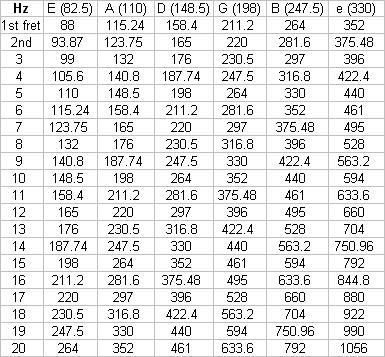
For my research I chose my favorite instrument - the acoustic guitar. The waves of the guitar occur on the strings which vibrate when plucked. They create transverse waves which vibrate at different frequencies to create different notes. Higher pitched notes have higher frequencies. My guitar has 20 frets (lines across the neak) and higher pitch is achieved by shortening the string by moving your fingers closer to the body of the guitar.
The musical scale has twelve notes - A flat, A, B flat, B, C, D flat, D, E flat, E, F, G flat, and G, then A flat again and so on. Each group of these twelve notes is an octave. Every octave the frequency is doubled, so a low C has half the frequency of a middle C, since it's an octave lower. There are ratios between a note and its octave (2:1), (C-C); its fifth (3:2), (C-G); its major third (5:4), (C-E); its major sixth (5:3), (C-A); its fourth (4:3), (C-F); its minor sixth (8:5), (C- A flat) and its minor third (6:5), (C-E). I used these ratios to fill in note frequencies using a reference (from Brittanica) that the A above middle C is 440 Hz.
The range of hearing for a child is from 16 Hz to 20000 Hz, and to 12000 Hz for a 65 year-old. The piano ranges from 27.5 Hz (an A) to 4186 Hz (a C). My guitar, with an EADGBe tuning for strings 1-6 (low to high), ranges from 82.5 Hz (an E) to 1056 Hz (a C). The tuning of a guitar can be changed to DGDGBD for blues and other tunings abound. I'm using the most common - EADGBe. The bass strings (E, A, and D) are appreciably thicker than the other three, which makes them have lower frequencies. The G string is thicker than the B and the e is the thinnest string. As you can see, many frequencies are repeated on more than one string. This is so the guitar player doesn't have to move their hand as much to reach notes.
When a string is plucked, the wave travels down the neck and over the hole in the body, where the sound is amplified, and then it hits the board at the end of the string where it's reflected and travels back and forth reflecting for a while. The velocity of the wave depends on the material the string is made of. Since my strings are made of an unknown metal, I don't know the velocity of the wave. It is slower in the bass strings because they aren't as taught as the upper three strings. Within each string the velocity of the wave will be constant even as the string is shortened and frequency increases. This is grounds for the assumption that the length of the string is the wavelength, but I can't verify this without a much longer string and a stopwatch.
In conclusion, this paper has made me learn a lot about waves, guitars, and music theory, all of which are interesting.
