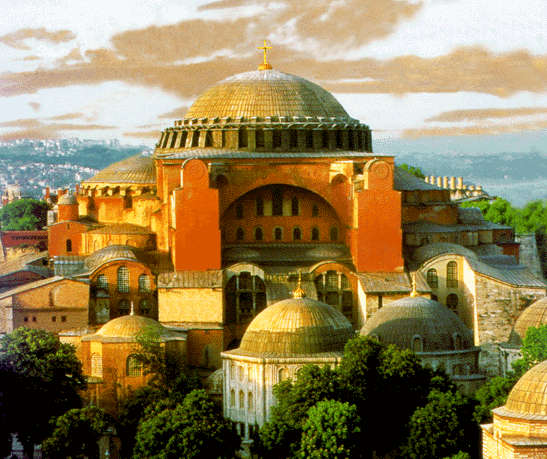
Nothing remains of the first church that was built on the same site during the 4th century. Following the destruction of the first church, a second was built by Constantius II, the son of Constantine I, but was burned down during the Nika riots of 532. The building was rebuilt under the personal supervision of Emperor Justinian I and rededicated on December 27, 537.
|
Hagia Sophia is covered by a central dome with a diameter of 102 feet and 184 feet high, slightly smaller than the Pantheon's. The dome seems rendered weightless by the unbroken arcade of arched windows under it, which help flood the colorful interior with light.
|
The dome is carried on pendentives — four concave triangular sections of masonry which solve the problem of setting the circular base of a dome on a rectangular base. At Hagia Sophia the weight of the dome passes through the pendentives to four massive piers at the corners. Between them the dome seems to float upon four great arches.
|
|
At the western (entrance) and eastern (liturgical) ends, the arched openings are extended by half domes carried on smaller semidomed exedras. Thus a hierarchy of dome-headed elements builds up to create a vast oblong interior crowned by the main dome, a sequence unexampled in antiquity. All interior surfaces are sheathed with polychrome marbles, green and white with purple porphyry and gold mosaics, encrusted upon the brick. On the exterior, simple stuccoed walls reveal the clarity of massed vaults and domes.
|