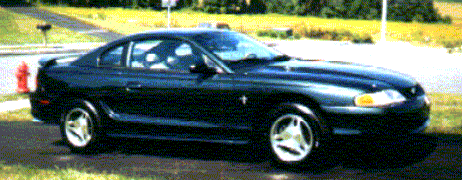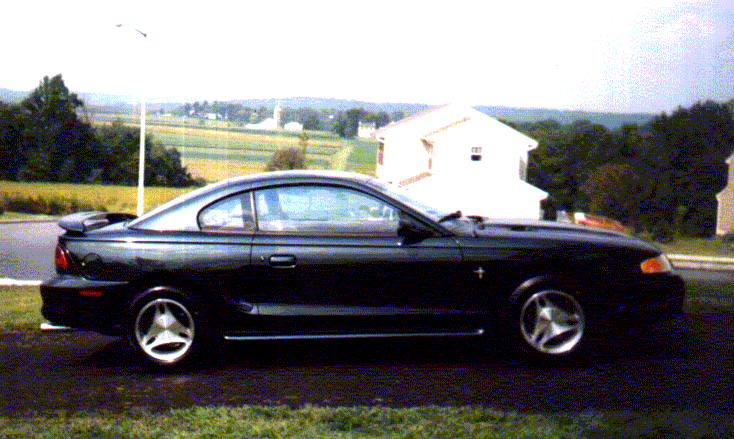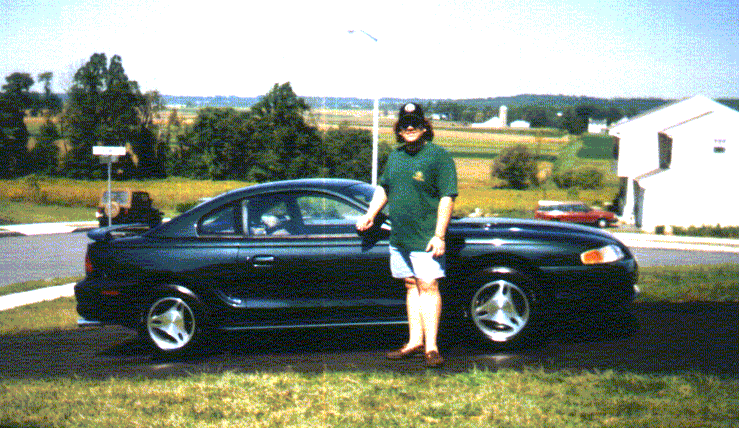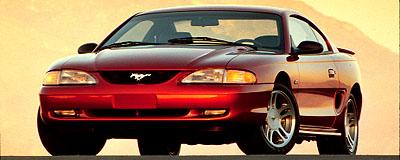

Following you will find some interesting information about the Ford Mustang as well as a a current list of modifications performed on my Stang, These were relatively inexpensive but added a good amount of extra power much needed by the 3.8L engine.
Please feel free to email me with feedback or questions by following the link at the bottom of the page.

On April 17, 1964, the world got its first taste of the car that would become an automotive legend. Ford executives had seen the need for a small sporty car in the lower price range. R. Perry Zavits, Mustang historian, notes the Mustang aimed to become "the working man’s Thunderbird." Using the Falcon’s chassis, Ford constructed hardtops, coupes and convertibles with a wheelbase of 108 inches, an overall length of 181.6 inches, and a 170-cubic-inch, 101 horsepower Six engine, with optional upgrades. The hardtop originally sold for $2,368.
The Mustang so quickly became popular that demand outstripped the capacity of the Dearborn factory where is was first produced. The number of cars sold in the first four months alone surpassed the 100,000 cars Ford estimated would sell in the first year. In fact, 22,000 orders were taken the first day. By its first birthday, April 17, 1965, the Mustang had established a new world record of over 418,000 sales in the first year on the market for a new model.
The evolution of the Mustang would take the car in somewhat different directions, subtracting features and adding options through the years. However, the same Mustang spirit would remain at every step. The 1965 and ‘66 models saw little cosmetic change, and only 58 percent were powered with a V-8 (which was the trend at that time), the lowest percentage in marque history. However, in 1967, an all new Mustang body was used; it was said that the original dies were worn-out after making nearly 1.3 million copies. Even with a new body, the Mustang styling remained much the same. That year production dropped over 22 percent due to smaller total Ford production; however, Mustang itself accounted for 6.2 percent of all cars built in the United States. In fact, the Mustang captured an amazing 42.5 percent of the pony car market.
Ford made only subtle appearance changes in ’68, but the Mustang was given new engine options. The Six and standard V-8 remained but were down to 115 and 195 horsepower respectively. With the additions, the Mustang now offered seven engine choices. Production fell again that year to 317,404, causing the Mustang to slip from second to seventh in production. Nevertheless, the Mustang was still at the head of the pony car pack.
A new body came along for 1969 model year, but designers made sure to keep the Mustang image. Some, however, regarded the appearance changes as seeming to miss the familiar Mustang mark. Two new models arrived that year: The Grande, a dressed-up edition of the hardtop with vinyl roof and plush interior; and the Mach 1, a variation of the fastback, identifiable by special paint stripes along the sides and across the integral rear spoiler. Now, 81.5 percent of all Mustangs had V-8 power and just over 71 percent had automatic transmission. While only 11 percent of all Mustangs employed the 4-speed stick, this was a record high. Some options were growing more popular. Power disc brakes were included in 40.5 percent and power steering in nearly 66 percent. Despite the new appreciation for increase options, total production was down again. According to some, the Mustang had simply over-saturated the thirsty market.
For the Mustang, 1971 brought with it a restyled body with a different looking front-end and a flatter roof shape making the car slightly lower. Now, the standard engine was the 250-cubic-inch 1475 horsepower Six.
The 1973 Mustang rag-top was the final convertible to bear the Ford name. A total of 16,302 were built that model year. Total production was up to nearly 8 percent, to 134,867. Overall, during those first ten Mustang model years, nearly 3 million cars were built. As Zavits puts it, the Mustangs went from "adequate coupes to road scorching racers."
And the continuing popularity of those very first Mustangs now is demonstrated by the numerous collectors around the country. "Not since the Model A has any car stirred up collector interest like the early Mustangs," says Tim Howley, in his article entitled "Mustang Fever." For most collectors, the Mustang was the car of the ‘60s. The car that began the pony car rage set a new trend of longer hoods and shorter rear decks. And never before or since has a car come with so many options. The Mustang may not have been destined for the fame it now boasts; perhaps that’s what was so "Unexpected."
This information was obtained from the Ford Motor Co. Vinatge Vehicles Web Site I take no credit in writing this article.
Click here to see a picture of my Stang
Here is another pick
My Stang and I
Click here to listen to the sweet sound of a Pony 
Current Modifications:
My Favorite Mustang Links
V6 Mustang Messageboard
Mustangworld
Stangnet Search Engine for Mustang related sites
Ford Motor Company Homepage
California Mustang
Saleen
SN95 Homepage
Mustangs in Motion
The Mustang Network
1998 Mustang Specifications