|
Background and Introduction to the Enigma
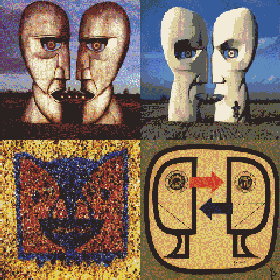
For more background information visit Eric Spierings' excellent Publius Enigma site. "There are works that come along once in an age and influence much of what comes later. Norbert Wiener's Cybernetics and Society is one of these seminal works for the information age... Wiener shows a prophetic understanding of the nature of information, communication, and automated control of our environment. If you want a book that tells you about the future of the Internet, buy the one that was written in 1950, thirty years before the Internet became a reality." The idea being driven here is that the enigma is an album concept, like 'The Wall', or more particularly, like the Amused to Death concept. 'The Division Bell' (TDB), it will be shown, is related to the landmark book Cybernetics and Society, by Norbert Wiener, and nearly all of the ideas expressed here are a consequence of that revelation. The book is the key to thinking about the enigma, and much else for that matter (including TDB), in a fundamentally different way. The essence of the enigma, like the essence of the aforementioned book, is the concept of "the message" and the reciprocal flow thereof--"feedback". Feedback it the Answer (literally) "See what you have not seen." -Publius
Understanding and appreciating the enigma and the division bell concepts involves arriving at a changed perspective (reflexive and cybernetic) in which one finds oneself to be a part of the system one is contemplating, engaging, and simultaneously creating.
[note: It should be fair to comment that the ideas expressed here are those of one mind (not in any special sense), and not consensual or the consensus of some official body, because unfortunately, there isn't any. To the person who actually knows a lot about the many sub-topics discussed on these pages, it should become evident that I really don't know very much about everything that I discuss, so I've included many off-site hypertext links throughout, as well as quotes, to compensate for my own limited time and knowledge. There's just too much there and I don't want to risk straying on relatively unimportant tangents, or resorting to a level of depth, which might be more limiting and confusing than enlightening. Naturally, your feedback is appreciated.]
|

 In June 1994, during the Pink Floyd 'Division Bell' tour, a character
began posting
In June 1994, during the Pink Floyd 'Division Bell' tour, a character
began posting