
**HOME**
-
The kidneys filter water from the blood.
-
The liver helps to eliminate toxic nitrogen groups from the body by
deamination.
-
Afferent arteriole: carries blood to the glomerulus
-
Glomerulus: a high-pressure capillary bed enclosed by the Bowman’s
capsule
-
Efferent arteriole: carries arteriolar blood away from the glomerulus
-
Peritublar capillary bed: capillaries that network around the nephron;
reabsorbs solute from the nephron into the blood and secretes aolute from the
blood into the nephron
-
Venule: carries filtered blood back to the heart
-
Urine formation depends on three functions: filtration, reabsorption,
and secretion.
-
The glomerulus acts as a high-pressure filter.
-
Selective reabsorption occurs by both active and passive transport.
- Secretion is the movement of wastes from the blood into the nephron.
- Filtration: Water and dissolved substances are forced out of the glomerular capillaries into the Bowman’s capsule, from which they are funneled into the tubule.
-
Reabsorption: In the proximal tubule, most of the important nutrients are
actively pumped out through the walls of the tubule and are reabsorbed into the
blood. The proximal tubule is highly permeable to water, so water follows the
nutrients, moving out by osmosis along its concentration gradient.
-
The loop of Henle maintains a salt concentration gradient in the
extracellular fluid surrounding it, with the highest concentration at the bottom
of the loop. While passing the descending portion, water leaves by osmosis as
the concentration increases.
- Throughout the tubule, potassium ions, hydrogen ions and ammonia ions are actively pumped and secreted into the tubule.
Water Balance
-
Antidiuretic hormone (ADH) helps regulate osmotic pressure of body
fluids and fluid volume.
-
Aldosterone regulates body fluid volume.
-
ADH and aldosterone are regulated by negative feedback.
-
Kidneys restore buffers by excreting excess H+ ions or
restoring more HCO3- ions.
Blood
Volume
-
Antidiuretic hormone is a peptide hormone, which promotes the
reabsorption of water in the kidneys and regulates the concentration of urine.
-
The collecting duct is very permeable to water when ADH is present and
water is reabsorbed back into the kidney tissues and the blood. The resulting
urine will be very concentrated.
-
When ADH is in low concentrations or is absent, the collecting duct
remains impermeable to water, and a very dilute urine is formed.

Regulation
of Blood Pressure
-
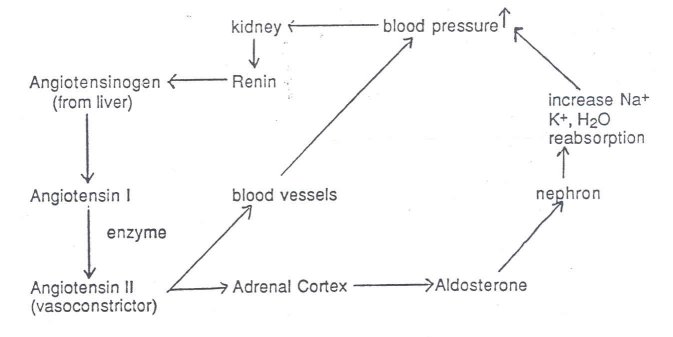
Aldesterone is secreted by the adrenal cortex, and regulates the sodium
and potassium levels in the blood by altering the sodium pump in the distal
tubule and collecting tubule walls.
-
If the blood pressure drops for any reason, the kidneys secrete a
substance called rennin, which acts on one of the plasma proteins and converts
it into a vasoconstrictor.
-
Proper functioning of the kidneys is essential for homeostasis.
-
Many kidney diseases can be detected by urinalysis.
-
A number of kidney diseases affect proper kidney function, including
diabetes mellitus, diabetes insipidus, Bright’s disease, and kidney stones.
- Dialysis and transplants are currently the most common treatments for kidney disease.
- Two types of cells are present in the pancreas:
Alpha cells:
- produce glucagons
- enters the blood stream and helps breakdown glycogen
- more sugar in the bloodstream
- more effiecient use of glucose
Beta cells:
- produce insulin
- increases the use of glucose
- promotes carbohydrate metabolism
- increases membrane permeability
- Increased blood sugar levels stimulate insulin production.
**HOME**
