
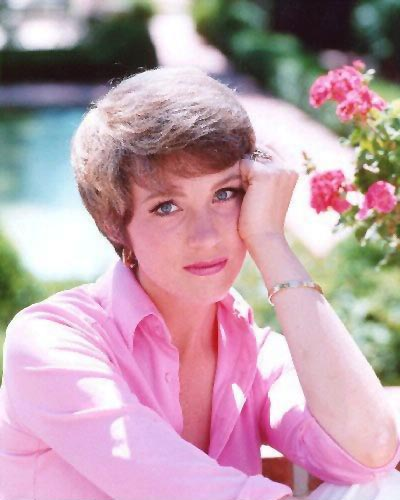
Julie Andrews was born on October 1st 1935 in the English county of Surrey in a charming little town called Walton-On-Thames where the river flows just South of London. She was christened Julia Elizabeth Wells,taking her name from her two grandmothers Julia Morris and Elizabeth Wells. Her Father Edward(Ted)was a teacher and her mother Babara was a part time piano teacher also giving lessons. Julie was only two when she first performed on a stage as a fairy show put on by her aunt.
In 1939 Barbara Wells took a job as a pianist for a variety show. Also on the bill was a tenor named Ted Andrews. After a short while they became a double act. With the event of World War II Ted and Barbara Wells grew apart and were divorced. After Barbara married Ted Andrews, Ted Wells also got married to a teacher at his school.
Julie's stepfather began to give her singing lessons in an attempt to get to know her better,to everyones suprise Julie had a fully developed larynx, perfect pitch and a large four octave vocal range. Julie soon became part of Ted and Barbara's act. It was at this time that Julie changed her last name to Andrews simplifying the billing of their act.
At the age of eight Julie began to have singing lessons from Madame Lilian Stiles-Allen,who had also been Julie's stepfathers old music teacher.The two became quite close friends. It was thanks to Lilians training that Julie ended up with perfect diction. During the school holidays Julie spent most of her summer touring England with Ted and Barbara. On December 5th 1946, Julie got to sing her big solo,The Polonaise from Mignon, in fron of the queen Elizabeth the queen mother, at the royal command performance at London's Stage Door Canteen.
In October 1947, when Julie turned 12 she was cast in Sarlight Roof, which opened at the London Hippodrome, staring comedians Vic Oliver and Fred Emnley. In December 1947, Julie was given a screen test by Metro-Goldwyn-Mayer(MGM). Julie was not signed by the studio, who said she was unfilmable. Julie made her radio debut in 1946 singing a duet with Ted Andrews, and in 1949 she made her TV debut in a show for the BBC called Radiolympia Showtime. Julie toured the lenght and breadth of Great Britain making music Hall appearances and at Christmas doing pantomimes. At the age of thirteen Julie was cast as Humpty Dumpty in Emile Littles pantomime. It was at this time that Julie met Tony Walton, who she will later marry.
In 1956 The Boyfriend was running in the west end of London. American producers Cy Feurer and Ernest Martin bought the rights to the show to open it on Broadway. Cy Feurer wanted to keep as many of the cast as possible English as possible. Julie was offered the leading roll as Polly Browne. After much hesitation she agreed to a one-year contract on Broadway. The show was an overnight success and Julie became a star.
Julie auditioned for Lerner and Loewe for the roll of Eliza Doolittle in the musical version fo George Bernard Shaw's play Pygmalion. Which was renamed My Fair Lady. The show was a critical success, it ran for two years in New York and for one and a half years in London's west end.
In 1955 Julie had her American TV debut, playing opposite Bing Crosby in a musical verion of Maxwell Anderson's High Tor for CBS. The show aired just five nights before My Fair Lady opened in New York. In march 1957 Rodgers and Hammersteins wrote the musical Cinderella for Julie, commissioned by CBS.
On May 10th 1957 Julie and Tony Walton were married. Tony designed Julie's wedding dress. In 1960 Julie was asked to play queen Guinevere in the Lerner and Loewe production of Camelot. The show ran for two years. During the run of Camelot Julie was introduced to Carol Burnett, they became good friends. The two will later do many shows for TV together. In the spring of 1962 Walt Disney went to see Camelot, he was impressed by Julies performense and thought she would be perfect for the roll of Mary Poppins. After visiting the Disney Studio's Julie accepted the roll. Julie's daughter Emma Kate Walton was born on November 27th 1962 in London. In 1964 Julie won an Academy Award for best actress in the roll as Mary Poppins.
Julie filmed The Americanization of Emily straight after Mary Poppins, this was Julie's first straight dramatic roll. Then came one of Julie's most important rolls, Maria in The Sound Of Music. This will end up being one of the most loved movies of all times. The film was a box office,and a smash winner of five Academy Awards. Julie made many other films during the 60's including Thoroughly Modern Millie,Star!,Hawaii,Torn Curtain and Darling Lili. During this time Julie and Tony grew further apart and ended up in divorce, although the two are still good friends. After filming Darling Lili in 1969, Julie married director/producer/writer Blake Edwards. They worked on several other films together including The Tamarind Seed,10,S.O.B,That's Life and Victor/Victoria for which Julie won her forth Golden Globe Award. Julie was also nominated for Goldon Globe Award for That's Life and Duet For One.
In 1995, Julie made a triumphant return to Broadway in the stage version of Victor/Victoria, directed by Blake Edwards. A few Years earlier she had been in an off-Broadway version of the musical Putting It Togetheter by Stephen Sondheim. Under the name of Julie Edwards, Julie authored the first of her children's books entitled Mandy published i 1971. The second, written three years later,The Last of The Really Great Whangdoodles takes its name from a word Julie found in the dictionary. Julie and her daughter Emma have finished working on four other childrens books Dumpy at school, Dumpy the Dump Truck, and The Big Torm, Dumpy Saves Christmas. All Four books are illustrated by Tony Wlaton. Ms Andrews is now working on her autobiography which is due some time in June.
Julie is the devoted mother of five grown children,her daughter Emma, Blake's two children Jennifer and Geoffrey, as well as Amy and Joanna, two orphans the couple adopted in 1974. In 1999 Julie was made a Dame of the British Empire by Queen Elizabeth at Buckingham Palace. In 2000, Julie was back on the big screen, in a film adaptation of the Noel Coward play Relative Values using the original script.
