“Dirty Story” is a savage bloody comedy about sex, politics, and the mid-east. If something in it doesn’t offend you, you’re tougher than a Texas jury. If something in it doesn’t make you laugh, you haven’t been reading the paper.
"Appallingly entertaining...ingenious...from the adventurous Labyrinth Theater Company" - Ben Brantley, New York Times

Tickets are $19. For tickets go to www.ticketcentral.com or call (212)279-4200
Tuesdays - Saturdays at 8PM
Saturdays at 3PM & Sundays at 7PM
From the "LAB BILL":
Florencia Lozano (Wanda)- "Kate" BLOOD IN THE SINK at Urban Stages, directed by John Gould Rubin; "Marcia Marie" in WHERE'S MY MONEY? at the Manhattan Theatre Club (originally produced at the LAByrinth Theatre Company); "Maria" in YERMA at Arena Stage, "Rosaline" in LOVE'S LABOUR'S LOST at the California Shakespeare Festival; "Ophelia" in HAMLET at the Colorado Shakespeare Festival; "Antigone" in ANTIGONE at the Roundhouse Theatre, various roles at Repertorio Espanol. "Téa Delgado" on ABC's ONE LIFE TO LIVE. Literary Manager, Producer of IN THE KITCHEN and member of LAByrinth since 1992. NYU Grad Acting. For my Mother and for my Father.
Dirty Story
Labyrinth Theater Company presents writer-director John Patrick Shanley's latest work, a curious allegory of Middle East politics. Whilte its first act is intriguing and highly suspenseful, the cartoonish symbols of the second become far too obvious, despite Shanley's lively direction and fiery performances by David Deblinger and Florencia Lozano.
The latest from John Patrick Shanley, Dirty Story, which opened at the Harold Clurman the same week that Our Lady of 121st Street transferred to Union Square, is another LAByrinth production. To the best of my knowledge, it’s unlike anything Shanley’s ever done before, a political allegory that recasts American foreign policy and the Mideast conflict as a torrid love affair glimpsed through a gauzy veil of popular culture stereotypes. Whether you greet it with mirth or disgust will probably depend on how openminded—or confused—you are about American foreign policy. I am the very soul of confusion, so I enjoyed it immensely.
Shanley has always had a gift for creating complex, idiosyncratic characters and setting them at odds with one another. Also for making neurosis both lyrical and surreal. Also for plumbing the deep recesses of fear and desire that drive heterosexual passions and hatreds. Shanley fans will rejoice to hear that none of these elements is absent from Dirty Story. They may also be glad to learn that the play reunites the wonderful David Deblinger and Florencia Lozano, who played the mutually murderous pair locked in a battle-to-the-death marriage in Where’s My Money? (also a LAByrinth production). Here Deblinger is Brutus, a poet and essayist of gargantuan ego and intellectual capacity. Lozano is Wanda, a dewy-eyed graduate student and aspiring novelist who has sent him a manuscript. In the opening scene, set in a public park, Brutus eviscerates both Wanda and her novel, while a bumbling Englishman sits listening to Mozart on headphones, making alternately whingeing and inane observations. How quickly you begin reading between lines will depend on how attuned you are to the potential layers of meaning in references to real estate and borders and inconsequential remarks like, "Even conflict requires common ground." But even the most dogged hunter after subtext will become mystified when the second scene finds Wanda and Brutus in the midst of a romantic dinner at his place, and a comic bout of role-playing, growing out of a discussion of the sous conversation in The Perils of Pauline, turns sadomasochistically nasty.
I won’t describe the Act I curtain, though I probably could without spoiling the effect. My guess is that Dirty Story is probably critic-proof. There’s so much more going on in the play at any given moment than what is happening in the story that descriptions of this or that element leave it still-virgin territory. What delights is the phenomenon of experiencing the play on both levels, the human and the allegorical. Act II is where the fun really starts, as Lozano and Deblinger, now full-fledged embodiments of the Israeli and Palestinian viewpoints, are joined by Chris McGarry and Michael Puzzo, playing two characters named Frank and Watson, who embody America and England respectively. Questions of self-interest and historical alliance, national guilt and moral responsibility briefly surface and disappear again, eclipsed by the flashes of rage that erupt from Deblinger and Lozano or engulfed by eddies of cluelessness that swirl around McGarry and Puzzo. Shanley isn’t for or against anything or anyone. His satire takes in everyone—us, the Brits, the Israelis, the Palestinians, even the French—and he gets everyone right, too. What makes it all so delightful and disarming—in every sense—is that he isn’t looking to make any political point. He has no agenda. Even here, it’s people he’s really interested in, with the result that the pseudo-human and pseudo-political aspects in the play shed light on each other.
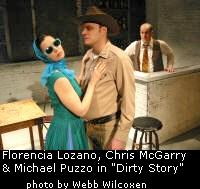
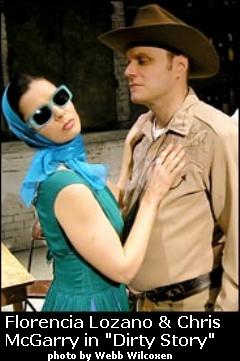
In Dirty Story, produced by LAByrinth Theatre Company at the Harold Clurman on Theatre Row, playwright John Patrick Shanley is waxing philosophic-a sure sign of trouble from this uneven writer. The play begins with a young, female graduate student approaching a famous writer for guidance. He trashes her work, then invites her over for dinner. There, in his grungy loft apartment, he dresses her up as Pearl White in The Perils of Pauline (don’t ask), then holds her captive, subjecting her to various forms of terror. A cowboy enters to save her, and is summarily dismissed. Incredibly, after the intermission, this becomes an allegory of the Israeli-Palestinian situation. The student now occupies the writer’s apartment, which has become a war zone, with the cowboy and his English sidekick trying, and failing, to adjudicate the situation. While it’s always good to see writers tackling complex political issues, this one is deeply troubled. The perfectly awful first act is off-putting in the extreme and in the second act Shanley never finds a workable comic tone. The cast certainly gives it everything they’ve got, with Florencia Lozano a standout as the grad student who learns to fight back. Michelle Malavet’s white-brick industrial setting stands in for three locations; Mimi O’Donnell’s costumes include a nifty cowboy outfit and a Euro-chic dress (complete with scarf and sunglasses) for Lozano. Jeremy Morris’ lighting is effective and Elizabeth Rhodes’ sound design, with its wicked use of movie themes including Exodus, The Magnificent Seven, and You Light Up My Life, is as effectively satirical as anything in the text. This one is, to put it politely, a mess, however.
Reviewed by David Cote
Dirty Story
by John Patrick Shanley
Dir. Shanley
With David Deblinger, Florencia Lozano
Harold Clurman Theater
John Patrick Shanley's film and theater works ("Moonstruck," "Where's My Money?") aren't known for their political content, so his latest play, "Dirty Story," may come as a surprise. What starts out as an arch, romantic comedy reveals itself halfway through to be a deadly serious allegory of global proportions. Here, the death struggle over an apartment resonates beyond a concern for closet space and rent control. But unless you like your geopolitics served in broad, cartoonish strokes, you may find yourself dissatisfied by Shanley's approach. Suffice it to say, any resemblance between him and Shaw ends after S-h-a.
The writer has, however, once again demonstrated his considerable ability to generate lively sparks between hyperbolic male and female characters. "Dirty Story" commences with a meeting between arrogant author Brutus Chiappa (Deblinger) and impressionable graduate student Wanda (Lozano), who wants feedback on her novel-in-progress. Without wasting any time, Brutus viciously dismisses Wanda's manuscript as a "348-page mud pie" and declares fiction dead. For all his bilious, macho bluster and her awkward dewiness, you can sense the beginnings of a romance. In the next scene, a dinner date at Brutus's apartment, the couple's intellectual flirtation continues, until Shanley throws us (and Wanda) a nasty, creepy curve involving a ball gag and a circular saw. Things get even weirder when a cowboy kicks down the door.
The first act is terrific, even if the banter feels slightly canned. But when it becomes clear that Shanley is attempting a live-action political cartoon, proceedings grow numbly predictable. Suddenly a dumb but well-meaning cowboy (guess who he's supposed to be?), a servile cockney barkeep (this one's a toughie too), and Brutus and Wanda are all fighting over who the apartment belongs to. (Any New York audience can tell you where this is heading: straight to Housing Court.) Despite Shanley's energetic direction and a strong cast - courtesy of the red-hot LAByrinth Theater Company - "Dirty Story" never gets beyond rehashed musings on centuries-old religious conflicts and the unintended consequences of American foreign policy. Shanley knows how to write crackling good dialogue, but his politics are weakened by a sentimentality more fitted for lightweight romantic comedies.
Reviewed By Gordon Cox
Gordon Cox is a frequent contributor to Newsday.
It's tempting to leave at intermission, but don't. In the ambitious, immoderate and surprising new play "Dirty Story," it may take the entirety of the show's first act for audience members to figure out just what writer-director John Patrick Shanley has up his sleeve.
That first half, which follows a twisted relationship between an older writer and a grad student who has just written a novel, features a lot of theoretical, philosophical talk about the power of narrative. Much of this is fascinating - especially the bits about story eroding forms, and what will happen to history when storytelling swallows itself - but after a while it starts to come off as prolix and windy. And when the play takes a dark turn into a game of pain and subjugation, it feels unenlighteningly familiar (even if the script does acknowledge, openly and repeatedly, the archetypal tale being acted out).
It's not until the start of the second act that it becomes clear just how mischievously funny and fiercely serious Shanley's play is. "Dirty Story" is nothing less than a comical political allegory about the Israeli-Palestinian conflict.
The older writer, Brutus (David Deblinger), represents Palestine; the woman Wanda (Florencia Lozano) is Israel; and Frank (Chris McGarry), her pudgy and depressive ex- boyfriend, is none other than our own United States. The disputed territory of this conflict is a barren warehouse apartment in the Meatpacking District (a spacious industrial loft by set designer Michelle Malavet).
The analogies really are as blatantly one-to-one as that, and that's what makes the play's second act as much fun as it is. With the help of Frank and his guns, Wanda has pushed Brutus and all his belongings into a cramped corner, and she tries to make the place feel like home by importing a slew of potted plants.
There's obviously an agenda to this dirty story, but it's not about taking sides. Shanley has a sympathetic sense of identification with each participant in the conflict, and every caricatured character talks sense at some point.
A large part of Shanley's agenda is to entertain, which he accomplishes with the show's over-the-top mood shifts (aided by sound designer Elizabeth Rhodes) and the flattened, direct playing style of the actors: Deblinger manages to be both intellectually assured and angrily unhinged as Brutus, Lozano shifts looks with every scene but always maintains an angular toughness, and McGarry has a hangdog charm as the cowboy who's lonely at the top.
As Shanley's real goal becomes apparent, one starts to realize that he's gone so far as to map out the specifics of his tactics in that verbose first act. He's inspiring active, engaged thought about a conflict in which our country is intimately involved, and he's doing it through the power of an abrasively amusing, empathetic, high-stakes story.
OFF-BROADWAY REVIEW
DIRTY STORY. Written and directed by John Patrick Shanley. With David Deblinger, Chris McGarry, Florencia Lozano, Michael Puzzo. Sets by Michelle Malavet, costumes by Mimi O'Donnell, lights by Jeremy Morris, sound by Elizabeth Rhodes. Harold Clurman Theater at Theater Row, 412 W. 42nd St. between Ninth and Tenth avenues. Seen at preview Wednesday night.
Reviewed By Tom Penketh
"Haven't you read the news? Fiction is dead."
John Patrick Shanley is the kind of playwright you want -- he takes chances, enjoys theatricality, directs as well as writes, loves actors -- but unfortunately, even folks like him throw out a lemon once in a while.
In the bluntly metaphorical "Dirty Story" -- put together by and starring members of the compagnie du jour, LAByrinth ("Our Lady of 121st Street") -- Shanley turns an interesting premise into a political rant against all sides of the endless Israeli-Palestinian conflict.
It starts out commonly enough: While sitting alone in the park, overly analytic writer Brutus (David Deblinger) meets up with an ambitious upstart, Wanda (Florencia Lozano), who desperately wants his advice and attention. Though he treats her cruelly at first, soon they are having dinner in his apartment. After eating, however, Brutus somehow tricks Wanda into letting him tie her up and is about to torture or even kill her when she's suddenly rescued by her former lover, Frank (a terrific Chris McGarry), the owner of a local bar who shows up outfitted toe-to-head in shiny Roy Rogers cowboy gear.
After this strange, twisting and overly long opening, the play soon hits a terrific stride as Frank, his British bartender Watson (Michael Puzzo) and Lozano hilariously discuss their mutual past and her looming litigation against Brutus. Unfortunately, all this good energy is soon thrown away as Shanley turns left again, transforming the play in its final 20 minutes into a painfully literal political metaphor -- one that resembles Sartre's "No Exit" -- and wiping out most of the story's initial power and levity in the process.
Despite the play's faults, the cast is excellent. The always strong and fearless Lozano makes a good foil for Deblinger, who does very well with an exceedingly verbose and often unsympathetic character. But the show is stolen by the terrific comedic pairing of McGarry and Puzzo. The play shines brightest when they are onstage together.
By Ben Brantley
At first glance they're just another crazy, co-dependent couple, part of a theatrical tradition that stretches from Strindberg to Albee and beyond. He puts her down; she begs for more. He ties her to a ladder; she learns how to humiliate him. They take turns dressing up as the embattled heroine from "The Perils of Pauline," waiting for deliverance from death on the railroad tracks. You know, the usual stuff.
But spend some more time with Brutus and Wanda, the sado-masochistic lovers in John Patrick Shanley's appallingly entertaining "Dirty Story," and you'll start to realize that the politics shaping their relationship aren't merely sexual. Mr. Shanley, a specialist in the combat zone where love and hate blur ("Psychopathia Sexualis," the screenplay for "Moonstruck"), has expanded his focus from the intimate to the international. And this broadening of perspective has led him to create one of the liveliest, boldest and — against the odds — funniest studies ever of a subject that even hard-core satirists tend to approach on tiptoe.
This is the point at which the rules of fairness to theatergoers and playwrights dictate that I issue a warning: Do not read any further if you want to savor fully the impact of "Dirty Story," which has been directed by Mr. Shanley and runs at the Harold Clurman Theater only through March 16. For at a certain point — at the end of its first act, to be exact — this unlikely comedy turns inside out, revealing itself as something more than the dark romantic farce it has hitherto appeared to be. That's when Wanda (Florencia Lozano), an idealistic graduate student, pulls a gun on her dominating companion, Brutus (David Deblinger), after an evening of wine, dinner and bondage, and says, "Call me Israel!"
Yes, "Dirty Story," the latest production from the adventurous Labyrinth Theater Company ("Jesus Hopped the `A' Train," "Our Lady of 121st Street"), is all about the Gordian knot known as the Israeli-Palestinian conflict. But before this animated satire shifts into straightforward allegory in the second act, Mr. Shanley insists that you get to know Israel and the Palestine Liberation Organization as the dysfunctional couple next door.
Just how ingenious a device this turns out to be isn't clear until you look back on the play's beginnings from the vantage point of its end. The first act has the combative lovers meeting cute in a Manhattan park. Brutus is an iconoclastic poet from a very old, very rich family; Wanda is an aspiring novelist with no home to call her own. His criticism of her work turns into a general discussion of fiction, storytelling and history.
This is pretty cerebral stuff, but it's not unexpected conversational fare for self-styled New York intellectuals. Still, that there's something more than argumentative foreplay here has been signaled by the presence of a dithery, chess-playing man with a British accent (Michael Puzzo), who has briefly held up a sign labeled "Fiction."
That sign is an implicit and legitimate plea from Mr. Shanley to pay close attention to what Wanda and Brutus have to say to each other. The playwright is setting up the framework and phrases ("boundary issues," anyone?) by which these characters perceive and mythologize themselves.
The second act is identified by another helpful sign flashed by Mr. Puzzo. This one reads "Nonfiction." Never mind that this part of the play, which also features a paunchy cowboy named Frank (Chris McGarry) and his English sidekick, Watson (Mr. Puzzo), is less naturalistic than your average political cartoon. Mr. Shanley may be dealing entirely in symbols by this point, but those symbols are literal-minded representations of a conflict that makes headlines every day.
Frank, played with a Texas drawl and a marvelous air of wounded complacency by Mr. McGarry, is of course as much the United States incarnate as Uncle Sam is. ("If I'm stupid, how come I'm doing better than anybody else?" he asks rhetorically.) His chum Watson is — need I say it? — Tony Blair's Britain. And soon enough, these guys follow the siren-like Wanda to the loft she now shares with Brutus (in the meat district, no less) to help resolve her, er, domestic crisis.
The implicit hokiness of this setup is overcome by the exuberant theatricality of the production, which has been designed with an artful mix of starkness and comic flair by Michelle Malavet (sets), Mimi O'Donnell (costumes) and Jeremy Morris (lighting). You're unlikely to forget Wanda's second-act entrance, in which she sweeps ravishingly onstage to the swelling strains of the theme from "Exodus," or the spectacle of Frank and Watson singing "You Light Up My Life."
The cast members are remarkably adept at finding real emotional logic within their roles, translating (but not trivializing) cosmic rage and exasperation into the terms of music-hall routines. And while Mr. Shanley wallows in his jokey allegorical correspondences, "Dirty Story" seldom seems merely facetious on one hand, or didactic on the other.
The play will no doubt offend partisans of all the points of view it considers and skewers. Yet beneath its jaunty surface burns a furnace of compassion, bewilderment and fear. Like the best jokes with razor's edges, "Dirty Story" uses laughter to clear the air of anxieties for just a moment before a profound and haunting question reasserts itself: Where on earth do we go from here?
DIRTY STORY
Written and directed by John Patrick Shanley; sets by Michelle Malavet; costumes by Mimi O'Donnell; lighting by Jeremy Morris; sound by Elizabeth Rhodes; stage manager, Mary E. Leach; assistant stage manager, Buffy King; assistant director, Jennifer Lauren Grant; production coordinator, Alexa Scott-Flaherty. Producers, Robin Kramer and John Gould Rubin; associate producer, Stephanie Yankwitt. Presented by the Labyrinth Theater Company. At the Harold Clurman Theater, 412 West 42nd Street, Clinton.
WITH: David Deblinger (Brutus), Florencia Lozano (Wanda), Chris McGarry (Frank) and Michael Puzzo (Chess Player/Watson).
In the next few months, theaters in increasing numbers will address Bush’s war on Iraq. On March 2 and 3, companies around the country staged readings of Aristophanes’ anti-war comedy Lysistrata; coming to New York later in the month are O Jerusalem at the Flea Theater and Golda’s Balcony at Manhattan Ensemble Theater, both of which address the situation in the Middle East with a spotlight on Israel.
But the LAByrinth Theater Company has taken up the issue first with Dirty Story, John Patrick Shanley’s vivifying though imprecise political parable about Why We Fight. The play asks the question that, right now, everybody has their own answer to: whether we should go to war or not. Shanley (who both wrote and directed the show) smartly and entertainingly gives us the political background before he closes his show with that question. However, he only poses it in the second half of the play.
The first half is an intelligent fiction about stories: Why We Write. As it opens, a chess player seated solo in a park holds up a sign announcing “FICTION.” Across the park, idealistic grad student Wanda (Florencia Lozano) meets blocked writer Brutus (David Deblinger) to discuss her manuscript. Deblinger, with Brooklynese accent and pompous sophistry, trashes her novel as a utopian mess lacking a foundation in reality.
But Wanda’s unwavering belief in herself compels her to challenge Brutus at his spartan apartment. Brutus, by way of explanation, extols the populist archetypes of The Perils of Pauline (a classic silent film that involves a girl in frequent melodramatic cliffhangers). To teach her about storytelling, he dresses her up as Pauline, ties her to a stepladder (in place of railroad tracks), and brings out the power saw. Then, at the last moment, she’s literally saved by the cavalry when her ex-boyfriend kicks in the door dressed as a cowboy.
By this point in the show, we’ve happily bought into Shanley’s fiction. The first half of Dirty Story is a post-absurdist theater piece of the sort that once defined the American dramatic narrative style: slick and intellectually playful. It’s ridiculous and exciting, and on its own, it’d be a stimulating one-act.
The closing line, however, marks a jump to a new, or nearly new play. Wanda, now untied and armed, announces “I’m Israel!” and in the second half, she is indeed. Shanley refashions his two-actor argument about storytelling into a four-person political fable about Israeli-Palestinian relations. This second act opens with a sign reading “NONFICTION.” The cowboy, who’d handed a gun to Wanda/Israel, is Frank, aka America. Wanda/Israel has taken over Brutus’ apartment (Palestine), but needs Frank's help to keep Brutus in line. Frank goes in to mediate the territorial dispute with his bartender-sidekick Watson/Britain (Michael Puzzo).
This political parable is just as ludicrous and clever as the first half of Dirty Story. The roles are fully-developed characters, but they’re also cartoons, the onstage equivalents of Uncle Sam. Chris McGarry, as Frank, combines John Wayne’s egotistical swagger with the slack face of the couch potato. When Wanda struts into Frank’s bar dressed like a ’50s Hollywood idol, the “Theme from Exodus” thunders. It’s still history, but, as Brutus pointed out in a wonderful monologue in Act One, history is “the biggest story of all.”
While Shanley is a clever storyteller, he’s no political-philosopher. Little slips (like America’s love affair with Israel deriving from a shared utopian spirit) avoid more complex realities (that the relationship is rooted in Cold War alliances). Shanley could have added this wrinkle and more into his parable, and enlightened his audience without bogging down the theatricality. After all, he addresses the relationship between America and England and the historical irony of Jews persecuting others, and sneaks in a critique of American capitalism (Frank runs a bar, sells guns and cigarettes on the side, and threatens Watson when unions are mentioned). Yet he underplays the oil card, which drives so much of our present situation: it’d be more accurate if Frank bought the hops for his bar from Brutus’ family rather than relying on his fondness for their olive oil.
With the second half’s angle, audiences will want to watch that first half again. But it’s probably not necessary: the acts don’t actually relate to each other on the political level, although a few dramatic devices are placed in the first act to facilitate the arguments of the second act. It’s as if Shanley asked himself why anyone should write plays after 9/11, and found that his personal answers raised political questions that needed exploration in a second half. Brutus has a line early in the first act that lies close to the play’s heart: “Fiction is dead. Nonfiction is alive, but all nonfiction is not of interest.” Dirty Story is Shanley’s reply to his own character. The fiction of the first half is alive; the second half’s nonfiction is fascinating.
Anyway, the complaints registered above are disingenuous, since Dirty Story is so much fun to watch. The play is deliciously rich with ideas and action. In fact, it’s one of the most fertile plays to come around in a while. It’s difficult to overstate how exciting it can be for an audience to feel that they are watching a play that addresses their world both politically and artistically. Although he doesn’t quite link those themes organically, this insufficiency doesn’t make Dirty Story any less exciting a show.
The LAByrinth Theatre Company begins Dirty Story, the latest work by playwright John Patrick Shanley, Feb. 18. The production will run through March 30 at the Harold Clurman Theatre in the Theatre Row complex.
Shanley directs his new work which is described as "a savage bloody comedy about sex, politics, and the Mid-East." The ensemble cast features David Deblinger, Florencia Lozano, Chris McGarry and Michael Puzzo.
The design team for Dirty Story includes Michelle Malavet (set), Mimi O'Donnell (costume), Jeremy Morris (lighting) and Elizabeth Rhodes (sound).
LAByrinth and Shanley first teamed in 2001 for Where's My Money?, the dramatist's dark-humored piece about two smalltime Brooklyn divorce lawyers and the women in their lives. The show ran at Center Stage in Chelsea and was later picked up, its LAByrinth cast intact, for a stay at Manhattan Theatre Club beginning in November 2001.
The first day of performances of Dirty Story coincides with another LAByrinth show playing Off-Broadway. Stephen Adly Guirgis' Our Lady of 121st Street, previously seen in a 2002 LAByrinth run, begins previews for its commercial at the Union Square Theatre.
Shanley's other plays include Cellini, Four Dogs and a Bone and Beggars in the House of Plenty. Speaking to PBOL in 2001, Shanley said of LAByrinth, "I started going over there, saw a couple things they did and I became very impressed with them in several different ways. One of the [things] I liked very much that it was a truly multi-ethnic theatre. I liked the idea of writing a play that celebrated that multi ethnicity without ever talking about it. I feel so often that Hispanic actors get cast as Hispanic people and their identities revolve around the fact that they're Hispanic, rather than that they're people. Black actors — the same thing... And I just liked them as a group. There's a lot of talent there, and a lot of good will. So I wrote Where's My Money? for them and did it there and I had one of the more pleasant experiences I've had in a long time."
For more information on the company, visit www.labtheater.org.
Tickets ($19) to Dirty Story at the Harold Clurman, 412 West 42nd Street, can be purchased through Ticket Central at (212) 279-4200 or online at www.TicketCentral.com.