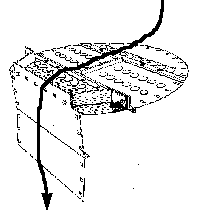
Trays and Plates The terms "trays" and "plates" are used interchangeably. There are many types of tray designs, but the most common ones are :
Bubble cap trays
- A bubble cap tray has riser or chimney fitted over each hole, and a cap that covers the riser.
The cap is mounted so that there is a space between riser and cap to allow the passage of vapour. Vapour rises through the chimney and is directed downward by the cap, finally discharging through slots in the cap, and finally bubbling through the liquid on the tray.
- Valve trays
In valve trays, perforations are covered by liftable caps. Vapour flows lifts the caps, thus self creating a flow area for the passage of vapour. The lifting cap directs the vapour to flow horizontally into the liquid, thus providing better mixing than is possible in sieve trays.
Sieve trays
- Sieve trays are simply metal plates with holes in them. Vapour passes straight upward through the liquid on the plate. The arrangement, number and size of the holes are design parameters.
Because of their efficiency, wide operating range, ease of maintenance and cost factors, sieve and valve trays have replaced the once highly thought of bubble cap trays in many applications. Liquid and Vapour Flows in a Tray Column The next few figures show the direction of vapour and liquid flow across a tray, and across a column.
Each tray has 2 conduits, one on each side, called ‘downcomers’. Liquid falls through the downcomers by gravity from one tray to the one below it.
The flow across each plate is shown in the above diagram on the right.
A weir on the tray ensures that there is always some liquid (holdup) on the tray and is designed such that the the holdup is at a suitable height, e.g. such that the bubble caps are covered by liquid.
Being lighter, vapour flows up the column and is forced to pass through the liquid, via the openings on each tray. The area allowed for the passage of vapour on each tray is called the active tray area.
The picture on the left is a photograph of a section of a pilot scale column equiped with bubble capped trays. The tops of the 4 bubble caps on the tray can just be seen. The down- comer in this case is a pipe, and is shown on the right. The frothing of the liquid on the active tray area is due to both passage of vapour from the tray below as well as boiling.
As the hotter vapour passes through the liquid on the tray above, it transfers heat to the liquid. In doing so, some of the vapour condenses adding to the liquid on the tray. The condensate, however, is richer in the less volatile components than is in the vapour. Additionally, because of the heat input from the vapour, the liquid on the tray boils, generating more vapour. This vapour, which moves up to the next tray in the column, is richer in the more volatile components. This continuous contacting between vapour and liquid occurs on each tray in the column and brings about the separation between low boiling point components and those with higher boiling points.