
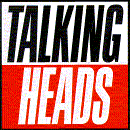
 | Review of True Stories |
by MARK COLEMAN
Talking Heads continue to delve into their American musical roots, and for my money it's a more sensible and successful mission than their pith-helmeted foray into Africa on Remain in Light. "Hey Now" pits the singsong insistence of early R&B with the hop-along kick of Tex-Mex; it's like setting "Mockingbird" loose at the Galleria: "Take me to the shopping mall/Buy me a rubber ball!" "Radio Head" is somewhat confusing lyrically (I think it's about a kid who receives radio transmissions – "the sound of a brand-new world" – on his teeth), but it clomps along compellingly, paced by a wheezing accordion. And "Papa Legba" is a total mystery: Byme's opening cries ring like an Arabic call to prayer, the percussion vibrates, hollow and spooky, and the cries become a chant intoned quietly in Spanish. It's all so weirdly melodic and eerily rhythmic that it's hard not to be enchanted. Maybe this kind of ethnic experiment works best when the results aren't too exact.
But even Talking Heads occasionally fall back on tried-and-true recipes. "Wild Wild Life" is pretty tame, an ironic, midtempo rocker that's the closest Talking Heads have ever come to formula – naturally, it's already getting radio airplay. Escapism is viewed wistfully, almost sentimentally, on the following track, a plaintive, Eurythmics-like dirge called "Dream Operator." Both songs indicate that Talking Heads could dive squarely into the pop mainstream and stay afloat – as long as they tread water.
It's the more ambitious cuts that give True Stories its veracity. The idea of Talking Heads going on a hayride may seem a dodgy proposition, but the country-drenched "People Like Us" is this LP's peak. Rather than affect a down-home twang, Byrne sings in his natural tone, and the resulting tension drives the lyric home. Some will hear this paean to the simple life as patronizing: it's about people who answer their own phones, watch TV, get fat, don't fret about politics and figure that human rights come down to finding another person to love. As incongruous as the breezy fiddle and gentle pedal steel sound at first behind the nasal, urbane Byrne, this unlikely combination makes a greater impact with each listening. When he sings, "Papa couldn't afford to buy us much/He said, 'Be proud of what you are/You're something special,'" you realize just how closely he identifies with these small-town rubes.
"City of Dreams" underlines this identification, ending the album on a stirring – and slightly corny – note. It's a stately march that pays tribute to those whose dreams small towns were built on; the immigrants are now assimilated, the Indians humiliated. Byrne sounds a tad sentimental when he sings, "We live in the city of dreams/We drive on the highway of fire." But the song has a clearheaded melody, and Byrne is ultimately pulled through by its cumulative beauty and the rest of the band's quiet precision. "City of Dreams" recalls the closing track on More Songs About Buildings and Food. Only now the jaded aesthete who looked down from a plane onto a "Big Country" has turned into the kind of guy who'd make a good next-door neighbor: interested and sympathetic but still willing to keep a respectful distance. (
