ASI
The Theory
and Practice of Spiritual Acupuncture

Lecture 10 - Techniques
The
Techniques of Spiritual Acupuncture
Vision
Exercise for viewing the Aura
Astral
Projection
Rising on the
Planes
The Magical
Memory
A Solar
Meditation
A Lunar Cycle
Practice
Method of the
I Ching
THE TECHNIQUES OF SPIRITUAL ACUPUNCTURE
SPIRITUAL ACUPUNCTURE is an art unto itself. It may incorporate ancient and modern techniques within its design. It has been found that acupuncture acts as an anesthetic when performing these exercises – an anesthetic that removes many of the blocks to esoteric practices, such as astral projection or territorial metaprogramming.
The practitioner should perform all of these techniques by himself or herself before applying them to any volunteer or performing them on any patient.
Each of the following techniques can be a valuable tool in your toolkit:
VISION EXERCISE FOR VIEWING THE AURA
- Obtain a piece of black velvet or other dark cloth. The size should be at least 3 feet by 3 feet.
- Obtain a candle, the type that burns away the wax leaving a clearly visible flame.
- Hang the velvet on a wall in a dark room; place the lit candle in a candle-holder about six inches in front of the velvet.
- Be seated. Stare directly at the candle flame.
- Notice the very bright, golden corona immediately surrounding the flame.
- Notice the rays of energy radiating from the corona. (Do not confuse these rays of energy with the rays that become visible when you squint your eyes).
- Notice the zone surrounding the corona that has no color and that extends a few inches.
- Notice the first colored zone that surrounds the non-colored zone.
- Continue to discover additional colored zones farther and farther away from the flame. (Some people find up to 7 zones).
- When you can perform this easily and at will, let a small amount of light into the room or turn on a dim light. Perform 1 through 6, above, in a new series.
- When you can perform this easily and at will, let a larger amount of light into the room or turn on a brighter light. Perform 1 through 6, above, in a new series.
- When you can perform this easily and at will, continue to increase the amount of light in stages until you can perform 1 through 6, above, in full sunlight!
- Then you may turn your attention to human beings. Look at the energy fields around them in the same way you looked upon the energy fields of the candle, and behold! The human aura.
ASTRAL PROJECTION
In this practice, the "projector" is the patient and the "practitioner" is the acupuncturist.
- Let the projector be at rest, the place of working having been cleared of disturbances.
- Let the practitioner perform his or her preliminary art, be it acupuncture, or meditation, or delivery of the empowerment energies.
- Let the practitioner guide the projector through the following stages:
- Let the projector imagine a place of tranquility.
- Let the projector imagine himself or herself walking about in the place of tranquility, so that it appears that the senses of vision, hearing, smell, and touch are all activated.
- Standing in a clear space in the place of tranquility, let the projector levitate, causing the imagined figure to rise to a great height above the earth.
- The projector may see figures, landscapes, or symbols. The projector should speak to such figures, describe such landscapes, or report or analyze such symbols.
- Let the projector return to the body by an act of will.
- The projector must not stay out too long, for fatigue must be avoided. The practitioner must halt the procedure if the projector fails to answer questions or if verbal responses are not rational.
- At the end, let the projector cause the imagined body to coincide with the physical body.
RISING ON THE PLANES
- The previous experience [Astral Projection] is of little merit, and leads to few results important results. It is, however, capable of developing into a form of concentration, and may therefore lead to full enlightenment. The primary reason for the practice of Astral Projection is to familiarize the projector with all the types of obstacles and all the forms of delusions, so that eventually every idea that might arise in the brain might be mastered by dismissal or transmutation.
- Let the projector begin as before, but with a most determined concentration.
- Upon levitating from the place of tranquility, the projector must take care to cause his or her imaginary body to rise straight upward without the least deviation.
- Instead of stopping, let the projector continue to rise until almost overcome by fatigue. If the projector discovers that he or she has stopped without willing to do so, and that figures or landscapes appear, the projector must continue to rise.
- Let the projector continue in this so long as the upward motion continues. Whatever appears, continue on, ever on.
- Finally comes the time when the projector's whole being is caught up in fatigue, overwhelmed by its own inertia.*
* In the case of failure. There are many results of success.
- Upon coming to full consciousness, let him or her recount all that has occurred.
AWAKENING THE MAGICAL MEMORY
- Zoroaster said, "Explore the River of the Soul, whence or in what order you have come; so that although you have become a servant to the body, you may again rise to that consciousness from which you descended, joining works to sacred reason."
- Memory is essential to the individual consciousness; otherwise the mind is but a blank screen upon which shadows are cast. In the practice of simple meditation, there is a stage where old memories automatically arise; the projector may simply stop at that stage and encourage (rather than reject) the flashes of memory.
- Otherwise, there is a variety of methods for obtaining those memories that lie hidden beyond the veil of personal recall; this following is amongst the simplest of those methods.
- Let the projector begin as before (in Astral Projection), and the practitioner will guide him or her to the place of tranquility.
- In this quiet place, let there be a stream. A smooth one, perhaps six feet across and six feet deep, colored green like the Nile and moving slowly.
- Moving next to the stream, even seated upon a rock at its bank, let the projector gaze into the depths of the water. Then let a special invocation be made, calling forth the experiences of the past, in general or in particular, that have a bearing upon the present.
- Then let the projector report such visions that arise. It may be that in order to experience greater detail the projector will enter into the vision itself, becoming one with his or her former self, yet continuing to report the drama. [At this point the projector may experience fear, darkness, difficulty in concentrating, blurring of vision, or inability to stabilize the inner vision. These are manifestations of the veil that guards the magical memory, and they must be controlled through courage, focus, and repetition].
- One the projector has entered into a "lifetime," he or she may be guided forward or backward in time by the practitioner, so that not only the essential experiences of that life may be assessed but also the circumstances of death.
- It may be that the more adventuresome will wish to set forth on an investigation of the abysses in consciousness that lie between the seemingly separate lives. However, this might plunge the projector into the great Abyss itself, and we hold that it is best to explore the individual lifetimes prior to conducting adventures into the completely unknown.
- After each vision, it is most critical that the practitioner encourage the projector to relate the essential nature of each "previous lifetime" to the here-and-now in an attempt to explain the workings of his or her present consciousness.
- Several lifetimes may be visited in a single session, or a series of investigations might be engaged.
- This all then being perfected, so that the memory reaches back into aeons incalculably distant, let the adept meditate upon the fruitlessness of all those years, and upon the fruit thereof, severing that which is transitory and worthless from that which is eternal.
SOLAR MEDITATION
- Envision a Star overhead, from which a shaft of golden light descends to touch you at the Crown (Du 20).
- Inhale, drawing the golden light from the Crown down to the base of the abdominal cavity (Ren 1); hold your breath for four seconds while seeing the golden light form a Sun at the base.
- Exhale slowly while the golden energy rises up the central column, awakening the heart, the throat, the brow, and finally the crown, where it breaks forth as a fountain of golden lights that settle down and touch every cell and every atom of the etheric physical body, energizing it for health and longevity.
- From the radiant etheric body, the golden energy radiates in all directions, passing into the astral body. The astral body is the emotional-feeling vehicle that extends about 24 inches beyond the physical body. The golden light radiating into the astral body stills the stormy seas of the emotions, rendering the astral vehicle as calm and clear as a sea of glass.
- From the astral body, the golden energy radiates outward into the mental body. The mind is an energy force-field extending about 12 inches beyond the astral body. The golden light radiating into the mental body washes away the rigid habit-patterns of thinking and dissolves fixed thoughtforms; it renders the mind pure, calm and clear, like a clean piece of paper upon which the Soul may write its message.
- These three vehicles, the physical, the astral, and the mental, when raised to this golden vibration and harmonized one with the other, constitutes the Temple of Truth and you are lit like the Sun.
- Go now into the center of this Temple, walking between two golden columns into your own Heart chakra; and there upon an altar burns a triple-fold flame of creation.
- Become one with this flame, burning up your personality in the fire of the Soul. Then, phoenix-like, rise up from the ashes.
- Rise up from the ashes in the Heart and ascend toward the Crown, passing out through the center of the 1001-petaled lotus we call the Crown, and enter into the garden of higher consciousness.
THE LUNAR CYCLE PRACTICE
- This practice may be utilized to determine your Will; that is, the one thing that you will do to the exclusion of all else.
- This practice lasts for one Lunar cycle, being twenty-eight to thirty days. [Full Moon to Full Moon, or New Moon to New Moon].
- On the first day, write down on a clean piece of paper (or on a new page in a record) a list of those things you want to own and want to accomplish.
- Each day thereafter, at the same time, and until the end of this practice, revise the list. You may add items, or delete items, or re-arrange the order of the list.
- There is no spiritual or material limit to what you may place on your list. It is wise to be thorough.
- Your goal is to identify the first item (number one) on your list on the last day of the practice.
- You may expect that:
The list will rearrange itself - perhaps several times,
2. Some items on the list may be fulfilled before the practice is completed, and
3. During the last few (3 to 7) days of the practice, the list will tend to stabilize as it nears the goal.
- You must do this every day. If you skip one day, it may not destroy the procedure. If you miss twice, it will probably destroy the procedure.
- The procedure is conscious in its execution, but subconscious in the nature of its results.
METHOD OF THE I CHING
The Tao
- TAO concenters itself upon Kether as a point.
Kether is sphere one on the Tree of Life
- TAO directs itself within Chokmah and becomes the male force. He is called Yang and is symbolized as a solid line.
Chokmah is sphere two on the Tree of Life
- TAO expands into Binah and becomes the female force. She is called Yin and is symbolized as a broken line.
Binah is sphere three on the Tree of Life
- These three, TAO, Yang, and Yin, bring forth heaven and earth and all contained therein.
The Apparatus
- TAO is the source of the I Ching, as of all.
- You shall obtain six Chinese coins. Five shall be of one metal and the sixth of another. One side you shall call Yang, and the other Yin (Heads & Tails).
You can even use U.S. coins - such as 5 quarters ans a penny
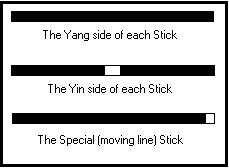
These coins should be kept in a wrapping of black cloth, and no other should lay his hand upon them. For they swell with your aura when used with sincerity and repetition. You have no coins? Six sticks will serve. Paint one side solid and the other broken One of the six is special: It is made unique by painting one end on both sides. Care for these sticks as though they were coins.
Use ice-cream bar sticks or tongue depressors
The Method
- When a situation arises in your mind and you would seek a divination, do thus: Go and take out your coins or sticks.
Face east. Make your mind clear – so that no thoughts intrude. Call upon the Tao, or what god you will; filling yourself with a fixed image of the situation into which you would inquire. Then gently toss the coins or sticks toward the east. They will fall into a certain pattern that you will arrange into a hexagram – the unit of divination of the book, I Ching. You must arrange the coins or sticks into a pattern.
The closest coin or stick to you is Line 1.
The next closest coin or stick to you is Line 2.
The farthest coin or stick from you is Line 6.The Hexagram
- A hexagram is composed of six lines, each line being Yang or Yin. The special stick or coin is called, "The Moving Line."
- Each line of the hexagram is numbered: The line nearest to yourself is Line One, while the farthest away is Line Six.
The coins or sticks may fall upon each other,
causing confusion as to which one is closer or farther.
In such a case, select the coin or stick whose center
is closest to you as the closest line.If the pattern is hopelessly confused,
Then throw the coins or sticks again.An Example
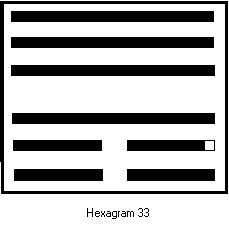
- You have concentrated on your situation, and your coins or sticks have fallen thus:
Line 6 – Yang (a solid line)
Line 5 – Yang (a solid line)
Line 4 – Yang (a solid line)
Line 3 – Yang (a solid line)
Line 2 – Yin (a broken line)
Line 1 – Yin (a broken line)
The hexagram will look like this:
Note that the hexagram is divided into two trigrams – An upper trigram and a lower trigram.
Interpretation
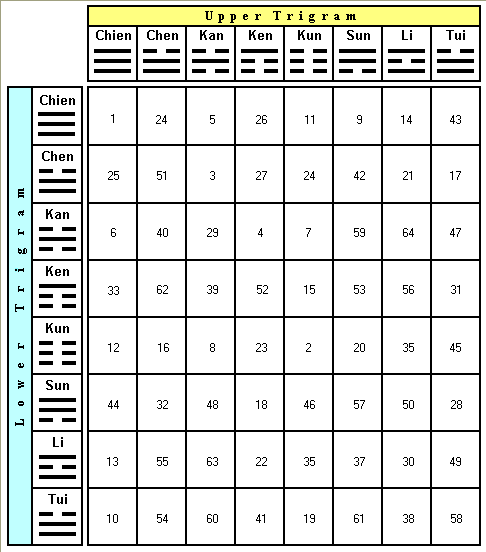
- Taking your Key (that is, the grid found in your copy of the I Ching or see the grid below), you will find the upper trigram along the top of the grid. Next, will find the lower trigram along the left side of the grid.
- Follow these trigrams into the center of the grid – Behold the number 33.
- Then you shall read the thirty-third hexagram in the I Ching.
- The initial description of this hexagram refers to the situation as a whole, showing you the general direction of the matter.
- Next, the six lines are described. The first line described in the text pertains to line number one in your hexagram. The last described line pertains to line number six in your hexagram.
- The moving line (in this example it is line number two) is the specific line that pertains to your situation: Your answer from the Tao.

Ó 2000 All Rights Reserved