Born: 1584
Place of birth: A village named Miyamoto in the Mimasaka province of Japan
Major works: Book of Five Rings
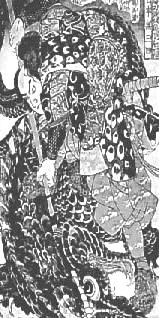
Though, as in most of the legendary Japanese heroes and philosophers, there is little known about the life of Shinmen Musashi no Kami, Fujiwara no Genshin (better known as Miyamoto Musashi) but there are many legends and tales attached to his name.
A good portion of what we do know of this bushi (armed gentry) mostly comes from the introduction which he wrote to the Book of Five Rings (or Spheres; more appropiately). Here he tells us that his duel, and his first kill, came when he was of the age of thirteen. The last was made at the age of twenty-nine. Somewhere in the interim he gave up the common use of his sword, yet was still apt at making mortal wounds upon those he faced.
The last three decades of hi life were spent in the contemplation of the military arts. He is said to have given up common forms of grooming during this time. From what we can learn he had never married, nor fathered a child. He also never set up a home. There are many things written about the interim of his life, but without proper verification, it is hard to separate legend from fact, so we have to leave the knowledge of this man short.
A moment's reflection of the government of his time might help to shed some light upon his character, for men are, to some degrees, reflections of the times they inhabit.
Musashi was alive during the third tent government of Japan, which spanned forth from the beginning of the seventeenth century on through the mid-nineteenth century. The third tent government upheld the martial traditions of its predecessors, yet differed in notable ways.
A quick look at the first two will thus be necessary here:
The first tent government was formed near the end of the twelth century, and lasted near one hundred and fifty years. The government was of warriors descended from noble houses. They had spent a large amount of time honing military skills in dipsutes with Ainu people of eastern Japan.
The second tent government came to power in thirteen thirty-eight. The ties to their ancient noble houses had thinned, and the warrior class itself had expanded forth. There were attempts made to establish high culture among the elite of the Shôgun class.
The trouble was that the rule of these tent governments was no where near absolute. Their was no common rule of unity in Japan upon these times. Rather these were periods of infighting that took place among different fractions who the tent governments were trying to govern.
The third tent government tried to place in effect a series of controls to keep the chaos that had spread through the first two previous governments under control. He took the capital out of the heartland of Japan, and set up in the eastern area. The peasants were disarmed and the samuria class were disenfranchised. Warriors that had lived out upon the land found themselves moved to castle towns.
The town where he set up his government was known as Tokugawa. Today it is known as Tokyo.
The baronies that were set up were made to minimize the amount of warriors that they employed. This resulted in a large number of unemployed samurias who became known as rônin, or wanderers.
With this view of the times in your eye, may the words of the Book of Five Rings be reflected truly.