
POSITIVE IDEAS...new book every month...learn...apply...LIVE THE BEST YOU CAN!
March 1999
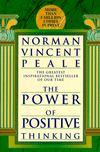 "The Power of Positive Thinking" by Norman Vincent Peale
Click on the book cover to see how to get this book.
"...At intervals during the day practice thinking a carefully selected series of peaceful thoughts. Let mental pictures of the most peaceful scenes you have ever witnessed pass across your mind, as, for example, some beautiful valley filled with the hush of evening time, as the shadown lengthen and the sun sinks to rest. Or recall the silvery night of the moon falling upon rippling waters, or remember the sea washing gently upon soft shores of sand. Such peaceful thought images will work upon your mind as a healing medicine. So now and then during every day allow motion pictures of peace slowly to cross your mind.
Practice the technique of suggestive articulation, that is, repeat audibly some peaceful words. Words have profound suggestive power, and there is healing in the very saying of them. Utter a series of panicky words and your mind will immediately go into a mild state of nervousness. You will perhaps feel a sinking in the pit of your stomach that will affect your entire physical mechanism. If, on the contrary, you speak peaceful, quieting words, your mind will react in a peaceful manner. Use such a word as "tranquility." Repeat that word slowly several times. Tranquility is one of the most beautiful and melodic of all English words, and the mere saying of it tends to induce a tranquil state.
Another healing word is "serenity." Picturize serenity as you say it. Repeat it slowly and in the mood of which the word is a symbol. Words such as these have a healing potency when used in this manner. It is also helpful to use lines from poetry or passages from the Scriptures. A man of my acquaintance who achieved a remarkable peace of mind has the habit of writing on cards unusual quotations expressing peacefulness. He carries one of the cards in his wallet at all times, referring to it frequently until each quotation is committed to memory. He says that each such idea dropped into the subconscious "lubricates" his mind with peace. A peaceful is indeed oil on troubled thoughts. One of the quotations which he used is from a sixteenth-century mystic, "Let nothing disturb you. Let nothing frighten you. Everything passes away except God. God alone is sufficient."
The words of the Bible have a particularly strong therapeutic value. Drop them into your mind, allowing them to "dissolve" in consciousness, and they will spread a healing balm over the entire mental structure. This is one of the simplest processes to perform and also one of the most effective in attaining peace of mind..."
April 1999
 "Think and Grow Rich" by Napoleon Hill
Following is an excerpt from this month's Power Book:
"...To protect yourself against negative influences, whether of your own making, or the result of the activities of negative people around you, recognize that you have a will-power, and put it into constant use, until it builds a wall of immunity against negative influences in your own mind.
Recognize the fact that you, and every other human being, are, by nature, lazy, indifferent, and susceptible to all suggestions which harmonize with your weaknesses. Recognize that you are, by nature, susceptible to all the six basic fears, and set up habits for the purpose of counteracting all these fears. Recognize that negative influences often work on you through your subconscious mind, therefore they are difficult to detect, and keep your mind closed against all people who depress or discourage you in any way. Clean out your medicine chest, throw away all pill bottles, and stop pandering to colds, aches, pains and imaginary illness.
Deliberately seek the company of people who influence you to think and act for yourself.
Do not expect troubles as they have a tendency not to disappoint.
Without doubt, the most common weakness of all human beings is the habit of leaving their minds open to the negative influence of other people. This weakness is all the more damaging, because most people do not recognize that they are cursed by it, and many who acknowledge it, neglect or refuse to correct the evil until it becomes an uncontrollable part of their daily habits...You have absolute control over but one thing, and that is your thoughts. This is the most significant and inspiring of all facts known to man! It reflects man's divine nature. This divine prerogative is the sole means by which you may control your own destiny...
...Mind control is the result of self-discipline and habit. You either control your mind or it controls you. There is no half-way compromise. The most practical of all methods for controlling the mind is the habit of keeping it busy with a definite purpose, backed by a definite plan. Study the record of any man who achieves noteworthy success, and you will observe that he has control over his own mind, moreover, that he exercises that control and directs it toward the attainment of definite objectives.
Without this control, success is not possible..."
May 1999
 "You Can't Afford the Luxury of a Negative Thought" by John Roger
Following is an excerpt from this month's Power Book:
"1. From a purely medical point of view, all this negative thinking suppresses the immune system, raises the blood pressure and creates a general level of stress and fatigue in the body. In short, opportunistic infections, cardiovascular failure, the degeneration of muscles and the random growth of unwanted cells get more opportunity.
2. From a thoughts-are-creative point of view, our worry about a particular disease tends to create that disease. There's an old saying:"What you fear may come upon you." It's old because there's a certain degree of truth in it. Medical students and psychology students will often take on the symptoms of the disease or disorder they are curently studying and, in some cases, produce the full-blown disease. The thought, "Oh my God, it's cancer!" every time you cough might be misinterpreted as an invitation or even a directive.
3. If you're sick, thinking it might be AIDS or lung cancer or Lyme disease, and it turns out to be just the flu, you say, "Thank God, it's the flu!" Such enthusiasm over the flu may create more flu.
4. The more that people believe they are going to die "within a few years, at best," the less they tend to start long-term projects - career goals, relationships, moving - which, in turn, tends to make life less fulfilling and enjoyable, therefore less livable. After a while, the question, "What have I got to live for?" might not have a satisfactory answer. And the desire to die is rekindled.
5. It's a miserable way to live life. If we had a bomb strapped to our chest and were told it could go off at any time, that might be something, over time, we could learn to live with. (We all have a similar situation in that we know we're going to die, but we don't know when.) If, however, we were told the bomb would tick precisely 1,243 times before exploding, every time the bomb started ticking, we'd stop everything we were doing and start counting. Some days it might only tick ten times. Other days it might get up to 287. But while it ticked: panic. And, after a while, the fear that it might start ticking begins. So even when it's not ticking, we're scared.
As we said, it's a miserable way to live..."
June 1999
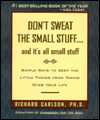
"Don't Sweat The Small Stuff" by Richard Carlson, Ph.D.
Following is an excerpt from this month's Power Book:
"Life Is a Test. It Is Only a Test
One of my favorite posters says, "Life is a test. It is only a test. Had this been a real life you would have been instructed where to go and what to do." Whenever I think of this humorous bit of wisdom, it reminds me not to take my life so seriously.
When you look at life and its many challenges as a test, or series of tests, you begin to see each issue you face as an opportunity to grow, a chance to roll with the punches. Whether you're being bombarded with problems, responsibilities, even insurmountable hurdles, when looked at as a test, you always have a chance to succeed, in the sense of rising above that which is challenging you.
If, on the other hand, you see each new issue you face as a serious battle that must be won in order to survive, you're probably in for a very rocky journey. The only time you're likely to be happy is when everything is working out just right. And we all know how often that happens.
As an experiment, see if you can apply this idea to something you are forced to deal with. Perhaps you have a difficult teenager or a demanding boss. See if you can redefine the issue you face from being a "problem" to being a test. Rather than struggling with your issue, see if there is something you can learn from it. Ask yourself, "Why is this issue in my life? What would it mean and what would be involved to rise above it? Could I possibly look at this issue any differently? Can I see it as a test of some kind?"
If you give this strategy a try you may be surprised at your changed responses. For example, I used to struggle a great deal over the issue of my perception of not having enough time. I would rush around trying to get everything done. I blamed my schedule, my family, my circumstances, and anything else I could think of for my plight. Than it dawned on me. If I wanted to be happy, my goal didn't necessarily have to be to organize my life perfectly so that I had more time, but rather to see whether I could get to the point where I felt it was okay that I couldn't get everything done that I felt I must.
In other words, my real challenge was to see my struggle as a test. Seeing this issue as a test ultimately helped me to cope with one of my biggest personal frustrations. I still struggle now and then about my perceived lack of time, but less than I used to. It has become far more acceptable to me to accept things as they are."
July 1999
"Men are from Mars, Women are from Venus" by John Gray, Ph.D.

Following is an excerpt from this month's Power Book:
"So many people are frustrated in their relationships. They love their partners, but when there is tension they do not know what to do to make things better. Through understanding how completely different men and women are, you will learn new ways for success-fully relating with, listening to, and supporting the opposite sex. You will learn how to create the love you deserve. As you read this book you may wonder how anybody succeeds in having a successful rela-tionship without it.
Men Are from Mars, Women Are from Venus is a manual for loving relationships in the 1990s. It reveals how men and women differ in all areas of their lives. Not only do men and women com-municate differently but they think, feel, perceive, react, respond, love, need, and appreciate differently. They almost seem to be from different planets, speaking different languages and needing different nourishment.
This expanded understanding of our differences helps resolve much of the frustration in dealing with and trying to understand the opposite sex.
Misunderstandings can then be quickly dissipated or avoided. Incorrect expectations are easily corrected. When you remember that your partner is as different from you as someone from another planet, you can relax and cooperate with the differ-ences instead of resisting or trying to change them.
Most important, throughout this book you will learn practical techniques for solving the problems that arise from our differences. This book is not just a theoretical analysis of psychological differ-ences but also a practical manual for how to succeed in creating lov-ing relationships...
HOW TO COMMUNICATE WITHOUT BLAME
A man commonly feels attacked and blamed by a woman's feelings, especially when she is upset and talks about problems. Because he doesn't understand how we are different, he doesn't readily relate to her need to talk about all of her feelings.
He mistakenly assumes she is telling him about her feelings because she thinks he is somehow responsible or to be blamed. Because she is upset and she is talking to him, he assumes she is upset with him. When she complains he hears blame. Many men don't understand the (Venusian) need to share upset feelings with the people they love.
With practice and an awareness of our differences, women can learn how to express their feelings without having them sound like blaming. To reassure a man that he is not being blamed, when a woman expresses her feelings she could pause after a few minutes of sharing and tell him how much she appreciates him for listening.
She could say some of the following comments:
"I'm sure glad I can talk about it."
"It sure feels good to talk about it."
"I'm feeling so relieved that I can talk about this."
"I'm sure glad I can complain about all this. It makes me feel so much better."
"Well, now that I've talked about it, I feel much better. Thank you."
This simple change can make a world of difference."
August 1999
"FENG SHUI Step by Step" T. Raphael Simons
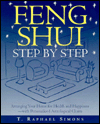
Following is an excerpt from this month's Power Book:
"HEAVEN, EARTH, AND MAN
Alignment and balance are the core and essence of feng shui.
They have both internal and external significance for practitioners.
It is said that in very ancient times, feng shui was only practiced inwardly, and that wherever its practitioner went, the world was filled with joy and content-ment. But in the past several thousand years, as life has become more and more complicated and the world has fallen into discord and strife, it has been necessary for feng shui to be practiced outwardly as well.
Feng shui has two premises and two levels of practice. The first premise is that man's state of mind and energy affects his environment for good or ill. The second premise is that the condition of the environment affects man's internal state.
In practice, the inner level involves concentration techniques such as contem-plation of the principles of the I Ching (or The Book of Changes)1 meditation, and chi kung (a system of internal exercises to promote good health and healing). The outer level consists of horoscope, compass, form, and divining techniques.
The inner and outer levels are like two sides of a coin. They are inseparable and interdependent. To illustrate more fully, let's look at an image called the "three coordinate powers." The three coordinate powers are heaven, earth, and man. Heaven corresponds to time. Earth corresponds to space.
The human relationship to heaven and to earth constitutes the outer level. Horoscopes are drawn to find your relationship to heaven.
methods, based on the same underlying principles as horoscope methods, are used to find and adjust your relationship to earth.
To understand how the principles of heaven and earth relate to one another
how they balance and interact with one another, and how they can be brought together in perfect harmony in man~constitutes the inner level.
The principles of heaven and earth are the father and mother of all phenom-ena. Man uses the principles of heaven and earth for good or ill. When we live in harmony with our essential nature and allow the principles of heaven and earth to interact freely and naturally through us, our environment becomes harmonious and radiant with vital energy. Conversely, if we lose the real character of our essential nature and abuse the principles of heaven and earth, our environment falls into confusion and discord. To quote Chuang Tzu, "If you get the Tao, there is no effect that cannot be produced; if you miss it, there is no effect that can.
EXERCISE
This is one of the first exercises I learned in feng shui. It is an excellent method for simultaneously applying inner and outer approaches and becoming aware of the space around you. Let it become second nature to you.
To begin, you may either sit or stand in the space. Let your posture be balanced and relaxed. Breathe naturally and calmly.
Concentrate, and gently let go of your thoughts. Just be in the space without any preconceptions about it. Next, simply walk about the space for a while.
Become aware of your intuitive responses and impressions. Where is there more energy? Where is there less energy? Where is the energy powerful?
Where is it depleted? Where is it positive? Where is it negative? Try this in different spaces. After a while you will get the knack of it."
September 1999
"The Book of Meditation" by Patricia Carrington, PhD
Following is an excerpt from this month's Power Book:
"Clinically Standardized Meditation (CSM)
I developed my new form of meditation by selecting a classical type of mantra meditation, modifying it so that it became suit-able for Western use, and creating a standardized set of instructions for teaching it.
The first group of people to use this method were Princeton University students who were attending a seminar I was teaching at the time. The students were enthusiastic about the technique, and on a series of personality tests administered before learning this meditation method, and again after they had practiced it for ten weeks, they showed changes similar to those reported by subjects who had been practicing TM in a comparable study being conducted on the campus. Both groups of meditators showed clear-cut evidence of anxiety reduction over a ten-week period.
The new technique I had developed was then revised, elabor-ated and given the name Clinically Standardized Meditation (CSM) to indicate its research and clinical nature. A teaching manual was prepared, successful testing of the method was carried out and since that time CSM has been taught to numerous psychotherapists throughout the world for use with their patients. Many organizations have also used it with their employees, and a large numbers of individuals have learned it either through recordings or by personal instruction.
CSM is closer in its structure to TM than to any other currently used form of meditation but differs from it in some important respects. Our trainees select their own mantra from a list of sixteen mantras presented to them, or if they wish to make up their own mantra they do this by following some simple rules.
My first task in developing CSM was to assemble a list of suitable mantras, resonant and soothing sounds which would be used as objects of concentration during the meditation process. Since I was devising a system to suit widely divergent groups of people, I did not select the sounds to be used by following religious or spiritual guidelines. In the great tra-ditions, mantras have very specific meanings and are dispensed with much careful thought by teachers well versed in their use, but for our purposes, the sounds used merely needed to have especially soothing qualities.
I assembled 100 words from the Sanskrit Hebrew and English languages which had particularly resonant sounds and (in English) calming connotations. I then presented this list to 150 students and asked each of them to rate these sounds according to how 'soothing' they found them to be. The sixteen sounds rated as most soothing by the students became the list from which CSM trainees later selected their own special sounds. This way I was able to avoid assignment of a word or sound that might be unsuitable for a particular individual.
I have never regretted my decision to use this method of mantra selection. Not one of the thousands of people who have been trained in CSM has complained about having a wrong or unpleasant sound to repeat in their mind. If the first sound they selected was later felt to be unsuitable, the person was encouraged to select (or to create) another This method has worked beautifully and is universally appreciated by those who learn CSM.
CSM is learned in one instruction session and is mastered in about a week's time, with only a few hours' practice necessary. Most people prefer to learn it by means of the Learn to Meditate
audiotapes and workbook but it is sometimes taught in person. Since the recorded training method has proven to be as effective
as personal instruction, the choice depends on individual preference.
The CSM instruction session, whether conveyed on tape or in person, does not involve any special ceremony but merely the use
of a quiet room, some plants pleasantly arranged, and (if the person wishes it) incense and a candle placed on a small table.
We then use a short, standardized, soothing means of transferring the mantra which the learner has personally selected. I developed
a simple, non-cultic ritual for imparting the mantra because I found that the dignity and emphasis lent to the occasion by a ceremony,
however informal, is an important part of the process.
Meditation is, in a sense, a rebirth. It is a new beginning, a significant commitment to one's own growth. Since CSM instruction emphasizes the effortlessness of the meditation technique and its permissive nature, CSM lies, as does TM, at the permissive end of the scale relative to other meditation techniques which can require considerable concen-tration. The main advantages of CSM are its simplicity, its flexibility and its sensitivity to the individual needs of the people who learn it."
October 1999
"The Art of Creative Thinking" by Gerard I. Nierenberg
Click on the book cover to see how to get this book.
Following is an excerpt from this month's Power Book:
"There have always been attempts to gain insight into a creative act, but rarely has anyone ever tried to delve into the how of creative thinking.
The purpose of this book is to show you how, by thinking in certain ways, you can solve your problems creatively. Problems exist in all shapes and sizes, and in every aspect of life. Creative thinking is what is needed to provide alternative solutions to every problem you have - from the smallest to the largest. Once you have read and studied this book, few if any difficulties will resist your creative solutions. Instead of obstacles, problems will present opportunities to exercise your creative thinking to a degree that will delight you.
Consider how you have related to creativity in the past. Can you recall when you were last creative? Can you recognize creativity in yourself and others, or is it a mysterious element possessed only by geniuses? If you have difficulty answering these questions, it may be that you fail even to recognize a creative experience. Can you think creatively whenever you want to? Or do you have to wait for a happy accident to line things up just the way you need them? If you must, then you are not realizing your full creative potential.
Creative thinking, broadly defined, means coming up with something new. It is part of human thinking skills. These are the skills that have insured human survival, therefore cultural continuum (civilization) and growth. This working definition of creativity includes the masterworks of art and science as well as a new recipe invented by a homemaker. As infants we began to think creatively. Each situation was new and had to be handled in a new (creative) way. Whether we ascribe this talent, as the child observer Jean Piaget did, to the interaction of our inborn predispositions, or as Noam Chomsky, the observer of language did, to inborn properties of the mind, we survived, which proves our creativity. As our experience grew and we continued to deal with new things successfully, behavioral patterns developed. With maturity, as new situations occurred, we handled them with previously successful thinking patterns rather than by trying to find new solutions. In other words, we had become hidebound and had forgotten how to be creative. Most of us continue this behavioral pattern throughout our adult life.
Studies demonstrate that we utilize only about ten percent of our brain capabilities. These studies also indicate that we can develop mental talents almost without limit.
This book will offer you methods to develop your creative thinking and substantially increase your mental capacities. The methods employ the use of the creative thinking skills which are divided into five areas of use: (1) knowing differences (making structures), (2) knowing similarities (making relations), (3) knowing changes (making order), (4) knowing and changing levels and (5) knowing and changing points of view.
To help you gain new insights, this book will provide you with problems to solve, tests to take, and workshop exercises and applications.
Creative thinking skills can be used as search patterns of your past experiences. With these techniques you can review and revive all conscious and even subconscious memories that might have even a remote relevance and discover new solutions to present problems.
Although these mental skills are not difficult to master, the problem is first to be able to identify, separate and objectify the tools, and then to bring them under conscious use and control. This book shows you how to do that. Once the fallacies and mysteries are stripped away, you will see the creative process for what it is: the means of achieving new solutions to any problem that may confront you. You will be utilizing creativity for results and not necessarily to understand the forces behind it. Lack of talent, inspiration, interest or even the distastefulness of a situation will no longer serve as an excuse to limit your choices.
You may even find yourself with the happy-go-lucky attitude of King Taufaahau Topou IV of Tonga, who in 1977 had a double problem: in spite of the fact that one of his subjects' prized national foods was fruit bats, there were too many of them. Fruit bats were destroying their crops, and therefore, they were short of exports. Instead of admitting failure, the king paid an official visit to nearby Guam and set up a sales force to boost Guam's consumption of fruit bats. This would increase Tonga's total exports and eliminate a lot of bats. The king of Tonga had found a creative solution which for him had been a literally distasteful problem. He explained, "I don't go head over heels for fruit bats."
Our rewards come not from having brains, but in using them."
November 1999
"Dowsing for Beginners" by Richard Webster
Click on the book cover to see how to get this book.
Following is an excerpt from this month's Power Book:
"Dowsing can be described as divining for something that is desired. Most people consider dowsing to be a search for water, and this is how the whole field began thousands of years ago. However, you can
divine for anything you want, be it oil, gold, lead, or even ancient ruins. You can find missing people or lost objects. You can determine if something is safe to eat or drink. I have seen people dangling a pendulum over fruit in the supermarket, but I feel that this is taking it a little too far! I have even met a few people who dowse for the winners of horse races.
Dowsing has a very ancient history.
There are pictographs in the Tassili-n-Ajjer caves in south-east Libya that show a group of people watching a diviner with a forked stick. It has been estimated that these drawings could be 8,000 years old.
In the fifth century B.C., Herodotus described how the Scythians dowsed with willow rods. There is a tradition that suggests that the Queen of Sheba included dowsers in her entourage whenever she traveled to see Solomon. Their task was to dowse for water and gold.
Divining "rods" are mentioned several times in the Old Testament. In the Book of Numbers (XX:8-11), Moses is said to have struck a rock twice with his rod, and the rock produced enough water to satisfy Moses' people and their cattle.
Rods were considered acceptable in the Old Testament only if they were used for the Lord's work. They can be related today to the bishop's staff and the sorcerer's magic wand.
The Catholic church disapproved of any form of divination, so for many years dowsing was considered to be the work of the devil. Martin Luther also regarded dowsing as a mortal sin, and even included it in his list of activities that broke the first commandment. This is rather strange, as Martin Luther was the son of a miner, and must have been well aware that dowsing rods were used constantly in mines…
The skepticism of many is in striking contrast to the giant Swiss pharmaceutical company Hoffmann-La
Roche. When asked why they always used dowsers when building new laboratories around the world, Dr Peter Treadwell, their spokesman and chief dowser, replied: "We use methods that are profitable, whether they are scientifically explainable or not. The dowsing method pays off." Dr Treadwell has successfully found water in countries as far away from Europe as Australia and India. He uses a large aluminum hoop as a divining rod, finding this light-weight piece of equipment less tiring than other
dowsing instruments. According to the company's in-house magazine, Roche-Zeitung, Hoffmann-La Roche has been 100 percent successful in finding water wherever it was needed. Many other corporations have also employed dowsers to find water. These include RCA, Bristol-Myers and Canadian Industries, partly owned by the Du Pont organization.
Even governments have been prepared to use them. In 1931, the government of British Columbia employed Miss Evelyn Penrose as an official dowser. She also did work for the British and Australian governments. Major W. N. Pogson became official water-diviner to the government of India. During the three years he held this position, water was found in forty-seven out of forty-nine sites he located. From 1941 to 1946, Norah Millen was the executive dowser to the government of Ceylon."
