
Nonvascular Plants - Mosses and Liverworts
Until recently, the nonvascular plants- mosses, liverworts and hornworts- were grouped
together in a single division, Bryophyta. The three deserve separate divisions because
they probably arent closely related.
The three divisions of bryophytes have been around for more than 400 million years and
there are more than 16,000 species today.
1. Division BRYOPHYTES
The most familiar bryophytes are mosses. A mat of moss actually consistsof many plants
growing in a tight pack, helping to hold one another up. The matt has a spongy quality
that lets it absorb and retain water. Each plant of the mat grips the substratum with
elongate cells or cellular filaments called rhizoids. Most photosynthesis occurs in the
upper part of the plant, which has many small stemlike and leaflike appendages. The
stems, leaves, and roots of a moss are not homologous to these structures in vascular
plants.
In the life cycle of a moss ,there is an
alteration of haploid and diploid generations. The diploid sporophyte produces haploid
spores via meiosis in a structure called a sporangium: the spores go on to form new
gametophytes. The haploid gametophyte is the dominant generation in mosses and other
bryophytes. The sporophyte is smaller and shorter lived, and it depends on the
gametophyte for water and nutrients. In vascular plants, the diploid sporophyte is the
dominant generation.
2. Division HEPATOPHYTA
Liverworts are even less conspicuous plants than mosses. The bodies of some are
divided into lobes. The life cycle of a liverwort is much like that of a moss. Within the sporangia of some
liverworts are coil shaped cells that spring out of the capsule when opened, helping to
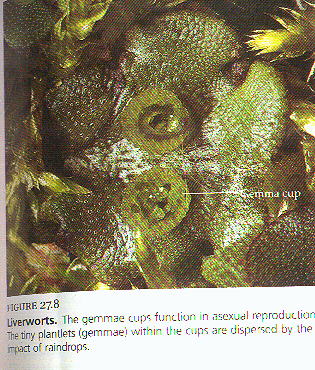
disperse the spores. Liverworts can also reproduce asexually from little bundles of cells
called gemmae, which are bounced out of cups on the surface of the gametophyte by
raindrops.
3. Division ANTHOCEROPHYTA
Hornworts resemble liverworts but are distinguished by their sporophytes which are
elongated capsules that grow like horns from the matlike gametophyte. The
photosynthetic cells of hornworts each have a single large chloroplast rather than many
small ones
