


 The Pilgrims, who
celebrated the first thanksgiving in America, were fleeing religious prosecution
in their native England. In 1609 a group of pilgrims left England for the
religious freedom in Holland where they lived and prospered. After a few
years their children spoke Dutch and they had become attached to the dutch
way of life. But the Pilgrims grew worried. They considered the Dutch frivolous
and considered their ideas a threat to their children's education and morality.
The Pilgrims, who
celebrated the first thanksgiving in America, were fleeing religious prosecution
in their native England. In 1609 a group of pilgrims left England for the
religious freedom in Holland where they lived and prospered. After a few
years their children spoke Dutch and they had become attached to the dutch
way of life. But the Pilgrims grew worried. They considered the Dutch frivolous
and considered their ideas a threat to their children's education and morality.
 So they decided
to leave Holland and travel to the New World. Their trip was financed by
a group of English investors, the Merchant Adventurers. It was agreed that
the Pilgrims would be given passage and supplies in exchange for their
working for their backers for 7 years.
So they decided
to leave Holland and travel to the New World. Their trip was financed by
a group of English investors, the Merchant Adventurers. It was agreed that
the Pilgrims would be given passage and supplies in exchange for their
working for their backers for 7 years.
 On Sept. 6,
1620 the Pilgrims set sail for the New World on a ship called the Mayflower.
They sailed from Plymouth, England and aboard were 44 Pilgrims, who called
themselves the "Saints", and 66 others, whom the Pilgrims called the "Strangers."
On Sept. 6,
1620 the Pilgrims set sail for the New World on a ship called the Mayflower.
They sailed from Plymouth, England and aboard were 44 Pilgrims, who called
themselves the "Saints", and 66 others, whom the Pilgrims called the "Strangers."
The long trip
was cold and damp and took 65 days. There was the danger of fire on the
wooden ship, so food had to be eaten cold. Many passengers became sick
and one person died by the time land was sighted on November 10th.
The long trip
led to many disagreements between the "Saints" and the "Strangers". After
land was sighted a meeting was held and an agreement was worked out, called
the Mayflower Compact, which guaranteed equality and unified the two groups.
They joined together becoming the "Pilgrims" that
we speak of today.
Although they
had first sighted land off Cape Cod they did not settle until they arrived
at Plymouth, which had been named by Captain John Smith in 1614. It was
there that the Pilgrims decide to settle. Plymouth offered an excellent
harbor. A large brook offered a resource for fish. The Pilgrims biggest
concern was attack by the local Native American Indians. But the Patuxets
were a peaceful group and did not prove to be a threat.
The first winter
was devastating to the Pilgrims. The cold, snow and sleet was exceptionally
heavy, interfering with the workers as they
tried to construct their settlement. March brought warmer weather and the
health of the Pilgrims improved, but many had died during the long winter.
Of the 110 Pilgrims and crew who left England, less that 50 survived the
first winter.
On March 16,
1621 , what was to become an important event took place, an Indian brave
walked into the Plymouth settlement. The Pilgrims were frightened until
the Indian called out "Welcome" (in English!).
His name was
Samoset and he was an Abnaki Indian. He had learned English from the captains
of fishing boats that had sailed off the coast. After staying the night
Samoset left the next day. He soon returned with another Indian named Squanto
who spoke better English than Samoset. Squanto told the Pilgrims of his
voyages across the ocean and his visits to England and Spain. It was in
England where he had learned English.
Squanto's importance
to the Pilgrims was enormous and it can be said that they would not have
survived without his help. It was Squanto who taught the Pilgrims how to
tap the maple trees for sap. He taught them which plants were poisonous
and which had medicinal powers. He taught them how to plant the Indian
corn by heaping the earth into low mounds with several seeds and fish in
each mound. The decaying fish fertilized the corn. He also taught them
to plant other crops with the corn.
The harvest
in October was very successful and the Pilgrims found themselves with enough
food to put away for the winter. There was the corn, fruits and vegetables,
fish to be packed in salt, and meat to be cured over smoky fires.
The Pilgrims
had much to celebrate, they had built homes in the wilderness, they had
raised enough crops to keep them alive during the long coming winter, they
were at peace with their Indian neighbors. They had beaten the odds and
it was time to celebrate.
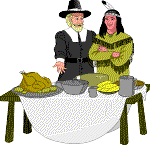
The Pilgrim
Governor William Bradford proclaimed a day of thanksgiving to be shared
by all the colonists and the neighboring Native Americans. They invited
Squanto and the other Indians to join them in their celebration. Their
chief, Massasoit, and 90 braves came to the celebration which lasted for
3 days. They played games, ran races, marched and played drums. The Indians
demonstrated their skills with the bow and arrow and the Pilgrims demonstrated
their musket skills. Exactly when the festival took place is uncertain,
but it is believed the celebration took place in mid-October.
The following
year the Pilgrims harvest was not as bountiful, as they were still unused
to growing the corn. During the year they had also shared their stored
food with newcomers and the Pilgrims ran short of food.
The 3rd year
brought a spring and summer that was hot and dry with the crops dying in
the fields. Governor Bradford ordered a day of fasting and prayer, and
it was soon thereafter that the rain came. To celebrate - November 29th
of that year was proclaimed a day of thanksgiving. This date is believed
to be the real true beginning of the present day Thanksgiving Day.
The custom of
an annually celebrated thanksgiving, held after the harvest, continued
through the years. During the American Revolution (late 1770's) a day of
national thanksgiving was suggested by the Continental Congress.
In 1817 New
York State had adopted Thanksgiving Day as an annual custom. By the middle
of the 19th century many other states also celebrated a Thanksgiving Day.
In 1863 President Abraham Lincoln appointed a national day of thanksgiving.
Since then each president has issued a Thanksgiving Day proclamation, usually
designating the fourth Thursday of each November as the holiday.


