
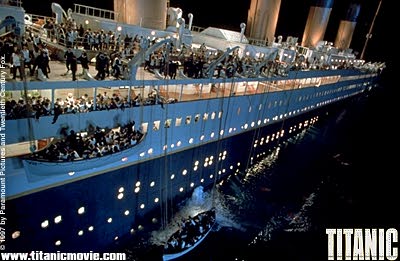
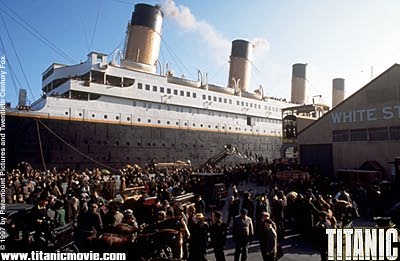
On Wednesday, April 10, 1912, 2,208 passengers and crew members boarded the Titanic, which weighed 46,328 tons, and traveled at 22 and a half knots (41.7 km/hr). Out of those 2,208 people, there were 806 crew members, including 475 stewards and cooks, 320 engineers, and 65 people engaged in the ship's navigation. The Titanic had a commander whose name was Captain E.J. Smith, and three officers whose names were Dr. W. F. O'Loughlin, First Officer W. M. Murdoch, and Purser H. W. McElroy.
The Titanic was 883 feet long, 92 and a half feet broad, and was 104 feet high. On board the Titanic had eight steel decks (in fact, the whole ship was steel), one cellular double bottom, 48 life boats that were 30 feet long each, 29 boilers, and 159 furnaces. Other features included special luxuries such as Turkish baths, gymnasiums, a swimming pool, and racquet courts. The gymnasiums offered exercise on mechanical horses and camels.
After two hours and forty minutes, the Titanic went under water completely, killing over 1,500 lives, including 815 passengers and 688 crew members. Only 705 people were rescued from lifeboats by the Carpathia's ship. The circumstances made the loss seem most appalling in England and the United States, because most of the passengers were from those two countries. The reason there were so few crew members rescued was because they gave up their lives to let passengers on lifeboats instead of themselves, and they tried to save the weak and the helpless as much as they could.
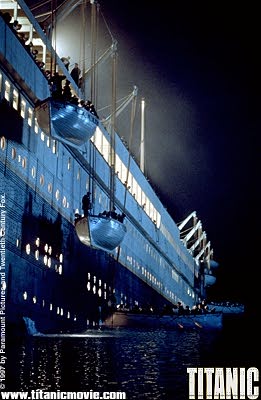

As described by more passengers that survived, at 2:20 a.m. the lights of the Titanic were still ablaze, and the remaining passengers on board sang a hymn. The Titanic's stern rose in the air vertically in the clear, starry night, and with a roar, everything plunged down toward the submerged bow. Finally, the Titanic slid under the dark, deep waters of the sea.
Survivors say that right after the Titanic went completely under water, the cries of those on board were horrible. No other vessels were able to reach the Titanic because they were too far away, except one that was only 10 miles away. This ship still wasn't able to reach the Titanic because its wireless operator had retired for the night.
Some sailors said they had never seen or heard of icebergs with that great of mass to have been so far south in the north Atlantic Ocean in 50 years. The temperature of the water was 28 degrees Fahrenheit, so the chance for survival was almost nothing before hypothermia kicked in and began freezing a body to death. So many people died because each boat was not filled to capacity. Each lifeboat could have held 60 people, but some boats were filled to just about 28 people. The reason people didn't fill the boats to capacity was because they thought the lifeboats would be too heavy and sink. Also, the people in the upper classes on deck A were rescued first before the lower class passengers on deck D.
Fortunately, the Titanic disaster has led to new strict standards and rules for nautical safety, such as bringing about measures to promote safety at sea, through the establishment of patrols to make known the location of icebergs. Also, stringent rules and regulations about the proper number of lifeboats to be carried by vessels have been created, and include guidelines for the proper equipment to withstand emergencies.
Only one male survivor survived the terrible tragedy. His name was Colonel Archibald Gracie. His room was on deck C, and his room was C51. As described by Gracie, the last day the Titanic was afloat after breakfast that morning, a church service was held in the dinning salon. They prayed for those at sea and sang out of a hymnal book. Hymn number 418 was sung and it began with the impressive words of "Oh God our help in ages past, our hope for years to come, our shelter from the stormy blast and our eternal home."
That night the Colonel described his record of the collision. He was in bed when all of the sudden he awoke to a great, bumping noise. He stumbled out of bed and looked at his watch. He also heard a tremendous noise of escaping steam. The ship had stopped, so it appeared to be that no problem had occurred. No sound of machinery could be heard, which made the Colonel at first think there wasn't any problem.
Colonel Archibald Gracie has received hundreds of letters from long, lost relatives of people who were killed on the Titanic asking if he had seen them. Many of the letters had pictures of the people. Not only has the Colonel received many letters, but other survivors have too. Colonel says he only remembered seeing some people on rare instances.
Today, the Titanic sits at the bottom of the north Atlantic Ocean. Many people are searching and trying to pull it up and out of the water. Some people are interested in all the treasures and jewelry people had aboard the ship. Unfortunately, the Titanic is not very easy to explore because there is a legal battle between England and the United States, and at the present time, it is being discussed and handled in a court of law.
Some of the information described above such as about the lifeboats varies. Some resources say that there were enough lifeboats for a third of all the passengers, and some say there were enough lifeboats for half of all the passengers on board the Titanic. Some resources say each lifeboat could hold a little over 60 passengers, and some say, the lifeboats could have held a little over 40 passengers. These discrepancies and the causes of the disaster make this event in history controversial and interesting.
Here are some really awesome links I've collected!
