
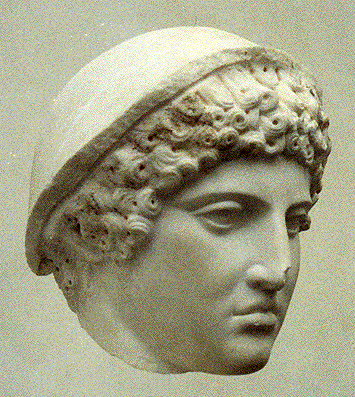
Hermes was the son of Zeus and the Titaness Maia. Maia was a solitary being, keeping to herself high up in the mountains. She had a large cavern in which she lived all alone. While flying over the mountains, Zeus noticed Maia, and went down for a closer look. Her beauty mystified him. He approached her and spent the day with her, seducing her that night. From that union, Maia gave birth to Hermes, who upon his birth was able to walk and talk as if he were fully-grown. Maia was very proud of her son, but kept him secluded in the mountains where she continued to stay.
Early one morning while Maia was still asleep, Hermes crept out of his crib and out of the cave. Nearby, there was a large field where Apollo kept his sacred cattle. Upon reaching the field, Hermes cut reeds from the riverbanks, and made pads, which he fastened to the cows’ hooves so that they wouldn’t leave any imprints in the ground as they walked. He then herded them out of the field backwards and back to his mother’s cave. He kept them hidden from her, because he knew that she would make him give the cows back to Apollo. Hermes sacrificed one of the cows to Zeus, and used to cow-gut to make strings for an instrument of his invention, the lyre. He returned to his crib, making sure that Maia was still asleep, and began to play his lyre. The sweetest music gently lifted Maia from her sleep, and she awoke to find that the source of this music was from her baby son. She begged him to keep on playing, not even thinking of asking him where he came across such an instrument.
At the end of every day, Apollo would return to his field to tend to his herd of cattle. He was furious to arrive, and find that the cattle weren’t there! He saw the prints that were left from the pads that Hermes had made for them, and followed them. He followed them for a few hours, and them found that they came to a dead end, as if the cows had just vanished into thin air. Hermes had made the cows walk out of the fields backwards, and where Apollo assumed them to have disappeared was really where Hermes had found them in the beginning. Apollo turned and followed the prints in the other direction, thinking that the cows may have backtracked, and may be somewhere else in the field. Eventually, Apollo arrived outside a large cave, which he already knew was the home of Maia. He strode into her cave, thinking that it was she who had stolen his cows. Right as he entered the cave, Maia stood up to greet him. “Hail Bright Phoebus! To what do I owe the honour of your visit to my home.” Apollo coolly replied, “Someone has stolen my herd of cattle, and I have followed the hoof print back to your cave. You must return them to me at once, no questions will be asked.”
Maia was insulted! God or no, he didn’t have the right to walk into her home and to begin accusing her of crimes that she had no part of. Before she had the chance to snap back at Apollo, Hermes stood up in his crib. “Please sir, it was I who took your cattle. I did so not knowing that they belonged to anyone. You may have them all back, they are in a small pasture behind this cave, but you will find one missing. It was sacrificed to my father Zeus. To compensate you for your loss, I present you with this gift.” Hermes produced the lyre that he had made, and began to play. Apollo immediately forgot about his cows, and sat entranced by the beautiful music.
“That instrument! Where did you come by such a wonderful thing?” Apollo exclaimed.
Hermes replied smoothly, without stopping, “I made it myself, from the remnants of the sacrificed cow. I offer it to you, you are the god of music and therefore it is yours by right.”
He handed it over to Apollo, who graciously accepted it. Hermes then reached down into his blankets, and pulled out another instrument, a set of reeds of varying length. He began to blow into the ends, and a haunting tune began to echo through the caves. Apollo looked up.
“What is that? I must have that too!”
Hermes smiled, “I will give you this in exchange for your herd of cattle, and that golden sceptre that your side.”
Apollo looked down to his wand; a golden shaft intertwined by two golden snakes. He quickly plucked it from its harness at his side, and handed it over to Hermes.
“With this wand, you will accept the office of the protector of travellers, and become the messenger to our father in heaven.”
The exchanges were made, and both gods were happy. Apollo took Hermes up to Olympus, and presented him to Zeus, who had no idea of his existence. There he became the god of invention, travel, and the heavenly messenger for all of the gods. He was given a pair of talaria or winged sandals made by his half-sister Athena. Wearing these, he could cut through the air faster than the winds themselves. He was the inventor of numbers and mathematics, teaching these arts to the men around the world.
