
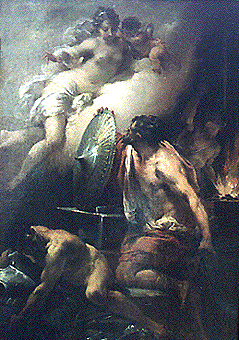
Hepheastus was the god of metalworking and fire. He was the son of Hera, being conceived on her own through an act of her will. She conceived him in this way in an effort to prove that she could bear the most beautiful child that the gods have ever seen. Hepheastus was conceived and born all in one day, and when Hera had given birth to him, she was disgusted by what she saw. She grabbed the baby and threw him off of the end of Olympus before any of the other gods saw him. He fell for an entire day, and landed on the shoreline, the force of impact shattering both of his legs. There he lay crying, unable to move, completely vulnerable. An ancient sea goddess Eurynome heard his cries, and went to the beach to see what it was. She was shocked to find a baby there all alone. Out of pity she picked the baby up in her arms, and brought him down to a secret grotto at the bottom of the sea. This became Hepheastus’ home, and anything that he ever wanted was provided to him by the goddess. He would make the most beautiful jewellery for Eurynome, and fashion weapons and armour of the type no being has ever seen before. For nine years he lived with Eurynome at the bottom of the sea, she was the only being he loved, and the only being that loved him in return.
One day Eurynome was invited to a festival of the gods on Mount Olympus. She begged Hepheastus to come along with her, but he adamantly refused. As a gift, he made Eurynome a brooch, one so beautiful that she actually began to weep, having never seen anything so wonderful. She wore it to the festival, knowing that she would be the envy of every goddess present. Sure enough, as she set foot into the Hall of the Gods, every goddess immediately fixed her eyes on the glorious pendant clasped at Eurynome’s neck. They all whispered throughout the course of the evening as to where Eurynome came across such a thing. Curiosity getting the better of her, Hera finally approached Eurynome by the end of the evening and asked her where she came by such a beautiful thing. She told Hera of the child that she had found by the water nine years before, and that he was constantly making her breath-taking jewellery among other things. Hera realised immediately that this was her son that Eurynome spoke of, and she demanded that he be returned to her to live on Mount Olympus. Eurynome knew that Hera’s only intention of having him there was for him to be able to make her whatever her heart desired, and that she would never love him as Eurynome did, but she had no choice by obey the Queen of the Gods. She accompanied Hepheastus to Mount Olympus where Hera greeted him with open arms. He was presented with a large mountain to use as a smithy, and the Cyclopses as attendants. Eurynome would constantly visit Hepheastus, and he continued to make her the most beautiful things, more beautiful than the things that he would make for Hera. On Olympus, he and the Cyclopses built a new Hall for the gods, and a throne was made for each of the twelve Olympians, suiting it to their particular office.
Hepheastus made himself a pair of braces for his legs so that he was able to get around the smithy. He also made two robots: one of solid silver, and one of solid gold. The tables in the smithy had rollers on them, and they would follow him wherever he went, or come to him when he called them. He also made a special gift for Aphrodite, and presented it to her on the night that the two of them were wed. It was a magical girdle that would magnify her beauty tenfold whenever she wore it. Every god would come to him at one time or another to ask favours of him, which he would gladly do, and ask nothing in return. The most beautiful chariots were fashioned for the gods, all of them made out of solid metal, but remained light as a feather.
