
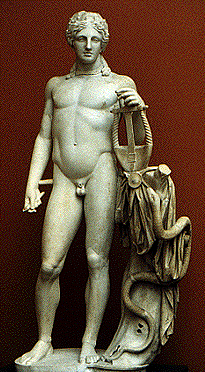
Apollo was the god of the Sun, and patron of poetry, music, prophecy, medicine, and light. He was the twin brother of Artemis, and the son of Zeus and Leto. When Leto had become pregnant with the twins, Hera had found out and was of course bent on ruining Leto. She cast a curse on Leto saying that she could not bear her children on any piece of land that the sun shone down on. To enforce this curse, Hera sent out Python, an enormous snake that could swallow anything that it came across. Python would follow Leto wherever she would go, never letting her rest. She soon grew heavy with her children inside of her, but she was unable to give birth due to Hera’s curse. Zeus took pity on Leto, and went to Poseidon for help. Poseidon raised a small island from the deepest part of the ocean that forever remained untouched by the sun, and sent it to Leto. This island was called Delos, and Leto gratefully collapsed, and began to give birth. She looked back, and saw Python swimming to the island. Poseidon saw this too, and summoned Eulus, the East wind, to blow the island gently across the water. Python soon lost track of the island, and Leto gave birth to two children; a boy that shone with a brilliant golden light and a daughter with cool silver light playing about her body like a lazy fog. Leto took her two children to Mount Olympus, and presented them t Zeus. Hera looked on the children with a look of the purest hatred, but she held her tongue so not to upset Zeus. He was very proud of his two beautiful children, and brought them into the pantheon.
By the time that Apollo had reached manhood, Leto had told him the story of Python and Hera’s curse. Apollo was given a golden bow, forged by the Cyclopses, and a golden chariot drawn by two golden lions. The arrows for the bow were kept in a quiver at his side, and that quiver would never empty. Whenever the arrows would strike their target, they would sear and burn with the heat of the sun. Apollo jumped into his chariot, and sped off to the Oracle of Mother Earth where Python was to be found. He found Python lying in the sun, with the Oracle sitting at its side. Pulling out his bow, he shot arrow after arrow into the enormous body of the serpent. Python roared with pain, as the arrows bit into its body, and began melting the flesh. In and attempt to escape, it slithered into a narrow cave where Apollo would not be able to follow, thinking itself safe. Apollo sped to the cave’s entrance, and drew two arrows. He breathed the breath of fury on the arrowheads, and fired them both into the cave. Upon impact, the arrows burst into flame, filling the cavern with smoke. Python had no choice but to come out of the cave, and when he did, he fell to the golden arrows. Gaia was furious at the death of her Python, and she immediately went to complain to Zeus. Zeus decreed that the Oracle that had once belonged to Mother Earth was to now be passed onto his son. Gaia was compensated for her loss, and she surrendered her Oracle to her great-grandson. From that point on, the Oracle became known as the Oracle of Delphi, and people would come from all over to seek the Oracle’s wisdom. This Oracle was in the form of a woman; she sat all alone in the temple on a little tripod. Whenever her counsel was sought, she would light a brazier filled with laurel leaves and spices, and go into a trance while breathing in the smoke. Then she would receive visions of the future, and be able to advise from what it was that she saw.
Apollo lived in a great palace on the eastern most point of the world. It was the Palace of the Sun, and this is where the Sun’s journey across the sky would begin every day. The Sun was a gleaming chariot, fashioned out of the purest gold and drawn by two horses as large as mountains. At the beginning of every day, Eos (The Goddess of Dawn) would dip her rosy fingers into a goblet of water, and sprinkle it all over the world, waking nature to behold to arrival of the sun. The doors to the palace would be opened, and the sun would begin its ascent into the sky, shedding its light and banishing the darkness.
Apollo had many children, most of which were mortal. One in particular was determined to meet his father, and he had a favour to ask. The boy’s name was Phaethon, and lived with his mother and seven sisters (called the Heliads) in a small village far to the east. One morning, Phaethon was having a chariot race with a friend of his, who had claimed on occasion to be a son of Zeus. “My father is Zeus!” cried the boy. “On my last visit to Mount Olympus, he had a small lightning bolt made for me, which I used to kill a vulture. On my next visit, he said I may get to use one of his!”
Phaethon believed every word that his friend had said, and was bitten by envy. “My father is none other than the great Apollo! I visit him quite often in his palace on the eastern horizon. He said that on my next visit, I would get to ride the chariot of the sun all on my own for an entire day!”
His friend laughed, mocking his every word. Furious, Phaethon knocked his friend from his chariot, and began to set off to his father’s palace in the east. “I’ll show him!” he thought. “I’ll show them all.”
Apollo sat on his throne, listening to the sweet music of the Muses before him. He was approached by Eos, and she said to him, “Lord Apollo, I have found a young boy in the forest at the base of the palace. He is your son, Phaethon. He lost his way in search for you, and now lies asleep, if you leave him there, he will surely die.” Apollo looked down to the boy sleeping in the forest, and realised that it was indeed his son. He sent down a servant of the palace on a flying carpet to bring the boy to him, he intended on finding out what this surprise visit was all about.
When Phaethon awoke, he found himself drifting effortlessly through the air. He was surrounded by thick white clouds, and could see nothing but the back of the man sitting on the carpet in front of him. He was just about to ask what was happening when the clouds parted and the Palace of the Sun loomed before him. It was the most magnificent thing he had ever seen! It seems to be made out of solid gold, which gleamed with its own light. The carpet landed on a shining parapet, and Phaethon was led into the throne room of Apollo. Upon entering the throne room, a brilliant golden light stabbed Phaethon’s eyes; everything around him seemed to be on fire. Squinting, he looked before him, and there sat Apollo, bathed with the brightest light that Phaethon had ever seen.
“Why have you come to my palace?” a voice boomed.
“Father, it is I, your son Phaethon! I have come to you to ask you of a favour!” “Ah yes, Phaethon. I do have fond memories of your mother. You are no doubt my son; your golden hair matches my own. You come seeking a favour? Ask, and whatever it is, I swear by the River Styx, an oath sacred to all of the gods, that I will grant it if it lies in my power.”
Phaethon’s face broke out into a smile, “I wish to drive the sun chariot across the sky on my own for one day.”
Apollo sat up in surprise, and looked into his son’s eyes, “No other being may drive that chariot! You are far too puny to handle the reigns of my horses! They are as large as mountains, and their breath is of the hottest fire. This task would mean your death!”
Phaethon hadn’t come this far to be talked out of what he had planned on doing. “You have sworn by the River Styx, Father, and must keep your promise!” Apollo sighed, “Yes, I must. The break of the dawn is near…come”
Apollo led Phaethon into the chamber where the chariot was kept. Eos was in the process of attaching the horses to the chariot, preparing them for their journey. Apollo applied an unguent to Phaethon’s body to protect him from the fiery breath of the horses, and tied the thick reigns around his waist. As the palace doors swung open, Apollo said, “You must keep the middle way; if you rise too high, the world will freeze, too low and it will burn. The middle way must be kept at all times throughout your journey. The horses know the path, just give them their heads and they will lead you safely to the west.” Apollo went to the horses, and spoke softly to them. They whinnied playfully, and began to nuzzle the god in the chest. Phaethon saw the fire of their breath dance over Apollo’s face, leaving him unharmed. The great palace doors swung open and the horses of the sun galloped off onto the horizon.
From that point high above the world, Phaethon could see everything; the oceans looked like small blots and the land masses like small pebbles. When he looked above, he could see the constellations spread across the sky, and all of the planets. He did what he came to do; he was driving the sun chariot across the sky. But how would his friend know that it was him? There was no way to prove that it was him riding so high up in the sky. Phaethon decided that he would just take one quick swoop over his village, and then resume the course that he was at. He pulled sharply on the reigns, commanding the horses to dive down. They whinnied in protest, and still continued on the path that they were accustomed to. He pulled again, and this time the horses dove, plummeting down to the world below. The wind howled through Phaethon’s ears, dampening his calls to the horses. He tugged on the reigns, screaming for the horses to go back up to their path. As the horses neared the earth, trees began to smoulder, fields burst into flames, and the rivers and lakes began to boil. The horses swooped down to the ground, and then sprang back up into the air. The rivers had long since dried up, and the naiads lay in the riverbeds moaning with pain. The entire world was on fire; rocks were melting, and people were dying. The horses continued on up into the sky; as they climbed up, the fires began to dwindle. Everything began to freeze; the sun was no bigger than a star from the world below. The planet was plunged into darkness, and snow began to fall. From high up on Mount Olympus, Zeus watched the sun chariot. When he saw that there was someone other than Apollo driving it, he immediately drew a lightning bolt, and flung it at the charioteer. The bolt hit Phaethon in the chest, and blasted him from the chariot. He fell through the sky, his body landed in a river nearby his village. Once the horses realised that there was no driver in the chariot, they continued on their journey to western point of the world. Phaethon’s mother and sisters gathered on the bank of the river where his body had landed, and began to weep. They all cried for days, never stopping to eat or sleep. Apollo looked down to them and felt that he was responsible for what had happened. He changed all of the women into willow trees, and to this day they continue to weep tears of amber for the loss of Phaethon.
The Muses were constant companions of Apollo. They were the daughters of Zeus and Mnemsone, the Titaness of Memory. There were nine of them, and each one was a patron of a form of art. They would sing the sweetest music for Apollo as he played his lyre. Their music drifted through the world in the form of the wind sighing, birds singing in the trees, and the waves of the sea gently lapping up on the shore. The Muses and Apollo would supply the music for the gods on Mount Olympus. Together, the ten of them created sounds only the immortals could comprehend, for mortal ears to hear this music would drive them insane.
