
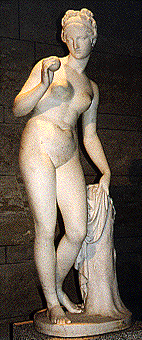
Aphrodite was the Goddess of love and beauty. She was beauty personified; no being, mortal or immortal, could resist her charms. She was born from the sea foam as Cronus flung the severed genitals of Uranus into the ocean. A giant scallop shell carried her to the island of Cyprus, where the Three Graces were waiting for her. The south wind, Notus, blew softly, guiding her journey to the island. When she set foot on the beach, sweet smelling flowers sprung up in a path behind her. There was a chariot waiting for her, drawn by white doves, ready to bear her to Mount Olympus.
Upon reaching Mount Olympus, the three Horae (The Seasons) opened the gates of heaven for her, and admitted her entrance. They were in awe of her beauty; every contour of her body and every move she made were perfect. She entered the Hall of the Gods clad in nothing but her thick mane of dripping yellow hair. All of the gods were silent as they marvelled at the goddess before them. Hera looked over to see Zeus’ eyes gleaming with desire, and whispered harshly in his ear, “You must marry her off at once, without delay!” Zeus agreed, and immediately began to consider a husband for her.
Apollo stepped forward, “I should be chosen for her husband! I could offer her the palace on the eastern most point of the world, and a crown made of the hottest sun-gold. She could rule over all things beautiful along with me. She shall be the Queen of the sweetest music, and most beautiful poetry; all beings will revere her as my wife.”
Poseidon cleared a path through the gods, and shouted, “She was born from the sea, therefore she belongs to me. I shall have a palace built for her in the deepest part of the ocean. The most precious treasures of the ocean’s depths shall be hers. She may ride the waves, and travel the world at her will.” He slammed the end of his trident onto the floor, and an enormous wave rose from the ocean, and stood in front of Mount Olympus. With a brief wave of his hand, Poseidon diminished the tidal wave, leaving only the slightest ripple on the ocean’s surface. The gods gasped in awe at his power, but Aphrodite merely giggled shyly into her dainty hands.
God after god stepped forward declaring why he thought that he should have Aphrodite as his wife. When it had appeared that every god had his say in the matter, Hera shoved Hepheastus into the centre of the throng, and whispered, “Speak fool! Say what I told you to say.” Hepheastus cleared his throat, and avoided the gaze of the radiant goddess standing before him, keeping his eyes to the floor. In a voice barely above a whisper, he said, “I would make a good husband…I work late.” Aphrodite threw her head back and laughed merrily. She knelt down before Hepheastus, and kissed him on the cheek. And so her husband was chosen, and the two of them were wed by Hera herself. As a wedding gift, Hepheastus fashioned a magical girdle for Aphrodite. While she wore it, her beauty was magnified tenfold, and there wasn’t a being that existed that could resist her power.
Aphrodite had many children, but the only one of the most notable was Eros, the god of love. It was believed that she had conceived him on her own through an act of her will. She had Hepheastus make him a bow, and a quiver of arrows that would never empty. With these arrows, he would fly invisibly throughout the land, and shoot them into the hearts of mortals. Whenever one was pierced with one of his arrows, he or she would fall in love with the next being that they set their eyes on.
Eros was a mischievous god, often being portrayed as a young child with a pair of feathery wings. There were times when he would use his powers of love to amuse himself. One case was in the story of Apollo and Daphne. Daphne was a beautiful river nymph, daughter of a river god. She was a huntress, singing the praises of Artemis. She vowed to always remain a virgin, and keep to the forest just as the goddess she worshipped. Eros was flying through the forest, when he came across Daphne hunting not too far off. Across the clearing from her was the radiant Apollo, golden light playing about his body like a lingering mist. Eros notched an arrow in his bow, aimed it at Apollo, and let the arrow fly. The aim was true, the arrow embedded itself deep within the heart of the god. The sweet poison of love flowed through Apollo’s body as he set his eyes on the beautiful Daphne, crouching behind a tree in pursuit of her prey. He began to run across the clearing to Daphne; his long legs carrying him faster than any mortal could run. Daphne heard a noise, and whirled around to see the shining god running her way with his arms wide open as if to embrace her. She broke into a full sprint, running as fast as she could through the winding paths. She could feel Apollo’s breath burning on the back of her neck, as her hair whipped out behind her. When her father’s river was within sight, she cried out to him to save her from Apollo. Right as her feet touched the sands of the river’s bank, roots broke out of the bottoms of her feet, and burrowed deep within the earth. The soft white skin of her body turned a dull brown and scaled up into the rough bark of a tree. Her arms extended into branches, and her hair became the leaves. Apollo lunged at her, and found himself embracing a laurel tree. He mourned for the loss of his love, and to commemorate her, he plucked leaves from the tree, and made himself a wreath of laurel leaves, which he wore on his head. Eros sat and watched the whole thing, laughing all the time.
Aphrodite was very conscious of her beauty, and used it to her complete advantage. She could have anything she wanted all she had to do was go to the right god and work her magic. The Goddesses were all envious of her beauty, none more than Hera and Athena. The two Goddesses thought that they were more beautiful than Aphrodite, and did everything that they could to improve their appearance in order to come some where near to her perfection. At the wedding of the ancient sea Goddess Thetis, to the mortal king Peleus, Eris (the Goddess of discord) arrived at the wedding with a golden apple from Hera’s tree. Engraved upon the apple were the words, “To the fairest Goddess”. She then threw the apple into the crowd of deities, and sat back to watch. As the apple rolled into the throng, Hera, Athena and Aphrodite immediately reached for it, each one thinking herself to be the most beautiful. When the conflict became obvious, they decided that the only was this was going to be solved was to hold a contest of beauty. The Prince of Troy, Paris, was chosen for this task. The three Goddesses stood before him, and he was to choose the most beautiful and present her with the apple. There was no denying their beauty, to him, each one of them possessed beauty beyond anything he could ever imagine. As he was trying to decide, a soft female voice broke out in his thoughts. He knew that this was Hera. “If you chose me, I shall make you the richest man in the world”. Before he had a chance to respond, another voice came in, this time it was Athena. “If you chose me as the most beautiful goddess, you shall have wisdom beyond your wildest dreams! With my gift, you could go on to rule the world.” He found this offer intriguing, but then the third goddess’ voice rang like the tinkling of a thousand silver bells through his thoughts. “If you chose me, the most beautiful woman alive shall be your wife. You will love her, and she will love you in return, and be forever faithful to you.” This was the offer that Paris wanted, and he immediately awarded the apple to Aphrodite. She kept her word, and told him of the most beautiful woman alive. Her name was Helen (daughter of Zeus and the mortal Leda), and she was the Queen of Sparta, the only thing was is that she already had a husband. Aphrodite planted the seed of love within her heart, and Paris abducted her, carrying her off to his kingdom in Troy. This offence to the Spartan king is what ended up triggering the Trojan War, a war branding itself in history.
Despite the sacred vows that Aphrodite made to Hepheastus, she was unfaithful to him. She spent a lot of her time with the god Ares (God of War, child of Zeus and Hera). They would meet away from prying eyes, and lay together every night. Even though Ares was by far the most savage of the gods, he possessed a form of beauty that Aphrodite found intriguing, and she sought to have it to herself. Hepheastus had suspicions of Aphrodite’s wandering eyes, and these suspicions were later confirmed. He went to his forge, and fashioned a net with strands as thin as a spider’s web, but as tensile as the strongest steel forged by god or man. He took this net, and placed it over Aphrodite’s bed. When she would lie in the bed with another person other than himself, the net would fall and ensnare the two lovers. A few days after setting the trap, Hepheastus returned to see Aphrodite and Ares trapped beneath his net. Rather than flying into a blind rage, he summoned all of the other gods to witness his wife’s unfaithfulness. All of the gods gathered and mocked Aphrodite and Ares for what they have been doing, none mocked more than Hera did. From that day on, Hera and Aphrodite would rarely speak or associate with each other in any way. Hera was the goddess of the vows exchanged when two people are wed, and Aphrodite was the wild, untamed passion of beauty and love, not to be bound by any vow. She continued on living the way that she did with Hepheastus as her husband. He still loved her, even though she continually broke the wedding vows the two of them exchanged. He really didn’t expect anything less when he married her, after all, she was the most beautiful thing to have ever existed in the universe, how could he expect for that to belong solely to him? From the union of Aphrodite and Ares came Harmonia. She was a mixture of her mother’s perfect beauty, and her father’s ferocity. Her name means ‘harmony’, that being the balance between law and chaos.
