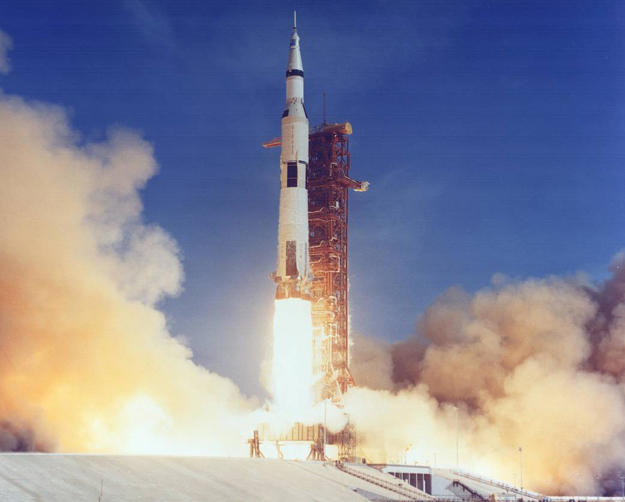
The Space Age was hardly a decade old when NASA decided to take a giant leap forward by sending American astronauts to explore the surface of the Moon. To achieve this great feat, they built a powerful heavy-lift launch vehicle named Saturn V.
In September 1945, the U.S. government brought the German rocket technologist Wernher von Braun and over 1,500 German rocket engineers and technicians to the United States in Operation Paperclip, a program authorized by President Truman. In 1960, von Braun and his group were assimilated into the National Aeronautics and Space Administration (NASA), where von Braun served as director of the newly formed Marshall Space Flight Center located in Huntsville, Alabama. He was the chief architect of the Saturn V super heavy-lift launch vehicle that propelled the Apollo spacecraft to the Moon
The 363-feet-tall and 2.8 million kilograms heavy Saturn V was primarily built using aluminum along with titanium, polyurethane, cork, and asbestos. It could carry a weight of 130 tons into the Earth’s orbit and about 50 tons to the Moon. The Saturn V used for the Apollo missions comprised three stages using outside contractors: S-IC (Boeing), S-II (North American Aviation), S-IVB (Douglas Aircraft) and an instrument unit (IBM).
Each stage would burn its engines until it ran out of fuel and then separate itself from the rocket causing the engines on the next stage to fire. The same process would repeat for the next two stages as the rocket made its way into space and the separated pieces fell into the ocean. The first stage used the most fuel and had the most powerful engines because it had to get the rocket off the ground and to an altitude of 42 miles while the second stage prepared to launch it into orbit. The third stage would place the spacecraft into the orbit of the Earth and push it towards the Moon.
The instrument unit was used to measure the acceleration and vehicle attitude to calculate the velocity and position of Saturn V and rectify any deviations. However, the Saturn V rocket that was used to launch Skylab into space consisted of only two stages instead of three. The S-II stage was changed to a terminal one to launch Skylab and prevent the first stage from rupturing in orbit.
The first Saturn V rocket to be launched into space in 1967 was called Apollo 4 and then came Apollo 6 in 1968. Over the course of the year, the astronauts, crew, and the 400,000 people involved in building the rocket did several test missions before finally launching Apollo 11 from Cape Canaveral in 1969, which landed astronauts on the Moon making the US the first and only country to have done so.
The Saturn V rockets also carried astronauts and landed them on the Moon during the Apollo 12, 14, 15, 16, and 17 missions that were launched between 1969 and 1972. The Apollo 13 mission lifted the astronauts into space but couldn’t land them on the Moon due to a problem with the spacecraft. In 1973, Saturn V was used for the last time to launch Skylab, the US’ first space station, into Earth’s orbit. All the launches blasted off from Launch Complex 39 at the Kennedy Space Center in Florida.
Facts and General Characteristics of the Saturn V Rocket:
Name: Named after the sixth planet from the sun.
Manufacture Contracts: Boeing, North American Aviation, Douglas Aircraft, IBM, and Rocketdyne
Crew: 3
Project Cost: US$6.417 billion
Cost Per Launch: US$185 million
Height: 363 ft. (111 m)
Diameter: 33 Ft. (10 m)
Mass: 6,221,000 to 6,537,000 lbs. (2,822,000 to 2,965,000 kg)
First Stage (S-IC)
Height: 138 ft. (42 m)
Diameter: 33 Ft. (10 m)
Power 5 X F1 engines
Propellant: LOX / RP-1
Maximum Thrust: 263 s (2,58 km /s) sea level
Burn Time: 168 seconds
Second Stage (S-II)
Height: 81.5 ft. (24.8 m)
Diameter: 33 ft. (10 m)
Power: 5 X J-2 Engines
Propellant: LOX / LH2
Maximum Thrust: 1,155,800 lbf (5,141 kN) vacuum
Burn Time: 360 seconds
Third Stage (S-IV-B)
Height: 58.3 ft. (17.8 m)
Diameter: 21.7 ft. (6.6 m)
Power: 1 X J-2 engine
Propellant: LOX / LH2
Maximum Thrust: 232,250 lbf (1,033.1 kN) vacuum
Burn Time: 165 + 335 seconds (2 burns)
Facts and General Characteristics of the Model:
The model configuration and paint scheme represent the Saturn V rocket used for the Apollo 11 moon mission. It includes the service, command and lunar modules. All stages can be unlocked and separated. The lunar orbiter and lander modules are stored inside the third stage and can be removed after opening the doors.
Manufacturer: Revell AG Germany
Scale: 1/144
Parts: 82
Decals: 52
Height: 30.3 inches
Width: 3.25 inches
Hours to build and paint: 20.3
Problems/Mistakes: It was difficult to mask and paint this model. Because of the corrugated surface areas, the paint would run under the masking tape. I had to repaint and touch up several areas.
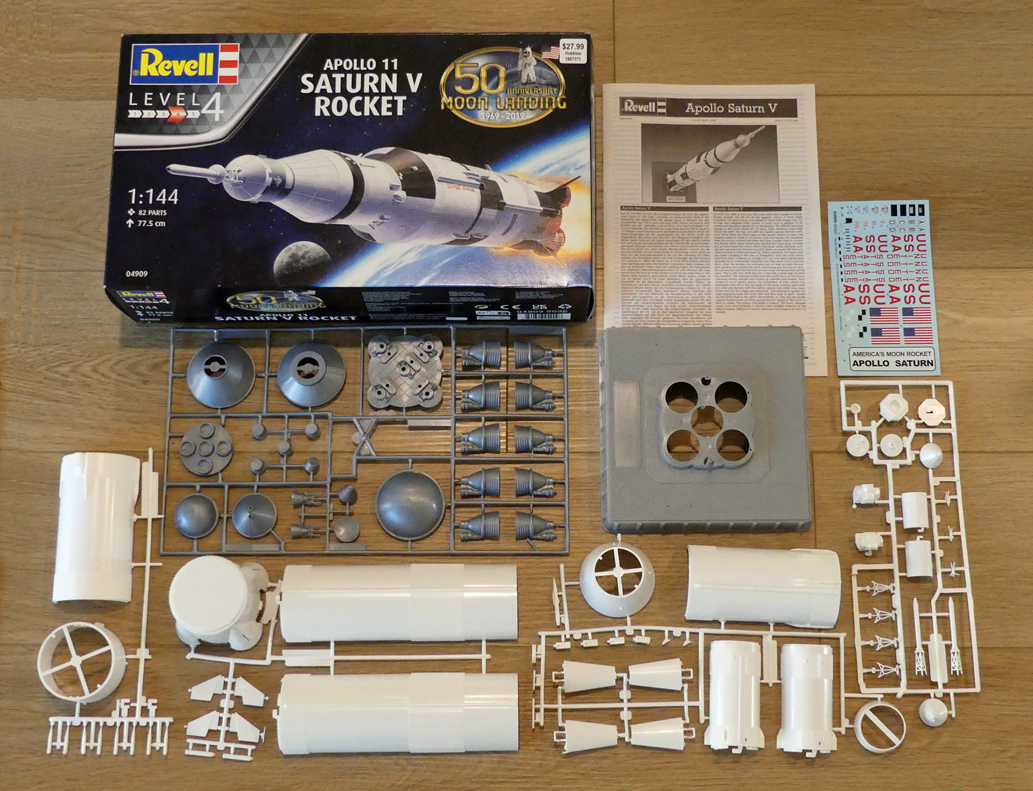

First stage masked and ready for black paint.
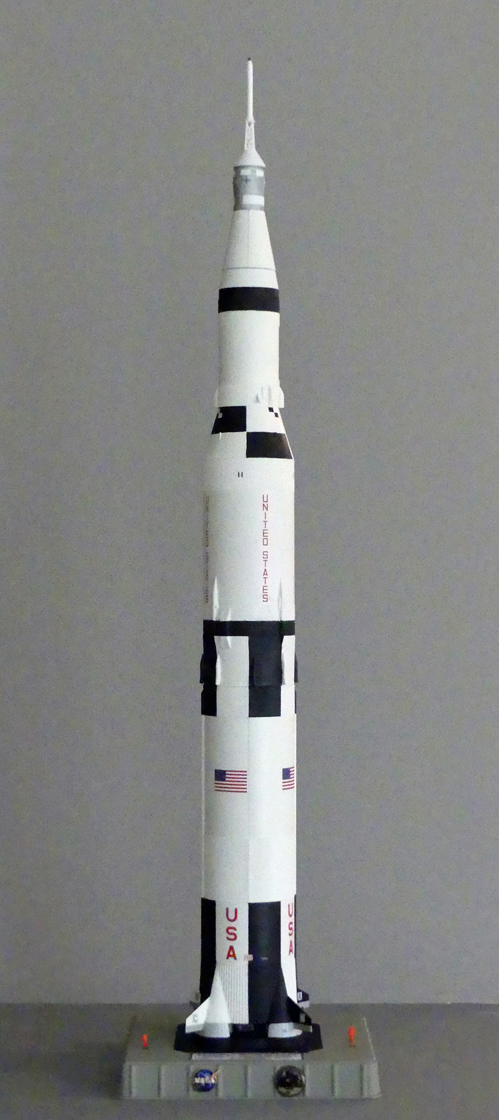


I made the label on my computer and added the logos which are actually lapel pins.
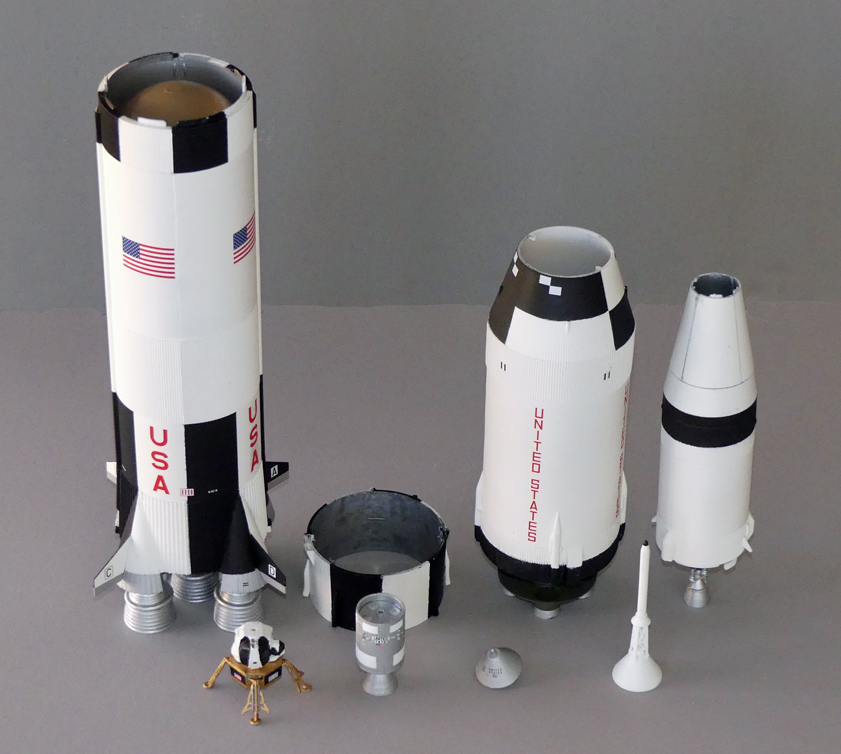
Stages, Lunar, Service and Command Modules and Launch Escape System.

Stages, Lunar, Service and Command Modules and Launch Escape System.
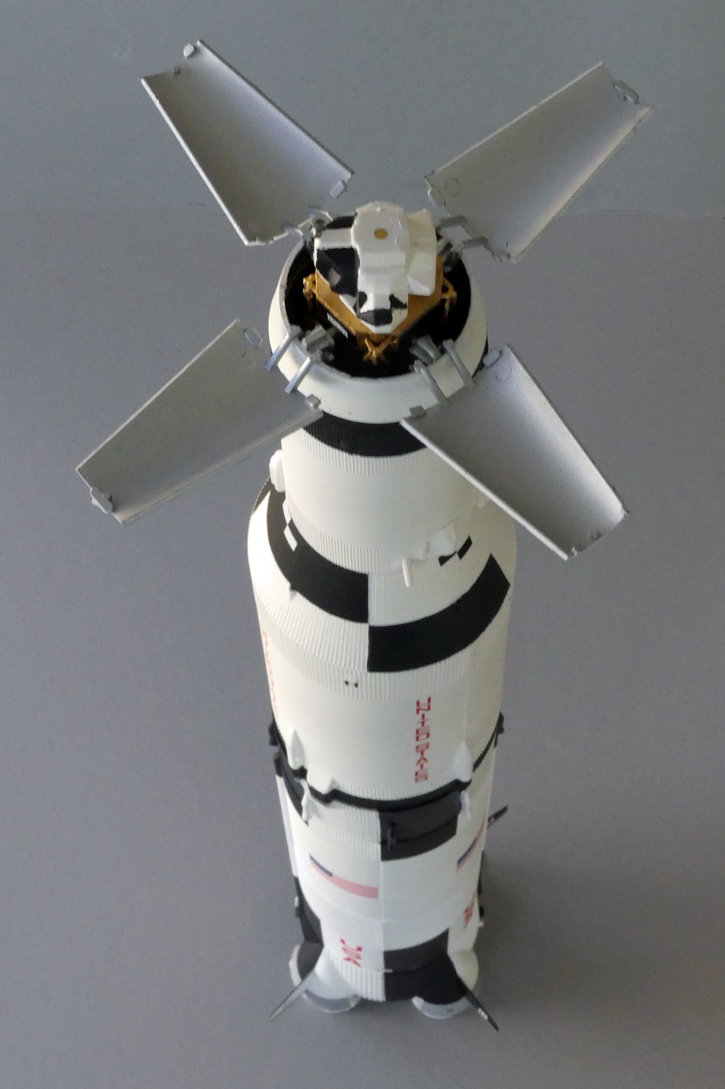
Lunar Module stowed for launch.

Command and Service Modules docked with the Lunar Module.

Saturn V Rocket with the Space Shuttle Atlantis (same scale: 1/144).