
Project Mercury
Name: Chosen from classical mythology
Mission Series: MR for "Mercury-Redstone" (suborbital flights), and MA for "Mercury-Atlas" (orbital flights)
Duration: 1958-1963
Flights: 6 crewed
Cost: $277 million (1965), $2.76 billion (adjusted for inflation)
Mercury Crew Capsule
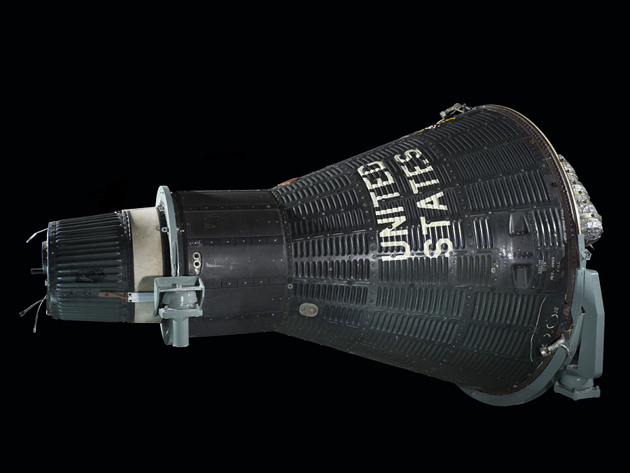
The bell-shaped Mercury capsule was built by McDonnell Aircraft Corp. for launch by either a Redstone or an Atlas booster. Its basic design was proposed by Maxime Faget of NACA (National Advisory Committee for Aeronautics) Langley in Dec. 1957. The pressurized cabin, with an internal volume about the same as that of a telephone booth, was made of titanium, while the capsule's outer shell consisted of a nickel alloy. Around the base, a fiberglass-reinforced laminated plastic heat-shield was designed to ablate during reentry then detach and drop about a meter to form the bottom of a pneumatic cushion to help soften the impact at splashdown. Attitude control in all three axes was achieved by 18 small thrusters linked to a controller operated by the astronaut's right hand.
Three, solid-fueled retrorockets, held at the center of the heat-shield by metal straps, were fired in quick succession to de-orbit then jettisoned. Above the cabin was a cylindrical section containing the main and reserve parachutes. Atop the whole capsule at launch was a latticework tower supporting a solid-rocket escape motor with three canted nozzles which could carry the spacecraft sufficiently clear of the booster in an emergency for the capsule's parachute to be deployed. Inside the cabin was a couch, tailor-made for each astronaut, facing the control panel. Early capsules had two small round portholes, but following complaints from the astronauts about poor visibility, a larger rectangular window was installed on later versions. A retractable periscope was also provided. The capsule was filled with pure oxygen at about one-third atmospheric pressure and the astronaut usually kept his helmet visor open. Only if the cabin pressure fell would he need to lower his visor and switch to his spacesuit's independent oxygen supply.
Facts and General Characteristics of the Mercury Crew Capsule:
Manufacture: McDonnell Aircraft Corp. St. Louis, Missouri, USA
Crew: 1
Height: 9.54 ft. (2.9 m) excluding escape tower
Diameter: 6.2 ft. (1.88 m)
Weight: approximately 2,500 to 3,000 lbs. (1,134 to 1,361 kg)
Project Gemini
Name: Named after the constellation
Mission Series: GT for "Gemini-Titan"
Duration: 1961-1966
Flights: 12 (2 uncrewed, 10 crewed)
Cost: $1.3 billion (1967), $9.1 billion (2023)
Gemini Crew Capsule
In 1961, NASA selected McDonnell Aircraft, which was the prime contractor for the Project Mercury capsule, to build the Gemini capsule, the first of which was delivered in 1963. All Gemini missions used the Titan II GLV, a modified intercontinental ballistic missile as their launch vehicle.
The Gemini crew capsule (referred to as the Reentry Module) was essentially an enlarged version of the Mercury capsule. Unlike Mercury, the retrorockets, electrical power, propulsion systems, oxygen, and water were located in a detachable Adapter Module behind the Reentry Module which would burn up on reentry. A major design improvement in Gemini was to locate all internal spacecraft systems in modular components, which could be independently tested and replaced when necessary, without removing or disturbing other already tested components. Reentry Module
Many components in the capsule itself were accessible through their respective small access doors. Unlike Mercury, Gemini used completely solid-state electronics, and its modular design made it easy to repair. Gemini's emergency launch escape system did not use an escape tower powered by a solid-fuel rocket, but instead used aircraft-style ejection seats. The tower was heavy and complicated, and NASA engineers reasoned that they could do away with it as the Titan II's hypergolic propellants would burn immediately on contact. A Titan II booster explosion had a smaller blast effect and flame than on the cryogenically fueled Atlas and Saturn. Ejection seats were sufficient to separate the astronauts from a malfunctioning launch vehicle. At higher altitudes, where the ejection seats could not be used, the astronauts would return to Earth inside the spacecraft, which would separate from the launch vehicle.
The original intention for Gemini was to land on solid ground instead of at sea, using a Rogallo wing rather than a parachute and three retractable skids, with the crew seated upright controlling the forward motion of the craft. This design was ultimately dropped, and parachutes were used to make a sea landing as in Mercury.
Retro Module
The Retro module contained four solid-fuel TE-M-385 Star-13E retrorockets, each spherical in shape except for its rocket nozzle, which were structurally attached to two beams that reached across the diameter of the retro module, crossing at right angles in the center. Re-entry began with the retrorockets firing one at a time. Abort procedures at certain periods during lift-off would cause them to fire at the same time, thrusting the Descent module away from the Titan rocket.
Equipment Module
Gemini was equipped with an Orbit Attitude and Maneuvering System (OAMS), containing sixteen thrusters for translation control in all three perpendicular axes (forward/backward, left/right, up/down), in addition to attitude control (pitch, yaw, and roll angle orientation) as in Mercury. Translation control allowed changing orbital inclination and altitude, necessary to perform space rendezvous with other craft, and docking with the Agena Target Vehicle (ATV), with its own rocket engine which could be used to perform greater orbit changes. Early short-duration missions had their electrical power supplied by batteries; later endurance missions used the first fuel cells in crewed spacecraft.
Facts and General Characteristics of the Gemini Crew Capsule:
Manufacture: McDonnell Aircraft Corp. St. Louis, Missouri, USA
Crew: 2
Height (all modules): 18.5 ft. (5.6 m)
Diameter: 10 ft. (3 m)
Launch Weight: 7,100 to 8,350 pounds (3,220 to 3,790 kg)
Facts and General Characteristics of Models:
Mercury Capsule
The kit was made in 1964 and while the box was unsealed, all parts, decals and window plastic were all sealed in a bag. Included were decals for all six crewed Mercury capsules. I chose to have this model represent Mission MR-3, America’s first manned space flight piloted by Alan Shepard in Freedom 7 on May 5, 1961. It was a sub-orbital flight lasing 15 minutes, 28 seconds.
Manufacturer: Revell, Inc. Venice, California, USA
Scale: 1/48
Parts: 49
Decals: 5
Height including Escape Tower: 6.5 in.
Width: 1.6 in.
Hours to build and paint: 7
Problems/Mistakes:
1. I lost the tiny cross braces and could not trim several of the diagonal supports for the escape tower without breaking them, so I had to manufacture replacements using wire.
2. The clear parts of the decals were yellow from age but did not look too bad after application.
Gemini Capsule
There were no name decals for this model as NASA chose to stop naming Gemini capsules after Gemini 3. I chose this model to represent Mission GT-7 (Gemini VII) crewed by Frank Borman and Jim Lovell on December 4-18, 1965. This was the fourth crewed Gemini mission and completed 206 orbits during its 13 day, 18 hour, 35 minute flight. When the original Gemini VI mission was scrubbed because the launch of the Agena docking target failed, Gemini VII was used as the rendezvous target instead. The primary objective was to determine whether humans could live in space for 14 days.
The model came with the option of adding the three retractable landing skids but since NASA decided not to use this landing option, I did not include the skids.
Manufacturer: Revell, Inc. Venice, California, USA
Scale: 1/48
Parts: 74
Decals: 2
Height (all modules): 4.75 in.
Width: 2.5 in.
Hours to build and paint: 9
Base
The base is made of wood. The NASA and mission logos are lapel pins.


Mercury: Alan Shepard.
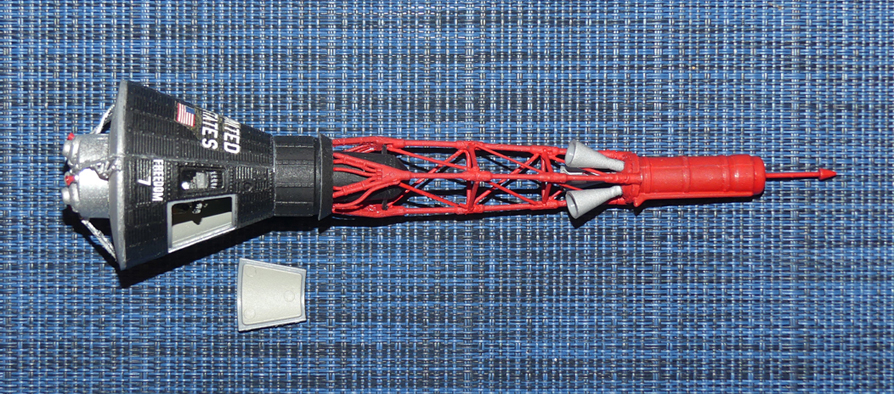
Mercury Capsule including Escape Tower.

Gemini: Jim Lovell and Frank Borman.

Gemini: Retro and Equipment Modules.

Gemini: Equipment, Retro and Reentry Modules.

Gemini: Reentry Module.
