There has been a fair amount of cybermaterial circulating about the lack
of netrality or bias in reviews. The internet has broken down age, race,
and previous experience categories for those who wish to put down their
feelings (sometimes expletive) about inanimate objects. Fetish anyone?
Sometimes, thhe most interesting/entertaining part of a web page are
sections/links I find called About Me. Some are classic reads:
- ATI: Ahh...oh, I see....
- 3Dfx: 61 fps...61fps...61fps....
- ATI: ..and most of these cards go up to 60fps....
- 3Dfx: Exactly.
- ATI: Does that mean it's...faster? Is it any faster?
- 3Dfx: Well, it's one faster, isn't it? It's not 60fps. You see,
most...most blokes, you know, will be playing at 60fps.
You're on 60fps here...all the way up...all the way up....
- ATI: Yeah....
- 3Dfx: ...all the way up. You're on 60fps on Quake...where
can you go from there? Where?
- ATI: I don't know....
- 3Dfx: Nowhere. Exactly. What we do is if we need that extra.
.
push over the cliff...you know what we do?
- ATI: Put it up to 61fps.
- 3Dfx: 61fps . Exactly. One faster.
- ATI: Why don't you just run the card at 100Mhz and
make it perform like a card clocked at 125 Mhz
and add other useful features ?
- 3Dfx: (after taking a few moments to let this comment sink in) These go to 61 fps and 125 Mhz.
Again, sorry about the mud slinging at 3Dfx but I couldnt resist.
Rent This is Spinal Tap soon at a video store near you.
- Jan 17, 1999
Some Quotes from the two latest ATI Rage Fury reviews:
"...The good part of the Rage128 Fury is certainly that here is finally a video card that runs on a Super Socket
7 platform without problems..."
"...the Fury generates the least amount of
heat of any card that I have tested so far..."
"The interesting aspect of this is that basically all 3D tasks
as e.g. ray tracing, texture and environment mapping show phenomenal details and visual quality. At this
point it actually looks more like the software developers at ATI concentrated more on the difficult features..."
"...the Rage 128 is also better
with much sharper 2D images at high resolutions and also
hardware DVD decoding..."
" In the Unreal benchmarks, there is no question who the
big winner is. The Rage 128 beats out the TNT by a large
margin in every "timedemo" benchmark, especially when
rendering in 32-bit color"
"...Finally, a non-V2 SLI solution
that you can get decent framerates in Unreal! Even with a
relatively weak CPU like the Celeron 300A, rendering in
32-bit color at a 1024x768 resolution with all effects
turned on, the Rage 128 is still able to muster 15fps!"
Some questions have arisen about the need for a reboot to run certain
applications. There is an explanation that has to do with WHQL approval
and of the driver. The boot utility was basically a workaround so that
the candidate WHQL approved driver could be used in previews without
violating MS requirements such as leaving VSYNC on (i.e. One requirement
is that card vendors must not provide a means to disable it in the
standard driver).
-
The latest Rage 128 Fury review to appear at
Hardware Central.
Most of the tessting focussed on how Rage Fury performs with Slot-1 systems
sporting the popular Celeron 300A
processors rather than P2-450 units which are proving to be a popular choice
for "green" PC systems. The performance gap between competing TNT running
UnReal is significant. For those more interested in Super7 results of
the Rage Fury
performance can go to the
Lost Circuits review which used both a Super7 system
and a Abit BH6 system that I think was defective as most other
sites had no problems with this very same mainboard. Very sharp image quality
under 2D applications such as word processing and
spread sheet software as compared to TNT. The Rage Fury card used in
conjunction with
high end monitors from Apple, Viewsonic and Nokia show very good image quality
at 1600x1200 and 1920x1200 modes.
-
Here is a post on the straight goods on some z-buffering from someone who helped design the code
for Final Reality and the 3dMark99 Demo/Benchmarks on the
issue of z-buffer settings. I hope it clears up some of the uninformed
comments on the web posted recently. I am at a lost at statements by well known
Hardware celebrities using "National Enquirer" like tactics of vague
and general statements on
z-buffering
for ends I still cannot figure out.
In "enquirer-like"
fashion...do not expect to see retractions. The FPS ATI forum is unique
in being the defacto watering/gathering hole. How ?
- being first...it helps :)
- being even...no flame posting policy ...pure flames are removed
- being fair...a webmaster with original insightful articles
who reads and responds in his own forum
- being balanced...this means being non commercial and laughing out loud
sometimes in this insane industry...it is the quiet ones that you have to
beware of. Conflict of interest abounds in this unregulated industry.
- being accessible...Gordon and PeAK must necessarily
tread a fairly fine line that is
bordered by you, ATI, and competitors. The opinions are our own
and are primarily for clarification of misinformation and are
unofficial. We have no capacity at the marketing level or any
involvement with company direction. Detailed information
with regard to company policy and strategy cannot be made or must
be available publicly by ATI beforehand or else we face the consequences.
Hopefully we can be ourselves and comment on the Clinton administration
as we see fit. Comments welcome.
So, when you decide where to source your information, looked to
pages with similar characteristics to Alan's which are in turn similar
to those of well repsected magazines such as TIME and PC Magazine.
Be wary of individuals who consistently publish in the absense
of of editorial feedback or who do not publish retractions on misinformed
information.
"Debate is a two way street requiring open ears and a willingness to
engage if the truth is what you are after"....Fox Mulder
Date: Tue Jan 19'99 - 12:10am
Author: Gordon Grigor
Subject: Tom's got it half right, or half wrong.
, in response to Possible explanation for Rage 128 32bit performance??, posted by Rodger on Mon Jan 18'99 - 5:13pm
Tom's got it half right, or half wrong.
I always forget that one .... is the cup half empty, or help full?
Tom is correct that some games like GLQuake2 are only using a 16bit Z buffer when rendering to a 32bit color depth. What Tom
neglected to mention, is that the game dictates the depth of the Z buffer, just as it selects the color depth.
Quake2 was designed for a software rasterizer, so low precision Z was designed into the models and geometry. Using a 32bit Z
buffer adds nothing to the quality while increasing required bandwidth, hence reducing performance.
In short, the Rage128 supports 16bit, 24bit, 32bit, and 24bit + 8bit stencil, Z buffers with either 16bit or 32bit rendering for
maximum flexibility in applications / games.
Gordon
-
Pared this page to about 40K today by archiving the December news.
I spent some quality time with my new modem on the weekend and finally
got the unit to flash the message "CONNECT 115200/LAP-M".
Some modems are created more equal than others and this one happened to
break with my old PPP dialup scripts due to the lack of a buffer to
queue up the "AT" commands. I know more about modem profiles,
init strings
and register settings than I thought possible. Most people take
these things for granted, but I found a piece of hardware that is an
amazing piece of engineering for $39 ($27 US) in the form of
the discontinued Motorola
MODEMSURFR.
The mechanical design and aesthetics are very good: no screws in the
manufacture with state of the art AT&T chips.
I will be creating a page covering the lowly modem due to the
dearth (not plethora) of information on the complex and wonderful
design of a v.34 modem. Why did I not buy a 56K modem ? Check out
some of my rules of thumb for
upgrading
in a cost effective manner. The new provides a "3x" increase in speed
which is slightly under my "4X" point but with Web downloads
averaging about 1 minute for a 60K page using a 10K modem,
I found the reduction to 20 seconds just incredible.
Note: Using a program such as TELIX or PROCOMM, type AT&V and save the
output to a file. You will be glad you did one day.
- I was curious about Progressive JPEG images that
use a concept similar to interlaced TV display whereby images are
refined by repeated passes. I find that the 3 swipe of 5 is often good
enough in quality to end the image download. Not much information yet
other than the fact that the fact that it was fully supported under
Netscape 3.0 and has yet to coded in correctly in IE 5.0.
There is an excellent source of information on odds and ends about
anything at http://www.faqs.org where one can find
a good bit of information about JPEG FAQs
- Jan 16, 1999
Some recents posts/quotes on the Rage 128:
- Mark Rein of UnReal: ....I've been working with the Rage 128 today. It's impressive. In 24-bit color, it's faster than the TNT. In 16-bit color, it's a bit slower. This
is the nicest announced card yet for 24-bit rendering. The feature set seems to be quite complete, including multi-texture and
stencil-buffering. The colors also seem *very* vibrant...I don't know what the technical explanation for this is, but the 24-bit image quality is
excellent.
- Brian Hook of ID: ....the Rage128 is looking to be
an outstanding part...it should
turn out to be a great Quake3 accelerator.
-
Click here if you want to see an updated shot of my computer running three different games of DOOM, Quake,
and Netscape all at the same time.
I shovelled my dad's 80 foot driveway sandwiched between two brick houses.
It was great to be outside in the sun shovelling the powdery white stuff
for 3 hours. Clears the mind...does wonders for your wrist shot...soothes
the soul for my next post.
-
Rage Dawning is a insanely great 3D Demo
authored by the Demo division of Futuremark Corporation.
The demo is designed expressly to show off all the 3D features
of the Rage 128 chipset. The animations are
liquied smooth, detailed and have that "you are there" realism.
3D has always been about more realism or better
visual realsim in spite of the clamouring of framerate bean counters.
A brilliant menu design encompasses the educational mode implemented by
splitting the examples of 3D functions into the following
5 categories:
- Texture Mapping: trilinear, billinear filter+mipmaapping, spot modes
- Fog: none, linear, and exponential
- Material Demo: normal, reflective, bump mapping, etc
- Shading: Flat, Gourad, Specular Gourad, etc
- Transparency: ...to be updated...5 different modes
The navigation menu is similar to that of a TV remote control using only
the up/down/left/right keys to select(left/right) any option within each of
the 5 different categories (up/down). You can see exactly what these different features do instead of just
reading about them in a specification sheet. In terms of the education
brownie points, this program scores a perfect "10". Menu design likewise
is excellent.
Final Reality in comparison to Dawning would score well as
a Benchmark and Demo with the lack of control limiting its
education value. You can only get so much out of watching a Demo
over and over and over. The Demo accompanying "Rage Dawining"
is visually stunning in quality. "Skywalker"
chase scenes through extremely natural looking
canyons(Grand Canyon anyone ?),
A dense tropical jungle provides a severe test for the jaggies followed
by a beatiful rendering of water falling down and
misting. The
demo clearly shows the breathtaking clarity of 32-bit resolution.
In like manner to the insignificant dropoff in performance between
16-bit to 32-bit resolution depths, there is no evident slowdown/performance hit as features were are turned on.
(I recall seeing this magic carpet effect for the first time
with DOOM on a Pentium compared to a 486 system. The 486 ran as fast
by dropping frames to maintain speed).
Bear with me as I...put on my ATI hat...compared to other 4th
generation video chipsets, the Rage 128 removes the inherent tradeoff
of quality vs performance when running 4th generation Demos such as
Rage Dawning. I really think this chipset/card will
have legs for some time due to
the combination of a well thought out and pratical feature set and
combined BIOS/driver software upgradability.
Beyond the bleeding edge hardware, comes continuous evolution and
support of existing chipsets like the Rage Pro. When the Rage Pro
was first introduced, the
glut of original features
exceeded the capability of Win95 software technology in the areas
of AGP support, advance mutlitexturing capability, TV-out and DVD support.
Lately, two new
drivers were introduced last month as part of ATI's two tiered
release program. The other tier consists of slowly evolved WHQL approved RELEASE
drivers
tested on a wide variety of platforms with the emphasis being on
stable operation.
This reflects ATI's
commitment to simultaneously optimizing drivers with major game
developers via joint driver/game code development and to put these
results in the End users hands. Hand in hand with these changes are
requisite changes to the Microsoft portion of the OpenGL driver.
The official support of this code by MS and SGI fully describe the
key contributions from each of these three groups to ensure robust,
stable and error free operation of games running under Win95.
Epic's Mark Rein stated that they will
finally began focussing formal efforts to learn OpenGL and to target game
code for better performance of Unreal on the Rage Pro.
He makes several interesting comments about the advantages of taking over the
OpenGL code base instead of subcontracting it out. He had this to say about the
Rage 128:
"The Rage128 card is especially exciting because not only will it be
a speed king on PC-based system "
Overerclocked Rage Pro chips are posting fairly decent
3Dmark99 score of about 1200-1300 in the default resolution.
Other competing products may come in later,
but ATI's hardware/software
experience with multimedia, TV-out, TV-in and OpenGL and continuous driver
developement with existing Rage Pro based products are things to keep in mind
when deciding on your next video card.
The early announcements of overclocked 0.35um designs ported to
0.25um with "me too" like Rage 128 feature claims need to be taken with
a grain of salt. Recall that the first Rage 128 silicon came back
at
the end of July. When John Carmack said "The Rage 128
is visually perfect" at MacWorld it was a very 3D centric statement but
indicative of the quality of one aspect of the Rage 128 design.
When the X11 GUI drivers for Linux are released,
I will summarize the board compatability of the Rage 128 on
different Super 7/Socket 7/Slot-1 systems.
-
What's in a name? The Rage Fury is ATI's official retail product
for users looking towards the traditional upgrade path offered by motherboard
slots. The official byline from ATI on availability is:
The RAGE FURY won't be shipping until February/March '99 timeframe with volume shipments not until March/April 1999. We do
however expect product shortages and backorders due to high demand.
Depending on whether or not you got your "Furby" this year, this could mean
many things. Here is my personal best case interpretation:
- January: Some limited availabiility might exist but trying the slots
in Las Vegas may offer better odds
- February: Significant penetration into the retail market could happen as
early as this date.
- March: If all goes according to plan, then these cards will be as
shipping in volume but may suffer from the "Furby" symptom found two weeks
prior Xmas.
What to do in the meantime? Pick up a Rage Pro to run on a second bare
bones computer tethered to the main unit by a network card. The bare unit
will serve as terminal which uses
the disk drive, modem, printer on the main unit. Once setup on Linux, you can
have two (or more) Netscape sessions running off one modem. This means sharing
some of your 6 BG hard disk space across your house and family. Network in
a burgular/fire alarm while you are at it so that it wakes up your main
unit from "SUSPEND" mode. The possibilities are endless.
- Jan 12, 1999,
In my normal day to day contact with the Drop Vead Dorgeous
chip known as the Rage 128, I normally run a slew of DOS and DOS based
images to look at mundane things such as the time stability analog data and
of clocks
that form the internal heartbeat of the chip. I was in the lab recently with
a Fluke infrared heat gun in an attempt to induce a high temperature
catastrophy by raising the ambient (sealed heat controlled
enclosure) whilst running severe
3D diagnostics and 3D Demo/Win95 programs in an attempt to raise the surface
temperature to 150 degrees C. The card was identical to those sent out in
the previews with the exception of an updated BIOS designed to wring
extra performance from the Rage 128 chip design which has been stable for over a
month while the chip was placed on a socket to insulate it
from the cooling/heat conduction properties of a soldered down chip
The extreme performance levels of the chip and density have forced
our foundry partners to optimize their 0.25um process recipes slightly
to much improve and lower the sheet resistance and lower the variability
of the numbers.
I can only say that the cards hitting retail and reaching you
will perform cooler and better than the preview units
and as reliably as the Rage Pro chip...that is saying a lot
gauging from the overclocking success of the Rage Pro using Neil's overclocking
utilities. Be patient, you will not be sorry.
Recall that a board is pieced together by superheating it to 310 degrees
C in order to solder down components. Silicon begins to become more
like a normal conductor and non-semiconducting at about 200 degrees C.
I managed to hit 147 degrees C
for the surface temperature (ambient greater than 80 degrees C), went for out for dinner and came back and
hour and a half later with the Benchmark/Diagnostic running perfectly (on
one sample).Shucks...no rolling ball of fire. By the way, if I point the infrared gun into my mouth with it
about 3 inches from my mouth, is shows 36.1 degree C(97 degrees F) within
1/2 second...amazing stuff.
- Jan 10, 1999
I now have motherboard envy. My Acer AP5T nicknamed "Olie" has been a standout Linux platform
featuring cool switching regulators to handle the high current/power
consumption of my Cyrix P200MMX (M2) processor.
(Have a look at my updated improved quality
JPEG screen dumps of
Linux/AP5T running Quake, 3 Doom windows
and Netscape all at once) I begain looking around
for an upgrade when my brother found that Win3.1 software was become scarcer
and scarcer and he asked me if it was possible to run Win95 on a 486
class processor. Floss your cat's teeth I told him. Win95 makes sense with
his wide collection of DOS and Win3.1 software. So despite the fact
the "Olie" will have a non-Linux home,I can visit "Olie"
on weekends and bring my 1.4MB floppy Linux system disk to feed "Olie" the
odd Linux boot.
So which board has caught my fancy and why ? What are my particular needs ?
Are the stars, moon and tide align or am I truly upgrading at the right time ?
For those of you who know these pages, I have discussed the
logistics
of hardware upgrading from a need perspective and for those who wish
to retrace my steps when I upgraded from a 486 to a Pentium system can
click here. I have an AT case that was born in the era of
DOOM back in 1994. I love it! It has been modified for longer fan life and
less noise by slowing it down with a specially selected series resistor
value.My Needs:
- 1) I need an AT case that is not built like a flimsy aluminium pop
can.
- 2) I am ready for AGP cards now that they have been on the market
for over a year and most of the graphic card/motherboard compatability teething
has been worked out. If you buy a older board, you may be getting revision 1 silicon
of some VIA, ALI or Intel chipset. Beware of the LX chipset, it has
very noisy logic "0" levels.
- 3) The on board regulators generating
the system voltages should be cleanly designed as they are critical to
overclocking success. This is one of the reasons I love my AP5T. It is
a perfect complement to the stability of Linux.
- 4) Need 4 PCI slots, 1 AGP and at least two ISA
- 5) Award BIOS, I like the control their menus give....
and the winner is:
The Microstar International MS 5184. It was the platform used to
evaluated the Rage Fury at Lost Circuits with stellar results.
The board has also been reviewed at the same site in conjunction
with the Rage Fury and amazing overclocking capabilities are a testament to
the power supply design and baord layout....Baby AT...here I come...Ooops...
forgot to mention PC100, AGP 2x, DIMM memory. I'll be visiting stores
soon with my single floppy UNIX disk to see how it boots up. I do not
expect any problems as numerous FIC products with the same chipset have
booted up flawlessly.
- Jan 7, 1999
As much as I am starting to feel sorry for Thomas Pabst, my brother
reminded me of the saying that what goes around...comes around .
The latest in this Jerry Springer sequal is a poll run at one of
Tom's beloved 3Dfx sites.
Sound like a case of love gone sour and spurned
- A number of questions were raised in Tom's review and in general about
the low frame rate of SIN's Half Life and the drop in performance with
S3's special large texture Quake maps. The OpenGL driver had the DIME
not enabled and all is fine now. The Rage 128 Fury has major
Super 7 mainboard compatability with ALI Aladdin V
(ASUS P5A) chipset and the VIA
MP3 (FIC-3013, Epox EP51-MVP3EM, MSI 5184 AT )
used by 4 different reviewer sites to date. BX compatability has been
demonstrated as it is the predominant system used by the remaining web sites.
The "heat" issues simply do not exists. The absolutely huge demand for this
chip and ATI's insistence on a absolute quality for Rage 128
(note most recent reviews have been on Super 7 systems), Apple's use
of the GL vs VR is going to create some interesting bets about the
Jan 15 date for the Retail sector. You might think about asking your spouse
for one on Valentines day :)
The following Rage 128 reviews using Super 7 boards are as follows:
- Lost Circuit's review:
This AT Form factor board uses the Microstar MS 5184 uses MVP3 and will allow me
to reuse my tank of a case.
- VoodooNation's review:
Need 4 ISA slots ? The Epox EP51 uses MVP3EM
- The Computer Paper's reveiw
Tom's problems with this Asus P5A using ALI Aladdin V
had to do with bad install practice.
- Anandtech' review
Trensetting FIC-2013 uses MVP3
- Jan 5, 1999
- Rage Pro forever! With the Rage 128 out the door, the software teams
at ATI have turned their focus back to the Rage Pro.
Click here to look at the updated beta and
one candidate (awaiting WHQL) drivers developed in
co-operation with the gaming community and feedback on
FPS ATI discussion forum. Thanks for all the postive/negative
feedback. The Future
Mark 99 demos are hovering around a decent 1000 mark on a P200 MMX. So if you
want near state of the art 2D, mature/continued driver development, economy,
and the ability to run a rock solid "Linux"....look no further.
- John Carmack was at MacWorld this week. He has been in privately
meeting with Steve Jobs to discuss the adoption of OpenGL over month.
ATI has been focussing tremendous resource on spinning of their
OpenGL onto the Apple platform in time for MacWorld. Read this
post at Blue's News about
why John calls the Rage 128..."the ATI Rage 128 chipset
was the best available so far"...
- Apple shows off the new
Power MacIntosh G3 the first computer to be powered off the
Rage 238 chipset.
- There is a good
summary about review bias, socket 7 compatability and heat issues raised
on the Tom's Rage 128 review that I got off of Anantech's BBS.
February 99 News
-
February 22, 1998
Way back in September 98, I put down a few thoughts about
zero margin overclocking.
The issue comes down to making reasonable engineering decisions regarding
overclocking for the sake of reliability. I read the following on the
VooDoo3 3500 at Sharky's Extreme:
...Sharky Extreme tested the Alpha V3-3500 we received on Friday for over 36hrs until its little
.25 micron heart couldn't take the abuse any longer and promptly died.
...In regards to the Voodoo3's liabilities, both game developers and players alike are wondering
why 3Dfx outfitted the Voodoo3 with just 16MB of ram, support for only 16bpp final color
rendering, and limited the maximum texture size support to just 256k X 256k
The board that STB gave us was intended for review
purposes but unfortunately we don't feel that the board we received is up to Sharky Extreme
review standards.
...Which is a very good thing
because from initial installation, this particular unit obviously had some pretty serious
problems. In fact, the board itself didn't even last for the three days of scheduled testing and
finally gave out and just died on us. Clearly this is unacceptable for review purposes
...we were forced to add extra cooling fans
(check out the photo) and turn the clock down to 179MHz just to get any benchmarks to run
more than twice in succession without crashing.
The truth of the matter is that the Voodoo3 uses the same architecture as the Voodoo
Banshee (its close cousin and indeed the Voodoo3 could be dubbed the Voodoo Banshee2,
a term that really makes the 3Dfx/STB marketing folks blanch) and is not capable of displaying
in 32-bit color. 16-bit color is the ceiling for any 3D game running on a Voodoo3- period.
AGND review: ...All of this is not to say that the Voodoo 3 had poor quality! Not hardly. I did see quality
that was at least as good as Voodoo 2, and I expect that there will be even more quality
enhancements as time passes by...
There has been tremendous hype from 3Dfx regarding the true state of their
latest creation ...for example they continue to erroneously report
AGP 2X (No DIME...just a fast PCI bus), 22 bit resolution (I count 16, when
they do 32...they will claim 45 bits), while hyping features
that do not exist or do not make any difference 350MHz DAC (will MS
need to invent extra large fonts ?).
Just
my two cents. Serious long term reliability issues seem to exist with
the chip if working prototypes are given out that then die even when cooled
by a heatsink and two fans.
If you wish to read Tom's V3 review...you might think
that two different products were reviewed. Go figure.
I have one question. Do all the game benchmarks (Incoming,Forsaken,Quake,
Sin, Turok) run native under the V3 using either the mini-GL or Glide?
If so what are the limitations of Glide as more and more games
are written for and optimized for D3D?
-
Review of Retail Rage Fury Card is up at
Sharky'e Extreme.
Some quotes:
3D:
In our benchmarks the Fury turned in numbers that beat the high scores
we've recorded for the TNT, the Voodoo2, the Savage3D as well as the Banshee and G200.
The Fury does this while also adding the high resolutions and color depth support that 32MB
of on-card dram gives.
...with DX6 or DX6.1-based games, as well as all the OpenGL games we
tested with, the Rage Fury offers the finest image quality we've seen in a product to date.
Newer DX6.1 engines like Rage's Expendable, and Acclaim's Turok 2 offer amazing color
richness, with no blending or artifacts present.
...More and more gamers are beginning to understand that speed isn't necessarily everything. If
the images being produced on the screen are dull, washed out, muddied, or pixilated, the
suspension of disbelief factor is ruined as the poor image takes the focus away from where it
should be: The game itself...We've spent some serious time with the upcoming Voodoo3 over the past month,
and the Rage fury literally blows it away in image quality.
Color representation the best we've
seen. A new high-water mark.
2D:
We'd subjectively rank the Rage Fury right with the Matrox G200 and Number 9 Revoultion IV
in the 2D visuals pecking order, which is no small praise.
...Excellent. High resolution and color depths no problem, a delight to the eyes. Definite winner
here.
Conclusions:
...there isn't anything short
of a Voodoo2 SLI setup that can touch the Fury's performance level. And with its stunning 2D
and 3D visuals along with impressive 2D performance, the Rage Fury is perhaps the most
well-rounded video solution on the market today.
...Again, ATi has raised the (multimedia) bar.
...a "High Performance Beta Driver" is almost ready for
testing.
The Rage 128 RAMDAC can run up to 312Mhz but decisions to optimized the
output filter and slow the DAC edges for 250Mhz operation were deliberate for
reduced EMI and better visual acuity.
It is the same reason the correctly designed bandwidth limited amplifiers
sound better than amplifiers designed for bats: Better overall visual design
and the decision to support the bandwidth requirements and memory footprint
for 32 bit resolution. Designing for 350 Mhz will cause all other
resolutions to suffer unless done very carefully. This something
like the early days of digital CD sound were 16 bits of resolution was claimed
but only 12 bits could be measured. Buyer beware.
-
The Rage Fury is ramping up to full channel production a month ahead
of last release prediction (given out in Mid-Jan) with a nice surprise...a heat sink. The Fury preview units
ran fine naked given system units met air flow requirements
that are easily met with motherboard designs. Adjacent add in boards,
coverless cases, bad cable routing, and overclocking software are
all issues to consider in the decision to add a heat sink. Enjoy you
new Rage Fury card dressed... ...the first and only card to crack the Winbench
700 barrier. Here is a quote from The Peddie Report on February 15,1998.
For those of you who do not subscribe, the web related site
at Dimension3D has a related post from their webmaster
Tammy McClain:
Our own 3D ace, Tommy McClain, has also been doing a little testing as well and he finds ATI's product to be a real threat. Tommy tested a Voodoo2 SLI, Nvidia's new Riva TNT with STB's drivers and Nvidia's own Detonator drivers, and they didn't come close to the Rage 128's score of 743. Tommy used a 400 MHz Pentium 2 machine overclocked to 448 MHz (using 112 MHz FSB) at 1024 x 768 x 16 at 85 Hz, triple buffer. Here's what he got:
Voodoo2 SLI 690
TNT with latest STB drivers 474
TNT with Nvidia Detonator drivers 678
Tommy used the 3DWinBench 99 version 1.1 instead of the 1.0 version used by Mercury Research, but in general the two versions are comparable.
-
Feb 16, 1998
Beg?...Borrow?...or Steal? ...sorry about the long potracted
wait...You should get the straight goods
about release dates from ATI but the last Fury release dates given out in
Mid-January regarding volume shipments in March/April with early initial
shipments in February/March seem on target and are in line with the
release of Quake 3 Arena. Here is a quote from a developer
who happened to somehow get hold of a Rage 128 card
and do an evaluation preview of Q3A:
...The Rage 128 is apparently quite a bit faster than TNT. On a high graphic content level, TNT gets 28fps while Rage
128 gets . That's about all I'm going to say folks.
Redwood, Feb 16, 11:35PM
- What if you could get a multitasking operating system with
applications that could
run your CD-ROM, play CD Audio, run a web browser, pronounce typed words,
run PPP, read DOS and Win95 partititions and take up only enough space
to fill a single floppy. It makes you ask why software is so poorly
written today that 7GB drives will soon be the norm...that is over 4,500
floppies. If Steve Jobs saw this... he probably would
have packaged a floppy onto the iMac. With another floppy, you can
be up and running the X11 GUI with a menu similar in look and feel
to that under Win95. That is a total space of two floppies (compressed).
The name of this amazing package is
muLinux, a tightly focussed packaged version
of Linux targeted towards the typical users (web, editor, ppp, graphical interface)
to introduce to him/her to the "extreme" power of Unix/Linux. Total minimum investment
is two floppies, 20 minute download time, "Running Linux" by
Matt Welsh,
and some free time on weekends to come up to speed on the most marketable
skills in the new Millenium. The minimum requirement is a 386 processor
running VGA.
-
 Mercury Research has just confirmed the Rage Fury
as having the top 3D Winbench 99 score of 743 compared to
its nearest rival in the TNT with 669. As Tom Dooley would say "King of the
Hill". Oh yeah, rooms to rent ....50 cents...King of the Hill.
Mercury Research has just confirmed the Rage Fury
as having the top 3D Winbench 99 score of 743 compared to
its nearest rival in the TNT with 669. As Tom Dooley would say "King of the
Hill". Oh yeah, rooms to rent ....50 cents...King of the Hill.
- Feb 13, 1998
Just an update to comments about the "not so good"
image quality of
the VooDoo1, VooDoo2 and VooDoo3 at 16 bits due to the 256x256 texture maps.
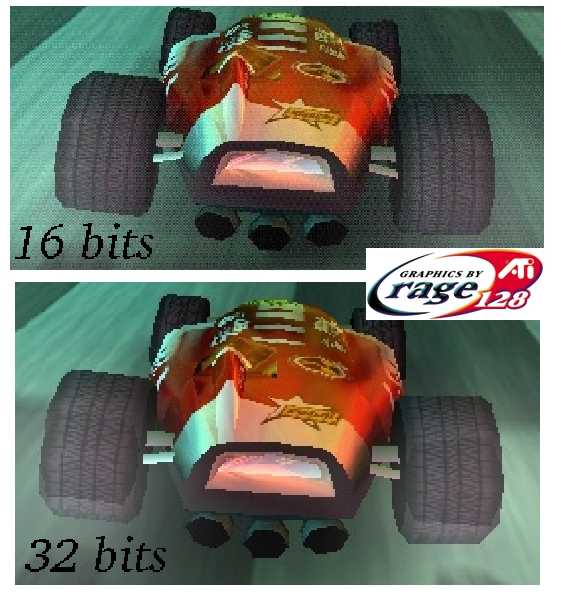
Click here to have a side by side look at the visual qualilty loss on
the VooDoo architecture. So (if) we ignore 32 bits better rendering imprvoements
for the a second, competing architectures
at an apples-to-apples 16 bits just plain look better at this lower resolution
than the Voodoo(1,2,3) in 16 bit.
-
Two web site have now relocated and renamed themseleves: Voodoonation to
FullOn3D and ATI Invasion has moved to ATI World.
The review from FullOn3D can be found
here and the one from
ATI World can found over here.
Here are a few quotes:
...single texture fillrate is quite satisfying to start with but gets very
interesting at higher resolutions, it even exceeds the 100 MPixel/s mark we'd expect from the 100
MHz core clock
...The texture rendering speeds are very solid indeed. Voodoo2 and Banshee are faster for the
textures they can fit into the texture memory but their bus kills them beyond that. Rage 128 GL is
steamrolling the competition here - and look at those 32 bit values, that amounts to driving circles
around the freshly flattened pancakes.
...The quality demanding multitexturing and alpha intensive
Game 2 bench goes clearly to the Rage Magnum at 32 bit, which is of importance to avoid
obsolence.
For me it is a board that defines what the next generation chips will have to deliver and what
game makers should be considering the foundation of their work, in particular the 32 bit
capabilities that are nothing short of outstanding.
Okay, you can ponder the charts as much as you like. Take as long as you need! What gets me is the fact that the Rage 128's drivers now have
performance 10% faster than what this chart already shows ...The Rage 128 really is the
TNT killer.
...32 bit performance that is unsurpassed, and better overall
2D/3D performance.
-
The idea and utility of Single Floppy Linux was
initially conceived to cope with the eventual disaster planning scenario
of a failed hardrive unit. You can use it to boot Linux on your PC
for the first time to try out UNIX commands in text mode. I have updated
the single floopy Linux page with a great implementation from
Thomas Oehser. Take in along with you,
the next time you visit a computer store. Here is a
testimonial from
a user who today runs all his Word and Excel under Linux. Finally some
insight
and pictures
at COMDEX in 1998 and why 1999 might be a watershed year for Linux.
- Feb 10, 1998
-
Computers and backward compatability are no longer synonymous. It used
to be that the number of computer manufacturer, motherboard manufacturers,
and peripheral manufacturers were of reasonable size so that compatability
testing with different combinations components was reasonably finite. Combine
this with different operating systems and with different software and the
combinations become huge. Microsoft found that just to verify their
own operating system running under differnt hardware becase an unmaneable
task. WHQL was a means to gate external software driver development
for hardware developed expressly by hardware vendors. There are monetary
incentives/penalties for providing non WHQL drivers. Now that computers
are so plentiful and inexpensive (they used to be the cost of a new car),
the compability of new hardware with last year's popular motherboards
become less of investment issue. One of the first and most popular
AGP 2X compliant motherboards was the ASUS P2L97 with the new ATX form
factor using the LX chipset. This provides a platform that can provide
very good performance using the latest CPUs and graphics cards.
The original TNT chip drew
4 to 5 amps (13.2W to 16.5W).
An interim fix was to provide a driver to
disable some of the
hardware features, such as sideband addressing, to enable functional operation
at lower power and lower performance. The release of new higher performance
drivers should be raising questions about "self detonations" and the true
meaning of WHQL, socket compatability, and the lack of this testing
of new products on motherboards that are barely two years old. All the
popular hardware sites are guilty of the following crimes:
- Testing of new motherboards with only one or two video cards.
Very limited or no swapping.
- Testing of new videocards with one BX based Slot-1 motherboards...usually ABIT.
Again, very limited or no swapping.
- Compatability ratings with clearly defined and designed
procedures.
- Sorting out compatability problems to either motherboard or to
peripheral. Really just a lack of science and sorting out the above
experiments. It is a catch-22 situation if you do not do the above
experiments of swapping.
3DXTC's Chubby has closed down his site and moved to
www.3dhardware.net. 3 of the 4
original ATI sites(Enduser, PeAK and 3DGaming) have regular updates.
Phil (@3D) is busy in his professional life and sends a strong message
at the top of his web page with regard to the Fury haven not been shipped.
You can be sure that when Phil sees it in the U.K., it will be widely
available around the world. So far, I hear it is available in
California,
Russia, and Estonia. Go figure.
I still have several 486 computers owned by my brothers and sister
that gets a steady diet of upgrades (memory and video)
when the local computer store begins to clear out it older hardware and
software.
Compatability is a key issue within my family.
-
An old acquaintance ATI site under the wing of Dimension3D
is about to move to a new site. The new management promises
more regular updates and better focus so I think it may make it back
to the links section for ATI centric sites. Dimension3D is one those umbrella
sites that hosts web pages for every major Video Graphics card manufacturer
but they will be going "belly up" on or about March 4, 1999 for unknown
reasons. They were one of the original Graphics Video technology sites
with one of the best discussion forums. Their support by John Peddie's
generous hosting had a lot to do with their original success. What happened ?
I think that it came down to content. Sites like Anand and our very own
ATI 3DGaming provide superior reviews and better insight into the relevant
issues (my opinion). Anand is very thorough but his reviews are based upon
a good formula that has been eclipsed by the likes of Alan Dang in terms
of covering issues such as heat, DVD, MPEG video, texture mapping and the like.
I have yet to see a good article detailing the pros/cons of AGP 4X. I truly
feel that I am now in the employ of some 12 year kid who goes home from
school on Friday nights to power up CPU with a massive heat sink and a
expensive memory solution to watch a framerate counter on a 21" monitor from
about a distance of two feet. Has John Hopkin's done a survey on the effects
of such radiation on myopia, language skills, social interaction,
left brain vs right brain size, explosive tempers, instant gratification
type-B personality developement,etc ? I think my Mom was on to something when
she did not allow us to watch our 17" Black and White TV (circa 1970)
from closer than 8 feet despite the lack of data from John Hopkins. Going for
a skate in the woods at Gage Park in Brampton acroos from the City Hall at
Main and Wellesly, today. It should be a blast skating around a 2.4Km
oval track with preserved forest growth in the middle. Hope I do not see
any 21" monitors on the way there or the something like "3D copy shop" or
"3D Marina" on the way up. Trust me...it has happened.
I had quick read of a independently purchased Xpert128 card ($115 US
from a local computer show) review running on a
Soyo 5EMA Super7 motherboard
sporting a VIA MP3 CE chipset with K6-2 300 MHz CPU. This card
uses the Rage GL chipset with 16 MB and no TV-output.Equivalent Rage Fury performance
at lower resolutions should be fine for those who do not have 19" or 21"
monitors.
Here is an update on the Xpert 128 running on a Celeron 300A.
Here is a quote about the updated 16-bit mode:
32bit vs. 16bit. Many people are applauding the performance of the
ATI Rage 128GL chipset under 32 bit color and rightfully so. It's
nice to see that the architechture of the chipset allows for less
performance degradation when moving to a higher color depth.
What's more impressive to me is the quality of the 16bit when
compared to the much talked about Voodoo2 chipset ( Voodoo3 will be the same). Folks, it's
pretty darn good. In fact, the quality of the 16bit rendering is so good
that you'd think you were looking at 32bit rendering. The only real
way to tell would be to take screenshots and compare them zoomed
up.
ATI has introduced an update to the successful Xpert series of cards with the traditional
8MB frame buffer was
just released called the Xpert 99 using the new Rage 128 chipset.
The extremely good AGP implementation
should allow it to use large texture maps for better visual quality
with minimal performance penalty.
- Feb 7, 1998
Formal 3D hardware support infrastructure is being developed for Linux/Xfree86 and will
contain a limited set of hardware accelerated functions to demonstrate how
complete hardware support can be added for any
3D hardware.
This should prove to be an interesting development allowing accelerated
3D support under Linux which will in term illustrate the speed and stability
of a the Linux operating system.
- What exactly is texture mapping.
It has been a misnomer generated in the gaming community and would
best be described as diffuse color mapping. The "diffuse color" is a material
property in the 3D world describing the natural colour of an object. A better
term might be "colour mapping" instead of "texture mapping" to describe a process
whereby a colour pattern is mapped/painted on top of a surface. Just as we
can paint the craters of a moon onto a flat piece of paper or put the little
dimples of a golf ball on the same piece of paper, today's texture a pattern
of paint much like the "tuxedo painted on a T-shirt".
Bump mapping should really be called "texture mapping" as it
incorporates the effect of light on a texture surface. Confused, then read more of
about Robert Polevoi's 57 lesson tutorial on 3D called
3-D Animation Workshop
for a clarification on exactly what texture mapping is and is not. I realized
that conscious tradeoffs need to be made with level design grid/resolution
and the texture map size which should be discussed more than it is. Any takers ?
-
Another Rage Fury review has sprung up from
Ritualistic, quote:
... think the reason I was so excited to get this card, was because I
wanted to see how Sin would play on it. I was impressed by my
TNT's performance in Sin, so I figured that the Fury would blow my
mind. Graphically, yes. The card lives up to its promises in this
area. It renders the game beautifully. No slow downs, or lock ups.
Sin uses 32-bit color rendering, and this card performs better than
my TNT when in 32-bit color mode. ATI took detailed care in
providing excellent 32-bit color performance. Hats off to them for
showing this gamer the vast difference between 16 and 32-bit color
depth. I don't think I can go back to 16 bit after viewing this
awesome product in action.
There will be a couple of real "nice" additions to the Rage Fury cards when
they hit the retail shelves that should put a smile on the hard core gamer.
I am sworn to secrecy so I better shut up now but will divulge and explain
when the first units are shipping to retail.
- Feb 1, 1998
The Emperor's Old Clothes:
As end users get more sophisticated and savvy in the area of 3D, they
find that traditional issues of framerate no longer being the "king" issue.
3Dfx has long proclaimed the banner that "framerate is king" and to keep
your eye focussed on the framerate beancounter whilst playing a game for
more playing satisfaction. Because the ATI forum's users who have the
unique priviledge using a
VooDoo2 3D card are, more than likely, Rage Pro owneres due to the need
of a existing 2D card with a passthru connector, comparisons can be
made readily about the quality. Here are some recent comments from
the following link
- ...Thought it has one very noticable thing about it, the image quality. It seems blurry or
washed out. Compared to using my Xpert@Play or i740 which the image quality is crisp the Voodoo 2 seems blurry and washed
out. I think this has something to do with the V2 doing some kind of over filtering. [Brent]
- ...In my opinion the voodoo 3 is Just Voodoo 2
SLI with built in 2D and a higher clock speed. No MAJOR Changes made. [Brent]
- I agree about the V2 quality. Try Quake2 and I think you'll agree that *even without alpha-filtering* that the Rage Pro looks
better. [Alan Dang]
The 256x256 texture maps are major contributor to this loss of detail
and a contributor to the speed increase...but at what cost ?
Deep Z-buffers and 32 bit resolution offer compelling increases
in visual quality in line with the economies of current RAM pricing
to make large local frame buffers an attractive architecture for
better visual realism. (It is ironic that present day video cards
match the main memory capacity of my motherboard)
I maintain that framerate is important up to a point (30 fps ?) but
is ecological waste after a point. >250 Mhz DAC's are
(at present) a marketing tool
for monitor manufacturers wishing to see 21" monitors on every desktop
without due
consideration of circuit board and cable characteristics and that
old friend known as FCC. I will put down my thoughts on this
sometime in the future. It makes some sense for high end workstations
running OpenGL but not for a gaming platform who's needs be better
served by a TV and a Nintendo 64 box. Remember that tradeoffs are
constantly being made. DOOM played fine in a 640x480 window in
software mode....those were the days. The VooDoo3 is a "me again"
product (my opinion) with more heat and a higher beancounter rate.
Buy a VooDoo1...it is a great bargain.
-
I have had some email requests asking about previous references to
texture compression articles...so here goes:
I am confused, too? What exactly are the rules of engagement when it comes to
compression and decompression. With JPEG, an international standards body
of "Picture Experts" gauges whether significant visible loss of quality is evident
prior to giving their stamp of approval to a compression scheme. The additional
time or processing is not an issue in this case for the uncompressing/decoding
stage. With my modem, the time factor is considered to give an
effective bandwidth increase. Recalled that the Riva128 automatically minimized the size
(and quality) of textures to allow for a speed increase and a smaller
local memory texture footprint but with a
simultaneous loss of quality.
Many game developers are opposed to having their "Mona Lisa's" altered
using these
automagic schemes. A uncompressed texture in local memory will always
be render quicker than a compressed one in the same local memory. Most game
developers want to control which textures are compressed/uncompressed
and whether they reside in local or main memory. The RagePro had texture compression implemented using
vector quantization techniques. The lack of a common standard or widespread
use of texture compression/decompression in hardware at that time gave
Microsoft little incentative to standardized on one technique or another.
Do not be mislead by assuming that the improved detailed you see in one
level of one game is automatically translated to every game and application.
Texture compression is a tool offered to game developers to allow them to
better juggle the tradeoff/compromise
between framerate rendering speed and quality. Here are the links related to
open questions about the present Microsoft Texture compression scheme
publicly licensed from S3 (
Overview/tradeoffs,
Uneven gameplay possible,
Oh No!...automipmapping of textures).
When you read these articles, you find that terminology seems inconsistent
and that question remain.
I think "compression on the fly" should read as "uncompression on the fly".
It really is too bad that the game developers could not vote on a feature
set and implementation that they wanted for texture compression but the
"Big Mick" has swung its bat. Today, The Rage 128 is able to render S3's MON2.demo
detail texture map without difficulty with its fast AGP performance and
large local memory store without need of texture compression. The
Rage 128 does have hardware texture compression implemented
but I'm not sure of the details. Open questions remain about
S3's texture compression details but their marketing arm is
definitely piping their texture compression format,
custom Quake levels optimized for their hardware,
and their proprietary GLIDE like interface called Metal.
I think that if they execute, they will have a part comparable to the
TNT (again...my opinion).
-
Not only are ground hogs getting antsy at this time it seems as if
consumers are trying to decide what to buy next. AGP4X will be a
different physical connector and will have a much longer gestation period longer
than the texture compression schemes (S3TC) being offered (my opinion).
Game developers
will start to offer support once significant market penetration
is seen, otherwise they will write to the greatest common denominator
which will be something in the class of Riva128, RagePro, i740 and G200.
The Rage 128 at even clock speeds has shown a
30% to 40% performance
advantage over the both TNT and Savage3. Alan did not specify the resolution
but I expect it to be 16 bits...expect the perfromance gap to
widen at 32 bits. I do not expect an increase in
core/memory frequency to buy back this advantage. The Rage 128 is a
long term investment demonstrating the best NT performance and OpenGL performance
to date in a maninstream graphics card. You are being subjected (my opinion)
to severe marketing hype not in line with the motherboard/gaming application
roll out plans. S3TC is now a somewhat open standard (like PCI) now
that they have openly licensed its use under Win95/98...free.
It will be adopted in the long term but a in depth review by several independent
reviewers is still needed to understand the tradeoffs between performance
and just larger textures.
How fast it will be adopted
is an open question. Tom Pabst had a good overview(a little overly negative,
though) of its advantages and
disadvantages in his Savage 3D review (this would be useful to understand
the 2.5x AGP texturing advantage as the Rage 128 part is already
reputed to have
2x advantage over TNT with recent drivers. So, I expect the
Rage128 AGP texturing speed to be more in line with the Savage4). I would not have
texture compression make or break
my 3D card buying decision. S3 has had
a lot of buggy driver releases to date for the Savage3D and if they use the same
basic core, 32 bit performance will still be limited
(it is not a memory limitation
issue but an architectural one). This goes ditto for the TNT2 as both
have taken a page from VooDoo3 in an effort to push out re-worked 0.35um
silicon early.
Wait for the 32 bit performance numbers which all of them have been strangely
silent. Shades of promises/hype from just six months ago. Yes waiting does tend to make one
salivate. The Rage 128 is tried, tested, true and should taste very good.
Cheers.