^/\^ PeaK /\^/\
What's new... is old again
January to June 2001 News
June 2000 News
June 8, 2001
I have added the recent "Radeon LE" review from Anandtech done on May 23, 2001 to the recent reviews sections of these pages. While the Radeon architecture shows that you can write an amazing game with its hardware capabilities, it is with side by side comparisons running the same programs that the better 3D image qualities (colour rendition accuracy and lack of artifacts) and sharper desktop that beat any theoretical advantage in a few more frames per second. Take a look at the above link to find out why the Radeon has been the favourite from "word of mouth"
ATI Radeon VE wins editor's choice award from CNET.
If you have ever seen the "splatter of blood" on the Quake 3 engine, you can
understand whether you are cut out for the medical profession. The VE provides
MX crushing performance (30% faster My annual Victoria Day to Memorial Day hiatus did not happen this year.
Just too much interesting and tantalizing stuff to chase down and sort out at work that I need to continue "wearing shades". The Ride for Heart
took place on Sunday June 3, 2001. I again roady my steely mount of a transformed racer-to-touring bike and road with "legend" Joe Hickey of the Toronto Bike Network. I'm no slouch when it comes to riding but Joe is something like 10 years my senior and just plain outgassed me on his classic "Dawes" made bike from the Seventies. On the weekend of May 12, my transformation to a "river runner" took a step forward on a two day course run by Equinnox Adventures in the beautiful setting of Elora Gorge. Together with my trusty "lake based" stern paddler, Oswin, we manage to complete the all rapids thrown at us without an upset...of course we optioned out of the killer set that saw 5 of seven boats capsized before the leaders decided that good fortune was on their side as no serios mishaps. The instuctors were two world class teachers. For someone who has paddle lakes for the last 18 years, there are a few things I found out very quickly: Do not pry but cross draw in the bow.
The classic "J" stroke does squat in the Stern if you are moving at the same speed as the water.
May 2001 News
May 5, 2001
Spring is in the air. Last week I took out my trusty green canoe onto the Rouge River with
my co-worker. The reality is that the "high"er water due to the spring melt has mostly passed...as we
found ourselves 1/2 carrying/walking about 50% of a 4 mile trek to Lake Ontario.
I found new respect for the design of the canoe which can literally work in as little as
4 inches of water. In low water, 40% of the river resembled a rock beach with a sprinkling of
of water about two inches of water...yes we tried in vain to run some of stuff to
the screams of the canoe hull. Plastic/Polyethylene/Royalex made be the only answer
to the little holes that now give me direct contact nature's water.
Read the Q&A session ATI's Dave Orton gave recently answering a
list of prepared questions. A little dry for the tastes of people but pretty much on target. You didn't think he talk about the new secret
weapon at ATI....did ya?
With all of the supposed Nvidia announced design wins in February, I find it a little
surprising that the principles at the company are selling the large volume of shares that they are.
The success of older generation TNT2 parts has been a cash cow strategy
that will be wearing thin as cheaper chips with better 3D offer, such as the VE,
strong competition with better DVD, 2D, video-in, video-out technology,built-in dual
display, and
working TMDS interfacss.
The strategy of focussing on X-box may be undone by
focussing on a niche high end 3D solution generating both heat and significant fan
noise that may limit it to being offered by
OEMs as a add-on option. Grphic board vendors will take whatever they can get as the
that market segment has no choice. The boards themselves will be expensive
to address power and heat requirements.
Many are finding that even ATI's entry level Radeon VE has MX(all flavours)/TNT2 besting 3D performance
offers home graphics that drive the new "digital" flat panels (versus analog flat panels
that do not use the DVI/TMDS connector) and allow their kids to play games.
With dual display, a game controller, and a VE...you can sit down with your two monitors
,pointed 90 degrees to each other,with you fiiling in your EXCEL TAX spreadsheet while your son/daughter figures
out the intracasies of WarCraft on the second monitor....dual keyboards anyone ?
To catch up on Radeon reviews recently published...click here
While you are at it take a look at the Anand's take on the Nvidia GeForce2 MX200 and MX400 (nee original
GeForce2 MX clocked 25 Mhz higher in the core). The new chips are essentially a rebadging of technology
that will confuse some and offer no real world imrovement to the knowledgeable...so that the unsuspecting
consumer walking into a store asking for a GeForce2 may not get a GTS, or even a MX
(original or mx400) but may get duped even more and walk away with a
low-end MX (MX200) with only a 64 wide SDR interface.
My suggestion to anyone considering the
GTS/Original MX/MX400 to pick what others have known for the last
3 months
You can now run the Fuji FinePix 1300 camera that I just purchased
recently. The neat thing is that Linux support already exists for this
camera. Evolve and conserve, my collection of junk CD-ROMS is already littered with
extinct AOL Titanium editions.
Some user's may have experienced problems with hanging and corruption
on their systems that use certain VIA southbridge chips with SoundBlaster Live
cards. The problem is arpparently more apparent when modern video cards,such as Radeon, vie for CPU
usage. The good news is that a "fix/workaround" in the BIOS will sort things
out. Read about it here
April 2001 News
April 22, 2001
Is the film camera doomed to follow the fate of the vinyl LP record album?
For the average consumer, great advances have been made in foolproofing the loading of the 35mm film cassette, elminating blurry photos via autofocus,
and eliminating incorrect exposure via auto-exposure and autoflash. However,
the most important aspect of camera design is quality of the pictures and the control of the image. The first aspect is governed by the lens quality (edge to edge sharpness, low barrel distortion, and low chromatic abberation) and image quality (shadow detail and colour accuracy). The best way to ascertain this aspect is through sample images.
0.3, 0.8, 1.2, 2.1 and 3.3 Megapixel sensors are needed to support resolutions of
640x480, 1024x768,1280x960, 1600x1200, and 2048x1536 resolutions respectively.
Higher resolutions do not necessarily make for a better image, I have seen vast
differences in images taken at 640x480 in terms of edge-to-edge sharpness, colour accuracy(vs washed out colours), and exposure latitude(details in shadowns). Not all lens, image sensors construction, and exposure metering systems are created equal. Note that for every doubling of the horizontal/vertical pixels (i.e. 640->1280, 800->1600,1024->2048) results in a 4x increase in memory requirement for a given level of compression.
The Fuji cameras both offer 640x480(0.3 megapixel) and 1280x960(1.2 megapixel resolutions).
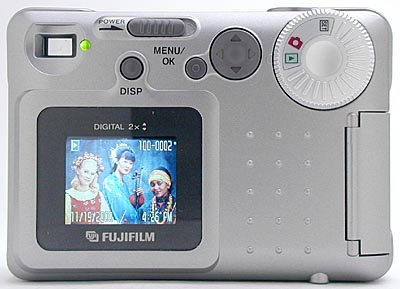
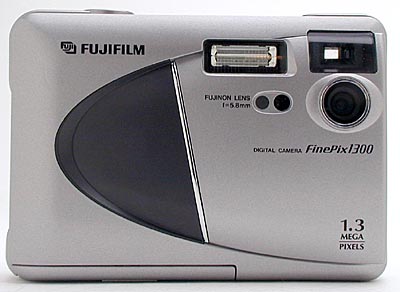 I am truly excited by excellent image quality and practical features offered in two modestly priced cameras from Fuji in the form of the MX-1200 and its replacement in the form of the FinePix 1300. The latter makes incremental improvements in adding USB, hiding less used previous features under menus, and about 20% less current/power draw and almost the same exact image quality (as the MX-1200) but a tad less.
What sets these two cameras apart from the field are the following:
- Sharpness and quality of the lens construction playing its role in
picutre quality. Equal to cameras costing two to three times as much.
- Colour accuracy possibly due to the use of multi-coating antireflective lens coatings (pioneered by Fuji in the late 70's) and careful CCD design playig their role in picture quality. Top notch.
- Included 8MB Smartmedia card allows for about 90 VGA/640x480 images
with good picture accuracy. A upgrade to a 32MB SmartMedia card will allow for 360(10 rolls of 36 exposure film) pictures at a cost of about $30. This storage medium (for those of you familiar with film) can be uploaded to the computer and then re-used for again and again for more 360 photo sessions.
Turn off the LCD display and flash to take picture after picture and you could survive two weeks away on a single set of 4 AA batteries.
- Flash can be disabled most of the time as the camera can take well exposed photos by an available 40 watt bulb in an average sized room due to shutter range from 1/2 second to 1/1000 second.
- LCD can be disabled for point and shoot operation. In this mode, the camera consumes about 40mA. Four AA batteries supplying 1300mA-hr capacity can operate for about 32 hours...that is 975 picture composing cycles. The camera is however has an auto-off feature so that it shuts off after two minutes so that you do not accidentally find your camera dead after 32 hours. Actual continuous-on time under normal operation is less when using the flash, LCD, and taking pictures/memory writing as average current/power consumption increases by factor of 10 for tens of seconds. Even in this high powered mode, the camera can run for about 2.5 hours. If you roughly take a picture every 12 seconds, you may be able to get off close to 800 pictures still. The smaller 1.6" (vs 1.8") LCD monitor is partly responsible for this long battery life.
- Practical resolution modes include 640x480 mode with 1/8 JPG compression and a higher resoluton mode
1280x960 mode with selectable 1/16, 1/8, and 1/4 JPG compression. This results in roughly a 2x increase in memory footprint per setting change (90KB/image, 160KB/image, 320KB/image and 610KB/image).
- Operation off four commonly available AA batteries. This allows for the use of advanced rechargeable Nickel Metal-Hydride batteries with alkaline capacity and no "memory recharge effect" common to Ni-Cads. The weight of these batteries adds a bit of useful heft to the camera weight to help stabilize the camera during picture taking.
- An excellent menu system and camera manual.
Are there any criticm's ?
- Green LED near viewfinder could be drop down in brightness, made smaller, or moved to a the periphery of a user's vision.
- The smooth plastic and small size makes the camera feel slippery to hold. Some of the expensive SLR digital cameras have a rubberized textured material that offers "tack" and some mechanical protection. How about a black rubberized textured version of the camera?
- A more predictable and less spongy shutter release. And a more accurate viewfinder with a rubberized surround eyepiece.
Should I be surprised by Fuji for this excellent design with great focus on effective features? No considering I bought their ground breaking Fujica ST-701 SLR back in the 70's which had the brightest viewfinder, lightest weight, and lens quality that was the equal of the best in the industry.
There is more to image quality than just the sheer number of pixels...the quality of them pixels matters and this is one fine camera than offers 0.3 and 1.2 megapixels for your evaluation.
April 5, 2001
2D and 3D image quality are standard with the Radeon Experience...get it soon at a dealer near you.
Video and sound are both carried by waves in vastly different frequency ranges. Today
they meet within the computer and vye for CPU cycles on PCI/AGP busses. With the release
of new video cards, many users reported "stuttering" with certain video cards. Disabling
legacy "SB16 emulation" resolved/worked-around many of these issues. Now it seems that
there might be a legitimate hardware issue within the SoundBlaster Live's chipset
and certain revisions of the VIA chipssets that are widely found in motherboards using
Athlon/Duron processors. Take a look at the following links:
- Via Hardware's SBLive thread
- Paul's Sound configuration hints
- KX133/KA7 hardware workarounds
April 1, 2001
Fans of the AIW products will be saddened to know that the popular
video streaming format known as "video for windows" (Vfw) is
no longer officially supported by Microsoft
and being replaced by DirectShow in Win98SE and Win2K.
Third party software which relied on these products being distributed
with hardware products, such as the AIW, will have to be rewritten to the
DirectShow API.
Newer low digital cameras are now making inroads into the consumer
market characterized by low cost, 4MB of memory, 50K compressed JPEG images
in 640x480/VGA/0.3 Megapixel format (about 20 pictures per 1 MB of memory),
no LCD preview panel (to hold down cost and battery consumption),
AAA battery operation, No Flash (due to low light capability of CCD) and
doubling as low cost webcams/security cameras. Take a look at the recently
updated digital camera
section with links to the Kodak EZ200 and Intel Pocket PC.
For now, I make due with a digital camera capable of only
8 VGA/640x480/0.3 Megapixel shots per 2MB of memory (no compression)
or 250KB/image, a $6 3V lithium good for about 200 pictures, no frame
counter, lens of questionable quality and construction, and built in
flash in the form of the Relisys Dimera 3500. Now if Kodak could come
up with a second generation EZ200 camera with incremental improvements
in the form of a small modest zoom, selectable built-in flash,
multi-element glass lens/better image quality and removeable
memory...the who industry might be transformed.
Update: Take a look at the Agfa CL20.
This is the third generation of cameras from Agfa and these seem like winners.
The unit offers a basic 1024x768 (0.8 Megapixel) resolution or an economy (512x384) near VGA mode for simple shots to mount on the internet. Unusual is a higer resolution 1280x960 mode(1.2 Megapixel mode). The flash mode can be disabled but the two AA akaline batteries are good for about about 36 pics.
So the only question about this camera is really about the power efficiency and whether enough engineering effort was put into edge to edge sharpness.
Beats the Kodak EZ200/Intel Pocket PC in terms of resolution, removeable memory expansion up to 16MB, and built-in flash...my new reference for the camera for the masses.
March 2001 News
March 22, 2001
The Radeon VE has received another favourable review...only this time it is from
a site with a reputation for driving cars strictly in the
fast/left lane/3D lane of graphics hardware. The pioneering work of Evans
and Sutherland/(Foley and Van Dam) in the mid-80s at a fundamental 3D perspective modeling and
animation was a solid base of work that has stood the test of time. can now be married more and more with increasing transistor
count but practical tradeoffs need to be made for aesthics enabling DVI
interfaces, graphics-videocams,graphics-on TV, graphics-2D text,
graphics-end cost/integration, and
graphics-dual panel ergonomics.
It is a sobering thought for many
me-too "Ferrari Framerate" centric sites cannot appreciate the uses of
graphics beyond 3D benchmarks. For the average consumer, once a graphics card
exceeds 30 fps in popular well written games, a graphics card's features should be
be evaluated upon likely uses the end user will make upon the unit in both
and entry level/mid level DELL/Gateway/Compaq/HP computer.
The "millisecond"
response time of human fingers and neural-eye processing limit the amount
of image variation that a user can appreciate in a coded game demos.
So where to should you put your
extra silicon devices too work? ATI has chosen integrating 1.6 GHZ TMDS unit
for the Digital Visual Interface (DVI) interface standard supporting both legacy RGB monitors
(via a dongle) and the new sharp as a razor digital LCD panels. The integration of a second DAC
allows for new ways of expanding the desktop for an increase in productivity. Disney
animation artists can rejoice.
Digital Interfaces offer the same advantages as the CD did to the record/phonograph/LP.
Transistors were also allocated to relieve the CPU from processing the
complex MPEG decode operations for viewing DVD and at the same time
implement a more math accurate/better quality decoding algorithim.
Architecturally, the use of a form of Hidden Surface Removal/Cache
nick-named Hyper-Z allowed for RISC-like gains on near-code graphics
image data. Careful attention to the feature list allowed for a low
power consumption and low heat/quiet/fanless board design with no
sacrifices on reliablity. The catch in all of this...it beats the Nvidia
MX on a number of fronts in
3D performance
and not to mention the TNT2 family of chips. You can thank John Carmack
for taking the time to optimize his engine for the TNT engine, used
in the MX, two years ago.
Positive word of mouth
about ATI has transformed the retail market for Radeon products due
to improved drivers and regularly updated beta/special purpose drivers,
breathtaking 3D rendering quality, sharp 2D text, and the aforementioned
features above.
March 10, 2001
 If you want to see the power of the Radeon with DX8, just take a look at some
of the reported 3DMark 2001 scores reported. The 2x skew in the 3DMark 2000 scores for some hardware did not actually reflect real world
gaming performance. Just as the Radeon took less of a hit in 32 bit that competing hardware, 3DMark 2001/DX8 is showing the strength of Radeon as the most future proof and hardware compatible DX8 that is available today.
If you want to see the power of the Radeon with DX8, just take a look at some
of the reported 3DMark 2001 scores reported. The 2x skew in the 3DMark 2000 scores for some hardware did not actually reflect real world
gaming performance. Just as the Radeon took less of a hit in 32 bit that competing hardware, 3DMark 2001/DX8 is showing the strength of Radeon as the most future proof and hardware compatible DX8 that is available today.
A couple of items on Linux beginning with running the new Xfree86 4.0/4.02
X11 GUI. The first thing is that the dream of one server running many different graphics cards has been achieved in this new server. In similar ways to how the sound cards were tethered to the Operating system kernel code prior to the introduction of modules, the new Xserver can now just have a card specific "object" module compile to generate new functionality. For those with the Rage 128/128 Pro cards, you can run the latest server providing you install
Version 4.0/4.02 along with its requisite libraries first. Then by following David St. Clair setup and configuration procedures
in his Rage 128 X-Server HOW-TO. To get the Radeon installed for for full 3D support requires
the a module "radeon.o" to be loaded. It will all come pre-installed in the
release of kernel 2.4.1 or later for those who want the easy install.
For those who want to figure out how to do all of this on existing Linux installs...I'm working on it :(
Linux on a PDA!!!...I guess these people at Agendaare ahead of their time.
It boots up just like in Linux. For those who have looked at Linux on a 1.4MB
floppy and the large/cheap memories available today...it is not surprising that Linux is truly a portable operating system that should be a great fit for applications. More information in the form of a review, here and
here
February 2001 News
February 28, 2001
GameCube will probably be the first game console that I will purchase
It is a reflection of what I call good design from
a corporate, creative, and a personal view. The hardware will serve
software (as it should) with a clean sheet of paper for both hardware and software with an set of software tools uncluttered by the legacy of the PC.
With Nvidia pushing the GF3 moniker(vs NV20)), the PClegacy of supporting
multiple memory footprints and types, bandwidth limiting slot interfaces
(instead of dedicated on board chip to chip high speed paths) will lead to
large footprints and extra pins that will ulimately make is expensive in the
consumer space.
Recent Mercury Research reports show the Radeon to be market favourite
at the Retail level with clear market share and exponentially growing sales...
it is an architecture with legs that will surpass Nvidia's two year
stranglehold with the TNT2 product.
Stability, 3D quality, 2D quality and a performace delta can clearly be
distinguished with the Radeon over the aging TNT2 product making up a
large percentage of Nvidia's profit from last quarter.
People are beginning to appreciate the benefits of vertical integration for
quality versus just selling chips based on a benchmark number alone.
When framerates requriements extend beyond 30-45 fps in high quality game modes
run at or beyond 1024x768...the 3D association with benchmarks is akin to the 2Dassociation with EXCEL/WORD 2D benchmarks...it just does not matter if it completes in a microsecond or a millisecond.
The software gurus at Nvidia have done an admirable job of
rehashing/borrowed common architecture (from the TNT) and extending it
(T and L). but things become significantly more complex with the
DX8 re-architecture (new), new T&L mode calle pixel programmable shaders,
new features(hype-Z and pixel shaders) that will put a significant driver burden into an already late project.
The plethora of hype in pre-previews is evidnt by the lack of
prototype silicon or prototype drivers.It is out of proportion and not
really justified other that to keep the analysts bubble from bursting.
I think that most of the information has been out there for a
while with the major sites and that the NDA signed back in December
expired at the end of this February. They just decided to invite everyone to the same party. It seems interesting that NVIDIA are playing the same hand now
with DOOM3/OpenGL that John Carmack played with "Quake3/OpenGL vs D3D stakes"
in saying that
there is a "reasonable" higher plane ia to what do hardware manufacturers need to do to service HQ mode under Quake3 and that D3D would not meet it.
OpenGL will do well by GF3/Apple and Carmack but X-box is supposed to
Direct3D. Jobs and Gates have come to some sort of compromise.
This might explain the recent licensing deal with Unreal to sub-license
the UnReal Engine...
they need one but it is going to be a pig in more ways that one. My opinion,
is that X-box aimed high and late to what MS and Nvidia could comfortably/affordably build using just Windows serving/PC based components. A
GF2 with no bump mapping and vertex skinning added to the works
would have made a nice X-box platform. Hyper-Z would have bought the external
memory requirements down. The problem there was that Radeon and Dreamcast covered some of that ground. Competition would also come from PCs (with the same or better graphics) or from someone else such as Nintendo's Game Cube. Like I said, I personally the position of GameCube at this point. The recent spat of
hype from Nvidia is reminscent of previous early announcements from Nvidia
based upon what they want they think the market needs/wants to hear at this
point. Based upon the delays, I say there are probably fundamental
design/technology issues in which key blocks are not functionaing
properly with Hyper-Z due to different types (more central) of
layout constraints related to memory distribution. All of Nvidia's
to date have used one simplistic layout scheme comprised on one large memory
instead of smaller distributed memories as in ATI's case.
A new market favourite in the PC Retail sector beginning to emerge called the Radeon. Perhaps it is all that the X-box really needed from a release point of view. Radeon 2 is a refinement of Radeon and probalby should have been what the
real X-box chip required in terms of schedule requirements of games
application development.
In addition to currently spanning all market segments from low-cost to high performance and I think it makes a better set of tradeoffs in the features/integration vs 3D performance in each category.
- Extreme End Gaming + Vidon : 64MB DDR, lower cost, consumer grade DVD, Video-in, Video out, great 2D clarity and better image quality generation capable of playing latest generation games. Rock stable 7089 drivers. versus GF2 64MB(no Video).
- High End Gaming: 32MB DDR, same great 2D and 3D accurate compute engine with 128 wide DDR memory
- High End with Tuner above with 4th generation Tuner software. Asus has numerous teething problems keeping in step each time a new driver release comes out.
- Budget/Performance: 32 MB SDR with same great 2D and 3D. 7089 drivers works with 98% of the software and increasing. .
Easily beats MX.
- Business/TNT2+ busting Performance : Matching the MX in performance but offering TMDS and dual monitor support. Same great 2D and 3D quality. Should be a hit. versus MX.
Check out Mercury Research for yourself when you get a chance.
 GameCube vs GeForce3...it should be a interesting horserace. Super Mario and Zelda's creator, Shigeru Miyamoto has said that Mario has been lonely travelling the Nintendo 64 world and expect to see him blossom under the Game Cube with great
storytelling coupled with great graphics. If you have any
questions on GameCube, drop by the Q&A section of IGN.
A 32 MB Radeon Card can be picked up for about $150 today with best of class DVD and uncompromised 2D, and 3D capable of serving to tell a very good story with spectacular 3D compuation accuracy (thanks to a high precision IEEE compliant math unit)resulting in better perspective accuracy, colour saturation ....that is image (3d) quality.
While higher framerate solutions exist in the form of overclocked and hot versions of the GeForce2, there are some caveats with the Nvidia alternative:
GameCube vs GeForce3...it should be a interesting horserace. Super Mario and Zelda's creator, Shigeru Miyamoto has said that Mario has been lonely travelling the Nintendo 64 world and expect to see him blossom under the Game Cube with great
storytelling coupled with great graphics. If you have any
questions on GameCube, drop by the Q&A section of IGN.
A 32 MB Radeon Card can be picked up for about $150 today with best of class DVD and uncompromised 2D, and 3D capable of serving to tell a very good story with spectacular 3D compuation accuracy (thanks to a high precision IEEE compliant math unit)resulting in better perspective accuracy, colour saturation ....that is image (3d) quality.
While higher framerate solutions exist in the form of overclocked and hot versions of the GeForce2, there are some caveats with the Nvidia alternative:
- Limited Z-buffer accuracy
- Unsharp 2D beyond 1280x1024...it might say 350MHz DAC on the package
in that it can put out data at that speed...but what you get is something t measures well up to about 170MHz.
- Speed up in drivers comes at the expense of using compressed textures in some games (Such as Quake) which are not supported correctly in the
hardware. The problem is bad enough that a special version of Quake (1.27) was released that does not use compress textures by introducting a new flag called "r_ext_compressed" to disable it automatically. Older configuration files that have the old flag called "r_ext_compress" enabled will see no compression, lower performance and better quality(1.27) or higher performance and bad compressed(pre 1.27) sky textures. Your pick.
- Non working TMDS in the graphics chip. Result is that the mass adoption of the the Digital Video Interface (TMDS and RGB in one connector) by bothe monitor manufacturers and graphics card manufacturers will require the board to implement an external ($$$) TMDS chip to drive a digital flat panel.
I think that now that games performacnce have come full circle with the 0.18um generation in that very good stories can be told on that platform...the versatile Video Card will return back to multimedia. This means downloading your treasured VHS tapes via the video-in port (Theatre in the Radeon 64MB and AIW Radeon) and archiving this as a VideoCD, playing back DVD with as good or better quality on your PC than a consumer DVD player, and providing HDTV capability to OEMs within the chipset.
When you get tired, you can play some games (not too much mind you or you will get that glassy eyed look) and then go back to "creating".
Video editing has been a complex as some of the image manipulation programs which allow you to author, edit, retrieve and transform between GIF, JPEG, TIFF and other formats. Similarly video has a plethora of standards (VFW, MPEG, DirectShow, etc) which need to be understood with respect to hardware capabilities and the right video software mix. Here are a couple of threads ( 1 and 2) which might be of interest to owners of the AIW series.
February 19, 2001
In 1996, a 4MB module of fast page memory worked out to about $40/MB and I ended up shelling out about $160. On the weekend, I spent about 1/4 that amount ($35==$24US) for 64MB. The price cost has gone by over a factor of 64 in 5 years...just amazing. I ended buying two sticks for a total of 128MB. The second 64MB will go into a new machine that will networked in this Spring. My 32MB system at home can now play UT and Quake2 with a skipping a beat or generating a thrash on the hard drive.
You have heard about the Radeon 2D sharpness and clarity. The one thing rarely mention or understood is the 3D clarity. The Radeon does away with mathematical approximations used to tradeoff accuracy for speed by implementing an IEEE accurate math unit. Read about the results here.
Do you wish to replace the aging TNT2 Ultra with a chip that runs without a fan
with GeForce2 MX equaling frame rates, twin monitor support, DVI/TMDS/Flatpanel support, TV-out for about $120 US dollars...check out the Radeon VE review at Sharky's Extreme.
With the plethora of hardware web sites today, it becomes somewhat easier to separate the men from the whiners. "Fight Back" were the words uttered on a consumer watchdog program best known for the byline used by the host (David Horowitz) whenever he sufficiently emabrassed a manufacturer/retailer for allowing consumer to inflict harm to their goods. While there were legitimate wrongs, it would not be suprising to see a tire shop reimburse a new set of tires, out of plain good will, to a customer who inadvertently drove on 1/2 inflated tires until the rubber parted. The point is that little insight is gleamed from computer hardware/software reviews on root cause. A sampler:
- P4 runs slower than P3
- Win2K performance is 50% less
- Fury Maxx does not run under Win2K
Some popular hardware sites seem to have an unfettered wish to make the graphics/CPU industry as a horse race. How? Unwittingly, these particular reviews (especially CPU and graphics cards) eke out their distinctiveness by being first to publish works in progress without looking at the whole picture. Often this occurs by pointing out and blowing up some aspect of a product out of proportion.
In the examples above, the P4 is in a similar position to the Pentium Pro's bet on software moving to 32 bit, so 16 bit performance was traded off. P4 will required code to be re-compiled to take advantage of some of its features to enable a performance advantage. Depending on which benchmark you run in which week, the "winner" may vary.
Some of Tom's P4 articles make fodder of articles published just days before as he flips and flops on his "read it first here criticism". Anandtechs comments about Win2K basically boil down to the fact that advanced hardware is very dependent on both applications being optimized to the driver layer and the driver layer itself. With a transition to Win2K, appication and driver groups have been in heavy transition mode. It is too early to in the game to make hard recommendations without qualifying remarks about this transition. Congrtulate
those who succeed early but why condemn those who are making an effort to tame
a very complex piece of hardware and software. It is the "favourite son" syndrome which is killing an industry with many capable sons.
The 3rd bullet regarding the MAXX came about due to the
hardware restrictions under Win2K relating to simultaneous operation of PCI and AGP slots...a transition that could not be anticipated when the MAXX was developed. Hardware manufacturers work in good faith, but
literature in hard and soft form in the PC industry is content on making the
industry a one horse race. The problem is the lack of communication between hardware sites and manufacturers. In the audio industry, the review sites always allow the manufacturer to see and comment on a rough draft of a review prior to publishing. It is not bizzare that some of the most popular sites do not have such a policy, their interests is not in the hardware community but in their policy of "read it here first...the truth can wait". Their undoing will utlimately be other sites that do publish with good editorial policy who will earn the respect of the public. Criticism is warranted but readers are not blind to the bias tones of certain narrow reviews. The plethora of Radeon reviews.
indicates that games performance is more or less a commodity, while features suchs as DVD efficiency and quality, Video-in, DVI/TMDS/Flatpanel support, and stable drivers (ATI's hallmark except for 0.25um generation) are proving to the
hallmark of the Radeon experience. Is there hope? I recently saw a review
on the dual display Radeon VE which properly focussed the aspects that were not related to
simplistic "framerate".
February 15, 2001
The Radeon has been arguably labelled the most advanced graphics on the market today. It comes standard with the Radeon Ark Demo on a CD to showcase features not yet found in Microsoft 3D interfaces.
To get an idea of the advanced rendering features showcased in the demo, take a look at the previous link or click here to see a Quicktime animation of the Ark Demo.
To find out more about the Radeon, take a look at the Radeon Tome...all together now..."We're not worthy!!!"...:)
A slew of beta drivers were released in December and January so that feedback could be solicited on any teething problems on hardware beyond which the drivers were developed. This has all culminated in the 7072 drivers available on the ATI website.
Beginning in late November, some of these drivers and the quality improvements seen in ATI drivers were witness by some of the review sites. So take a look at some of the recent reviews on a product that has an almost cult following today in high end gaming with a balanced act with business(2D) and home (DVD, video-in, video-out) activities.
The plethora of camcorders today was anticpated long ago by ATI's hardware division with initiatives to support "video" inside the PC. Video for Windows has long been a standard since the Win 3.1 days. Like a lot of Microsoft products, they learn by doing, and by the 3rd incarnations...things begin to look right at a architectural level. This however means a phasing out of one standard and the phasing in of another. The jump over to Win2K will probably mean that DirectShow will become the defacto standard in the future.
To find out more about this area, you can get the low down on "video in the PC" from John McGowan's excellent AVI page...
February 10, 2001
Heeeeeeee's BACK...the webmeister of @3D is back after a near six month sabbatical. While he is catching up on what has happen in the ATI world with Radeon, you can expect some expert information from a working professional on 2D quality and what to do with two monitors. In the meantime, I have to agree the "Rage 128 Pro" is probably one of the best value cards on the market today when coupled with 700Mhz class CPUs and is now a basic offering in DELL computers with DVD quality, 2D quality and games performance well beyond the requirements of most average households today and tomorrow with continuos
driver updates. Get the Feb 5,7078 release drivers today
I'm not sure how this one slip through the cracks but ATI has released
two new official WHQL driver releases since the beginning of this 2001 year modeled on a combination of
feedback from the user community using their beta drivers,
special purpose point releases and WHQL production release drivers.
The progression of improvements from 3056,3063,7020, WHQL 7041, 7062, 7068,7072,WHQL 7075 and 7078 drivers partly problems introduced in game application code development interpretation of hardware/software specifications by not beta testing on the Radeon when code was developed and have been fixed with a combination of patches to games
and folding driver updates into new release driver CDs.
performance advantages (40%) in the Radeon architecture using new games
such as MBTR (Mercedes Benz Truck Racing) or is that "mean time before failure" ? The new aspect to this is in 16-bit and the performance gain tradeoff in going from 32-bit to 16-bit. Clearly the SDR solutions beat the MX and the DDR solutions even more so. What is more interesting are the lack of comments on the clear superiority of the Radeon architecture in certain benchmarks when tested on new advance games beyond Quake where the playing field is more even.
Despite this fact, guess what is dished up on the front page of this site...a review of five identically performing cards just so that the "free" hardware
commitments are honoured. Still no mention of MX texture problems, 2D blurriness, and the significant performance improvements of the Radeon of late.
Go figure. The users have and they are flocking to Radeon for smoother game play, sharper 2D, much better DVD, and now performance!!!
Do you actually want the last word on quality(DVD and 2D), performance, and value(100 US$)?
Then the Radeon LE may be for you. The price is parlty due to the availability of low cost DDR, the overclockability due to the low power consumption and demanding worst case OEM testing conditions, and the display quality engineered within the chips. So if you can live without the retail store 90 day exchange warranty on
this OEM product, even your sister can now appreciate the power of Radeon :) unleashed with "Radeonator" driver plan.
January 2001 News
January 25, 2001
Why is it that people fear for the obsolescence of their computer's CPU and graphics subsystem? Download and listen to this interesting .wav file that discusses the appreciation of one's apparent poverty.
You can also read the full text here. It sort of makes you long for the days of DOOM on a Intel 386 system running in 640x480 resolution.
Are you running Win2K with a Radeon and want the last word in 2D? Then enable the following GCOOPTION_SlowerEdge Registry entry instructions as described below:
I've not seen this posted anywhere for Windows 2000 so I thought I'd share.
For those with the shimmering/text crawl problem, the fix that has
been posted so far has been for Win 95/98/ME/NT.
For W2K go to the following in your registry:-
HKLM\SYSTEM\CurrentControlSet\Services\ati2mtag\Device0
Add a new DWORD:-
Modify the value to 1, then reboot. It's upped refresh rates by 1, ie instead of 85Hz you get 86, and so on. Worked for me anyway on my Iiyama VM Pro 400 17"
Hossanah...Hossanah! It is now possible to translate from Chinese to English and back. Quite an achievement but what are the results? For people who are fortyish, remember those amusing phrases that came with China/Hong Kong/Japan made no-name camera/lens/stereo instruction manuals? One neat review that you can now access using the above translation facilities is a product not seen in North America called the Radeon LE. From what I can gather, it is not SDR or DDR but it sure kicked butt in comparison to the Geforce 2 MX...that is if the phrase "smelting the day" means anything to you.
Read all about it..."and the top Video card for the year 2000 goes to ...Radeon!!!"
January 18, 2001
ARRRRRrrrrrgggghhhhh! www.rage3d.com or Rage3D is down again is what a lot of
you RADEON loving card owners have found either Friday night or this morning. It
turns out the pointer that associates the above address to Rage3D is WRONG.
Use the following Temporary Rage3D Link
or http://209.217.53.195/
January 4, 2001
Personally, moving of any sort is a pain. The phenomenal success of the
www.rage3d.com site has necessitated the move to a bigger server just as other popular web sites have done. This sometimes means moving to a provider who has the bandwidth and resources without causing conflict to his existing customer base of web sites. Sometimes, the provider regrets hosting the new popular web site because of this fact. The first move by Rage3D used workstation class SUN servers but unknown teething problems had them down for the count from January 8 to January 13, 2001. Well the site with the best user forum pages (and possibly support) is back up and running. Cheers to the gang at Rage3D.
Still the one in 2001...
Image quality as more and more reviewers are finding out is composed of both the 2D quality and the 3D quality. Radeon technology has steadily improved with each driver release and the above links speak for themselves. Some quotes:
"...before I move on to the benchmarks I want to mention that after having used all of the current generation video cards, the ATI Radeon CLEARLY has the best image quality of all of them" Radeon Roundup, PCMonkey Jan, 2001
"...with the same 350MHz RAMDAC found on the other RADEON products, the All In Wonder delivers crystal clear test text at high resolutions. In fact, resolutions of up to 2048x1536 at 75Hz are supported. As far as PC usage is concerned, the RADEON offers 2D quality that matches the infamous clarity of Matrox's lineup. AIW Radeon review, Sharky Extreme/Chris Angelini, Jan 9, 2001
Early in July 2000, a number of Radeon reviews
(Anandtech, Sharky, and Cubic) pointed out instability in some some motherboards based upon
early Revision VIA 4X chipsets. These are restricted to a problem in
the VT8731 (KX133) Revision CD Northbridge
chip (CPU/AGP/Memory). It has since been corrected in the CE chipset and only affects the AGP 4X operation. It has been used
in all of many of the Slot-A motherboards supporting the SlotA based
Athlon processor. Similarly for Slot-1/370 based motherboards using the Via Pro133a (VT82C694X). Again,
revision CE chipsets are key to getting AGP4X
running.
A related issue related to how AGP4x is implemented relates to driving strength.
AGP4X has one of the most advanced "drive control" mechanisms found in
a consumer product to ensure good signal integrity by having
the output buffer drive correct for supply voltage, temperature and manufacturing variance. The goal is to keep the output drive fixed and
constant at a very precise strength...not too strong and not too weak.
Many early adopters of the very early KX133 boards chose ABIT's KA7 due to the qualilty and stability of earlier generation BH6 products supporting Pentium II processors and AGP 2X.
What is peculiar (in the case of the ABIT KA7)
is that the driving strength is actually set in the BIOS and that various users have experimented to find out values are optimal for reliable booting and AGP2X operation of this interface.
It seems that a value of "68" is optimal for these boards when used with Radeon products. As mentioned, differences in
manufacture or environment will require slight tweaking of this value.
For AGP4X operation one must first ensure that they have a CE revision of the
chips to have any hope at all of running in AGP 4X mode. This is difficult to verify visually as the
Northbridge chip is now covered by a heatsink. Secondly, a graphics driver
that is aware of the Chip revision must exist(download any of recent
WHQL drivers). Last, if the strength of
the AGP I/O is set manually, then the value must be determined by trial and
error for 4X. One suggestion would be to somehow clip on a fan onto the KX133 chip itself to stabilize the temperature
as the "drive" will vary as the chip self heats.
The last thing to do is to add in additonal bypass capacitors to the
KX133 chip across the 1.5V AGP power supplies. Good luck.
The model of how Windows drivers are to be written is changing...for the most part, for the better. This is called the WDM or "windows drivers model". What does this mean to the end user? For people who have steadily upgraded Win95 with service packs to that they have a "quasi Win98" system it means that a graphics vendors latest drivers written for WDM may not support OpenGL features under Win95. To take advantage of this, the user must upgrade to "Win98". Is there any way around this?
I found out the www.glsetup.com is an independent task with unifying the OpenGL development across different graphics programs. These developements and OpenGL drivers, however, are tested to work under Win95 as well as Win98, WinMe and WinNT.
I recently tried the drivers under Win95 with good success. The Win98 tested drivers operated correctly under Win95, but the OpenGL component was not accessible until
the GLsetup OpenGL drivers were installed.
There was an increase in visual quality and frame rate under Quake. Hardware supported are Rage Pro, Rage 128 and Radeon.
The most recent release of these drivers was Jan 1, 2000. Give them a try and report back here to see what you thought of them.
Although there is an uninstall facility, it does not use Install Shield.
Monday January 1, 2001
Good Morning!!! It's a blanket of snow outside and the first day of the year 2001. So...what's the first post of the year going to look like? Well it is definitely not something new but a post about my aging ASUS P5A-B AT motherboard. My motherboard has served partly as a test bed to evaluate various chipset drivers and graphics drivers that form the basis of the "pipe to the eyeball" as someone nicely put it. As new hardware features and technologies come on to the market, graphics cards adopt an approach somewhat similar to car offerings narrowing the choices to one or two offerings. PCI graphics card volumes are well served by older chipsets and are rarities in new graphic chip offerings. I have a similar predicament with the Radeon AGP graphics cards on the software side. Putting in the graphics card will shift the bottleneck solely to the CPU. The costs of 700MHz CPUs and motherboards
(getting more expensive due to expensive high amperage regulator designs) mean that very powerful and affordable sub $1,000 systems are pretty much the norm.
I will try to support this platform for as long as it serves my needs by judicously upgrading drivers, operating systems, and hardware. So where is the hitch?
Basically the Radeon user's manual that states Win98 as the minimum operating system. It is a strong recommendation, I think, to circumvent a plethora of possible limitations with Win95 with regard to patches, workarounds and new hardware support. So is it possible to get the latest Radeon chipset up on the very popular ASUS P5A-B motherboard. I do not have first had experience yet until I assess how close the patched Win95 system is to Win98. In the meantime, here are a bunch of links on experiences with this path from the world wide web...product of the decade.
- K63 and P5A success
This user is running a new
beta bios and no problems
- Beta Bios post and some install hints from a FAQ.
Partial confirmation on the need for the ALI driver update. Information is available on all driver files. The AGP169E readme covers the history of the driver. AMD users may wish to read the
following post
- 8 posts in www.rage3d.com forum.
Particularly good is the MVP-3 user who outlines his install sequence and cleansing procedure for old drivers.
- This is a catchall search for radeon posts concerning the Asus P5A
and P5A-B motherboards.
I'll add links to this journey as it continues. As they say, the squeaky wheel gets the oil and there are a lot of P5A-B mice out there. Write me about your successes.
New 7062 beta drivers exists that apparently solve all game funnies and multimedia glitches. Use at your own risk but the overall reaction is ultimately positive. Some users report significant performance increases in the game Giants. Happy new year!

