

 Stages:
 Stars do not burn. Instead they form new gases from a previous type of gas. By this, they shed heat and light and this process goes on for millions of years. However, some very large stars- those much bigger than the Sun, may explode. The quick death of this star leaves a cloud of spinning gas known as a pulsar. If the debris of the star expands far enough into space so that most of it has left the orignal era, it is called a supernova.
 Galaxies:
The Spiral Galaxy we live in is called the Milky Way. It is made of hundred of thousands of stars. Stars closer to the center of the Galaxy travel faster from those farther away from it and are mainly red giants. It would take us approximately 100,000 years to travel from one side of the Galaxy to another. You can only see the Milky Way when you are far away from streetlamps or other prevention of visibility to the night sky. To see a totally clear sky, you must be 100 miles away in each direction from a city or town.
Galaxies are shaped in different forms. Some are shaped like balls and others with no outline. The closest Galaxy, Andromeda, is more than 5000 million light years away. Light penetrating from this galaxy now is to have been set out long before man
 About our sun:
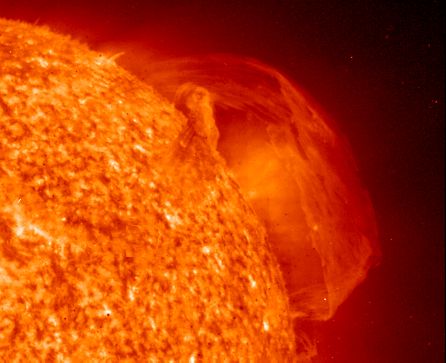
In Breif: The Sun is yellow, normal G2 Star. You should never look at it through a telescope of binoculars of any kind, even if it includes a shading effect. It will blind you instantly. The distance between the Earth and Sun is 93 million miles. The sun emits energy, light, and heat. The most outer region of the sun is called the Corona, the surface is called the Chromosphere, and then follow the outer layer, middle layer, and core.
        Diameter:    1.392 million km
        Temperature: Surface 5800 Kelvin
                     Core 14 million Kelvin
        Distance from center of galaxy: 30,000 light years
        Age: Estimated 4.5 billion years old
        Gravitational pull: 27.90 times more than Earth
        Volume: 1,303,600 times that of Earth
        Revolution period around galaxy: 225 million years
        Time for light to reach Earth: 8.3 minutes
        Containment of mass in our solar system: 99.8%
Mythology:
Containments:
The Sun is made of 25% helium and 75% hydrogen and an extremely small amount of metals. These amounts change as the Sun slowly changes hydrogen to helium inside of its core.
The Surface:
The photosphere of the Sun always have existing sunspots, which are the centers of the Suns magnetic field and are 2000 Kelvins cooler than the original surface. Although it is understood that these spots are associated with the magnetics of the Sun, all of its concepts are not fully understood. However, it is known that the Sun's magnetic field stretches far beyond Pluto, and sunspnts can reach up to 50,000 km in diameter.
The Core:
Gases in the core are condensed to a density 150 times more than water. The energy put out by the sun is produced in the core by nuclear fusion reactions and in a matter of minutes, millions of tons of hydrogen are converted into helium. As a result, millions of tons of energy are converted into gamma rays. The energy loses strength as it travels out of the sun and eventually reaches visibility at the surface.
Solar Winds:
The Sun produces a stream of charged particles called solar wind which travels through the solar system at a speed of 450 km/sec. These particles have a powerful effect on Earth through power surges and auroras at the poles of the Earth. Comets traveling near the sun will appear to have tails due to solar wind. Also, spacecraft will often be disturbed in path by the solar winds.
