An integer is a whole number that can be either greater OR less than 0
Positive integers are all the whole numbers greater than zero: 1, 2, 3, 4, 5,...
If an integer is greater than zero, we say that its sign is positive.
Negative integers are all the whole numbers less than zero: -1, -2, -3, -4, -5,...
If an integer is less than zero, we say that its sign is negative
We do not consider zero to be a positive or negative number
For each positive integer, there is a negative integer, and these integers are called opposites.
EXAMPLE: -3 is the opposite of 3, -21 is the opposite of 21, and 8 is the opposite of -8
ABSOLUTE VALUE
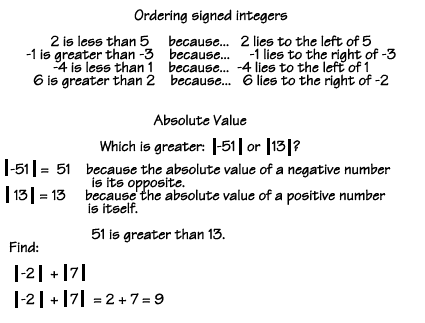
Every number on the number line also has an absolute value, which simply means how far that number is from zero.
The symbol for absolute value is two vertical lines. Since opposites are the same distance from the origin, they have the same absolute value.
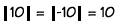
EXAMPLE: the absolute value of "negative 10" is ten, and the absolute value of "positive 10" is also 10.
The absolute value of zero is zero.
ADD AND SUBTRACT INTEGERS
We can use the number line as a model to help us visualize adding and subtracting of signed integers.
To add integers having the same sign, keep the same sign and add the absolute value of each number.
To add integers with different signs, keep the sign of the number with the largest absolute value and subtract the smallest absolute value from the largest.
The negative of a negative is the opposite positive number -(-a) = +a
EXAMPLE:
TRY OUT the practice problems
In the game the addition sign "+" is denoted as * because of technical problems. sorry for the inconvenience.



 TRY OUT the practice problems