The Rover V8 engine site - this site has an incredible amount of
information about the Buick 215cid engine which is essentially the same
motor as the rover 3.5, 3.9, 4.0, 4.2, and 4.6 V8 engines used by Land
Rover inrecent years. Rover bought the design rights from Buick a
long tiem ago.
Another Rover V8 page-
some good tuning and newer version vs. older version information.
Rover
V8 information page
Some
Buick/Rover Engine Specs
Buick/
Oldsmobile 215 V8 information
Buick/ Rover
V8 history and background - can be helpful in understanding
interchangeability of certain parts.
Buick.net -
very useful factory specs and things like recommended torque settings
for various engine bolts.
MGB V8
conversion site- A lot of good conversion information
Buick
V8 in a motorcycle - Too strange and interesting not to list
V8 Buick.com - 'nuff said
BritishV8 newsletter site -
These newsletters are great! They are made up of accounts of actual
experiences people have had building their own british V8 cars as well
as articles by some of the most knowledgeable guys on the planet on
converting MGbs to
V8 power. HIGHLY RECOMMENDED!-+
Great
Rover Parts source - Rimmer Bros.
Isky Cams - has several camshaft
designs and valve train components to increase the power of your Buick
215/ Rover 3.5 engine. Go to the engine sub-menu and select the Buick
215.
December 2002
OK the shop says the block bored out to .040 over. I called Dan LaGrou
at D&D Fabrications and ordered the pistons and rings. Meanwhile I
am porting the heads myself. Something I would not recommend without a
lot of
studying on the subject. I did not remove much of the aluminum head
material. Mainly I just matched the head openings for both intake and
exhaust with the openings in the intake and exhause gaskets. On
aluminum heads they say you should use a die grinder and coarse bits.
On Cast Iron they recommend regular bits. They being hotrod magazine
where I got this crazy idea that I could port my own heads in the first
place. It seemed easy, I guess I'll see how much damage I have done
when the engine is in the car and running.
I ordered 10.25 to 1 compression pistons. That, I am told, is about the
maximum compression you can run if you want the car to run on the gas
you can buy at any old gas station. If you go higher, you may have to
use an
octane booster additive or buy your gas at the airport (high octane
airplane
gas).
April 2003
The engine shop completed my engine. The engine currently consists of:
10.25 to 1 compression pistons
.0010 decked block
Ported heads (both the area beneath the valves and the intake and
exhaust
ports).
High volume oil pump
Stock Buick 4 barrel intake manifold
Stainless steel bolt kit
D&D starter nose (to rotate the solenoid around to hang directly
beneath
the starter and clear the side of the engine bay)
Clevite 77 crank bearings
lightened flywheel
Stainless steel swirl polished intake and exhaust valves
Isky 262 cam
Isky Cromoly push rods
Isky double valve springs
Pertronix electronic ignition (the one that fits inside the stock
distributor).
Pertronix Flamethrower coil
I plan on using mild steel block hugger type headers with the Jet Hot
coating
on the interior and exterior. This seriously reduces the headers'
ability
to absorb heat. This should help keep the engine bay cooler and prolong
the
life of the headers too!
Here is a photo of the engine as it looks now (without alternator,
water
pump, carb, or crank pulley installed)
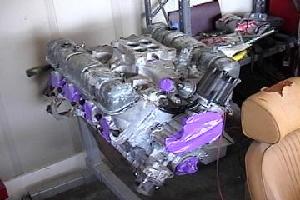
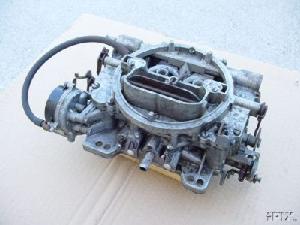
Engine
Carter
AFB
400CFM Carburetor that I will use.
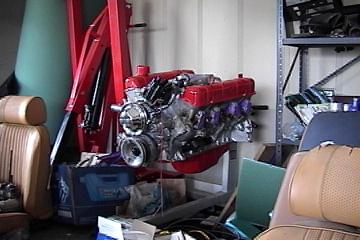
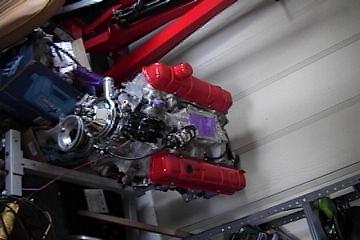
Engiine with some components bolted on and the oil pan and valve covers
powdercoated red.
 December 2003
Hit a snag trying to drop the engine in. First snag was
the little lip with the hole in it that the flexible clutch hose
connects to in the engine bay was keeping the engine from seating down
low enough to line the mounts up. I bent it down thinking that
would give me anough clearance, but it didn't. It needs to be
surgically removed.
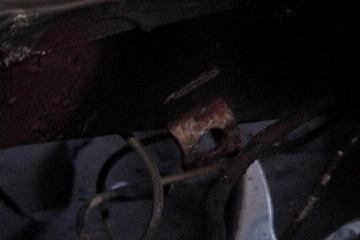
Then I tried again, but there was another snag. The harmonic balancer
made contact with the steering rack and would not let the engine drop
low enough for the mounts to line up.
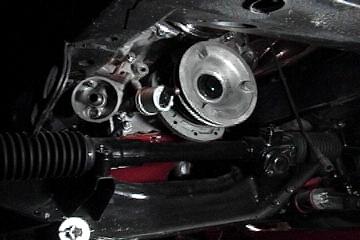
I am still researching what to do about this. I will bring you up to
date when I find out.
That's all for now.



 Project (page 2)