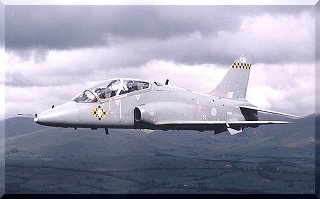
 In the current RAF training programme, the Hawk T1
is the first jet aircraft that a student pilot
will fly. An advanced, and very successful
trainer, Hawk is used to teach operational
tactics, air-to-air and air-to-ground firing, air
combat and low-level operating procedures. A
number of aircraft are also flown as target-tugs
by No 100 Squadron at Leeming, as well as by many
test establishments and the Royal Navy.
In the current RAF training programme, the Hawk T1
is the first jet aircraft that a student pilot
will fly. An advanced, and very successful
trainer, Hawk is used to teach operational
tactics, air-to-air and air-to-ground firing, air
combat and low-level operating procedures. A
number of aircraft are also flown as target-tugs
by No 100 Squadron at Leeming, as well as by many
test establishments and the Royal Navy.Originally
developed as a private venture by Hawker Siddeley,
the company was awarded a production contract in
October 1970 to supply 175 of their new two-seat
trainer aircraft to replace the Gnat in RAF
service. The aircraft was christened Hawk in and
the first production aircraft (no prototypes were
built) made its maiden flight on 21 August 1971.
First deliveries were made to No 4 FTS at Valley
in April 1976. Aircraft were delivered with the
ability to carry weapons and so some of the
Valley- and Brawdy-based Hunters used for weapons
training were retired and a new single-aircraft
syllabus developed to take advantage of the Hawk's
capabilities. By the end of 1976 all 175 aircraft
had been delivered, other receiving units being
Nos 1 and 2 Tactical Weapons Units at Brawdy and
Lossiemouth, the Central Flying School at
Scampton and Valley and later the Red Arrows, the
RAF's Aerobatic Team. In 1983, a contract was
signed for the modification of 88 Hawks to enable
them to carry Sidewinder air-to-air missiles and
be used as 'point-defence' fighters at airfields
around the country. With the reduction in RAF
training requrements, the Hawk fleet is now
concentrated at Valley, and many of these
aircraft will be modified in the coming years to
extend their service life well into the new
millennium.
One of the most successful British aircraft in
recent history, a number of foreign air arms fly
the Hawk (and its single-seat derivitives)
including: Abu Dhabi, Finland, Kenya, Saudi
Arabia, South Korea, Switzerland and the United
States Navy.
|
 |
Powerplant:
One Rolls-Royce/Turbomeca Adour Mk 151 turbofan
of 5,200lb st. Span: 30ft 9.75in (9.39m)
Length: 39ft 2in (11.96m)
Max Speed: 622mph (1,000km/h) at sea
level.
Accommodation: Two seats, in tandem.
Armament: Hawk T1 - One 30mm Aden
cannon pack and up to 5,600lb (2,540kg) of
underwing stores (rockets, bombs and missiles); T1A
- in addition has inboard pylons for Sidewinder
AIM-9 air-to-air missiles.
Recognition: Slightly-swept wings set
at the bottom of the fuselage. Top line of the
fuselage curves up from the pointed nose to
incorporate the long clear cockpit canopy then
slopes down to the jetpipe, giving a humped
appearance. Engine is internally housed with
small circular intakes on the lower sides of the
fuselage, forward and above the wing roots.
Slightly-swept vertical and horizontal tail
surfaces.
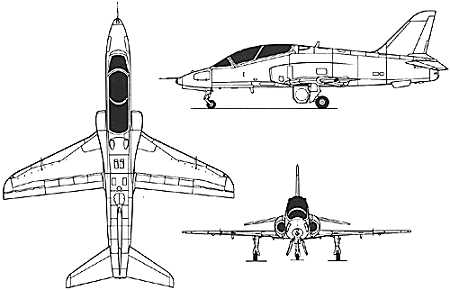
Hawk T1
|