Site hosted by Angelfire.com: Build your free website today!
How To Crochet
(And A Brief History Of)
By Ashley


    About  a year ago I picked up the fine tuned ability of the art of crochet.  Crochet seems to have originated in France. The modern name derives directly from the old French word “croches” which meant hook. There is historical evidence that crochet was practiced in the eighteenth century by French nuns. When they came to Ireland, they brought their crochet where it quickly became accepted. At this stage of development, crochet was used almost entirely to make lace. Only the finest threads were used for a delicate lacy effect, as seen today in Irish crochet.  Crochet became popular in England at the beginning of the Victorian era when it, along with embroidery and knitting, was an accomplishment of leisure class ladies. Early nineteenth century English crochet used fine thread, often silk, and was made to resemble imported laces as closely as possible.  In the early twentieth century, English crochet continued the Victorian taste with edging for linens and undergarments. Collars, ruffles, doilies, and gloves still return as popular items in each generation.  Today, yarn is more popular than fine threads for crochets. Afghans, blankets, and sweaters are made with all weights of yarn, but worsted is the most popular. Crochet is one of the most popular needle arts toady because of its versatility and adaptability. As a technique, crochet is used for toys and other 3 dimensional projects. Flat pieces, round, square, rectangular and free-form are easily accomplished. It is fairly easy to understand and make a challenging hobby for all ages.


  Before we actually get started I want to show you the different things that make up crocheting possible.  These things are also essential in actually performing basic actions.  To start there are also a few vocabulary words you can check back with for a reference.


Gauge

Gauge is determined by the tightness or looseness of your stitches, and affects the finished size of your project. If you are concerned about the finished size of the project matching the size given, take time to crochet a small section of the pattern and then check your gauge. For example, if the gauge called for is 10 dc = 1 inch, and your gauge is 12 dc to the inch, you should switch to a larger hook. On the other hand, if your gauge is only 8 dc to the inch, you should switch to a smaller hook.  If the gauge given in the pattern is for an entire motif, work one motif and then check your gauge.


Needles also come in a variety of different sizes, sizes, shapes, weights and materials.


Crochet Terms

Abbreviations

Definitions

alternate

alt

Alt sc, dc means to alternate single crochet and double crochet sts, you work an sc in the next st and then a dc in the next st.

approximately

approx

almost the same as

Back loop(s) only

blo

work your st(s) in the back loops of the sts only.

back post

bp

work your st around the post of the st inserting your hook.

beginning

beg

the 1st ch st number or st of a rnd or row.

block(s)

bl(s)

Bl(s) means block(s).

centimeter(s)

cm(s)

a measurement of length as in a work of crochet or a body measurement for sizing. (Example: 1cm =.3937 inches or 1in = 2.54 centimeters)

chain(s)

ch(s)

this stands for chain stitch. 

cluster(s)

cl(s)

a group of sts which make a cluster.

Color A

CA

the second color in a pattern

Color B

CB

the third color in a pattern


Yarn Over
YO
The yarn goes over the needle or the stitch.

Color C

CC

the fourth color in a pattern (see also Contrasting Color)

continue

cont

Go on with a pattern or st.

Contrasting Color

CC

Instead of using Color A, B and C, CC is the
secondary color used in a pattern.


dark

dk

not light


decrease

dc

to make fewer stitches by crocheting sts together or leaving sts unstitched.


directions

dir

the written instructions within a pattern.


double

dbl

two of one kind


Now is the time for you to sit down relax with your favorite yarn and needle and prepare to create!


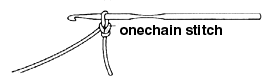
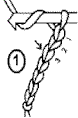
First you need to tie a simple slip knot to begin the base stitch of your project.   Place the needle into the first stitch.  Pull the yarn through the first loop in the stitch and you've started your chain.  Continue pulling the yarn through each consecutive loop until you are comfortable enough to move on to the next step, or until you have your desired length.


To insure that you are sucessful in your first venture into crochet try to get a firm grounding stitch.  The stitch on the left is the perfect grounding stitch because the stitch is firm, not to tight and there is an uniform look to all of the stitches.  The stitch on the right is too loss and hard to handle making each stitch even more difficult to read.  It may take you awhile to be able to achieve the stitch on the left but all you need is practice.


o
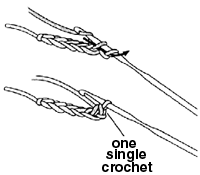
When  you have finished your base stitch you are ready to start creating actual rows for your project.  The picture above illustrates just how easy it is to start a new row.  Simply stop where you are in the first chain, flip the chain over and slip the needle through half of the stitch and bring the yarn through the opening.  This action is similar to the pull made in the first step.  Once you have the yarnsecured around the needle, pull it straight through the both openings.  You have created a single crochet.  Continue the same motion until you reach the end, making sure that you have caught all of the stitches.  When you get to the end of the row make the same turning motion you did when you created to row, and continue from there until you have reached your desired size.


 When you get to the end of the row make the same turning motion you did when you created to row, and continue from there until you have reached your desired size.


The Half Double Crochet Stitch
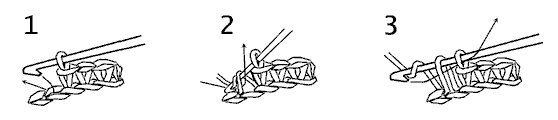
Chain 15 to practice. Yarn over hook once (1). Insert hook in 3rd chain from hook, yarn over, and pull a loop through chain (2). Yarn over and pull yarn thru all 3 loops on the hook (3). Work a half double crochet in every chain across. At end, chain 2, turn to other side.


As you get better and better you can start doing larger projects such as afgans and even clothing.. The possibilties are as endless as the imagination.


Helpful Links


Crochet Guild of America's
Official Web Site


Crochet Partners


Crochet Treasures
 
Stitch Guide