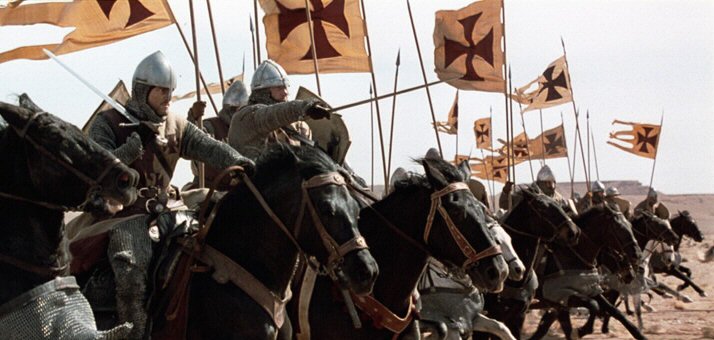
DIRECTOR: Ridley Scott
CAST:
Orlando Bloom, Eva Green, Jeremy Irons, Marton Csokas, Brendan Gleeson, Liam Neeson, Ghassan Massoud, Alexander Siddig, David Thewlis, John Finch, Edward Norton
REVIEW:
With its desert landscape and ancient setting, Kingdom of Heaven bears some superficial similarities to Ridley Scott's 2000 Oscar-winner Gladiator, but is in some ways an even more ambitious production. Unfortunately, Kingdom of Heaven is a far less engaging motion picture.
We start in France in 1184. It has been over a century since Crusaders from Europe seized Jerusalem, and one Knight, Godfrey (Liam Neeson), returns to his home village to find his son, the blacksmith Balian (Orlando Bloom), who is mourning his wife's suicide after the death of their child (even more so due to the belief that she has condemned her soul by taking her own life) and has never known his father. Their first encounter isn't exactly warm, but Balian is drawn to Godfrey's description of Jerusalem as a place of salvation. Father and son's reunion is brief, however, as Godfrey is mortally injured in an ambush in the forest. Before dying, he explains that in Jerusalem they are trying to create a "better world", open to all faiths, where all can live in harmony. After surviving a shipwreck and a an encounter with a young Muslim warrior, Nasser (Alexander Siddig), Balian finally makes his way to Jerusalem "at the end of the world", where thus far a somewhat tense but unbroken peace with the Muslims has been upheld by King Baldwin IV (an uncredited Edward Norton, hidden behind a silver mask). Baldwin is a fair and just man, but he is dying of leprosy, and this raises the fear that he may be replaced by less reasonable elements who do not share his willingness to co-exist with Muslims, chiefly Guy de Lusignan (Marton Csokas), a haughty nobleman who shows little respect for the ailing King and sneers openly at the commoner Balian ascending to his station. To further complicate matters, Guy is married to Baldwin's sister Sibylla (Eva Green), and an attraction quickly develops between she and Balian. Two other significant Christian characters are Tiberias (Jeremy Irons), faithful servant of the King, and Reynald (Brendan Gleeson, who seems to show up on almost any battlefield from medieval Scotland to ancient Troy), a war-monger itching to go to war against the "infidels" and allied with the scheming Guy. On the Muslim side, in addition to Nasser, we have the famed general Saladin (Syrian actor Ghassan Massoud), who can be a fearsome enemy but is not unreasonable and has been willing to negotiate with Baldwin in the past. But Guy and Reynald's lust for war and religious intolerance is about to shatter the peace and embroil the Holy Land in a conflict which the walls of Jerusalem will not be able to withstand.
This all sounds like a much better story than it turns out to be. Maybe it's just poorly-handled. Or maybe the filmmakers bit off more than they knew how to chew. It's hard to determine how much to blame Ridley Scott or screenwriter William Monohan, as Scott's original cut ran over three hours until producers balked at the length, insisting no one would go see it, and wanted it fashioned into more of an action-adventure than the religious/historical epic Scott and Monohan had intended it as, ordering it cut down to two hours. Ironically, one of the main criticisms of the film, which performed underwhelmingly at the box office, especially considering how expensive it had been to make, was that it felt "incomplete", likely a result of the studio meddling. Aspects of the storyline are muddled; Guy and Reynald's enmity with Balian is set up as a major plot point and is then abandoned altogether once the war gets started. Guy, set up as the villain, is basically completely forgotten about by two-thirds of the way through and his fate is not even made clear, indicating there was probably originally more resolution to this plot-line than what we see here. One also gets the feeling that David Thewlis, as a friend of Balian's, was meant to have a larger role. However, there are still flaws even with what remains onscreen. The battle scenes, while epically-mounted and technically convincing, are also stupefyingly repetitive. Endless shots of columns of troops marching forward again and again, flaming arrows raining down on Jerusalem, swordfights, bloody flying...it all looks impressive the first time, but not when repeated with little variation over and over. Character development is thin (though this is likely more so due to the cut material) and about two-thirds of the way through, the filmmakers seem to abandon any attempt at building it any further and simply occupy the remaining screentime by throwing one identical battle scene after another at us. The result is that we're bored not only because the battles all look the same, but because we haven't grown to care very much about anyone. Incidentally, the film was also criticized for Hollywoodizing its history; while Balian, Guy, Baldwin, Sibylla, and Saladin all actually existed, Baldwin was indeed a leper, and his sister Sibylla was indeed married to Guy de Lusignan, Balian was in fact a born-and-raised nobleman, not the blacksmith of the movie, and had no romantic relationship with Sibylla.
The acting is adequate but unexceptional, and as with other aspects of the film, some performances seem undercut by too much of their screentime ending up on the cutting room floor. At the time of the film's release, this was touted as Orlando Bloom's meatiest dramatic role yet, but there is really nothing here to justify that claim. There's nothing really "wrong", per se, with Bloom's performance, but there's nothing distinguished about it either. Balian has no more dimension than the prissy villains. He's never anything less than pure-hearted and righteous, and somehow manages to become a great military commander and a skilled warrior, although the scant time he spent with Godfrey hardly accounts for his sudden abilities. If Bloom is seeking to prove himself as a dramatic actor instead of merely a bland pretty boy, he needs to find a more substantial role than this.
No one else, even much more acclaimed actors than Bloom, makes much impression either. Marton Csokas preens and sneers and glares but never makes it seem to add up to much of anything, and Brendan Gleeson is running on over-the-top autopilot. Even if some of their material was cut, it's disappointing that Guy and Reynald are such one-note villains when Scott made an effort to give a level of dimension and conflict to Gladiator's Commodus. Equally lackluster is the romance between Balian and Sibylla; Orlando Bloom and Eva Green, at least with each other, generate no spark whatsoever. They're two characters who suddenly fall in love because the script says they do. Jeremy Irons brings gruff authority to Tiberias, and Ghassan Massoud brings touches of dignity and nobility to Saladin, but their screentime is limited. Some praised Alexander Siddig as a standout, but to me the same is true of him as the others. Edward Norton manages to play the dying King with some sense of dignity, although we never see his face. Ironically, the most vibrant performance comes from the actor with probably the least screentime of anyone. Liam Neeson might be getting a little typecast in the role of the martyred mentor (Star Wars Episode I, Gangs of New York), but when he's onscreen, Kingdom of Heaven feels alive, and we come to miss him once he's gone. Neeson seems at ease in period battle scenes, and can make a line like "I once fought for two days with an arrow through my testicles" sound like he's speaking from a real experience, not just reciting what the script tells him to say. He has a few mildly amusing lines like that, providing the only spark of humor in a movie that's otherwise too earnestly dour for its own good. Incidentally, Ridley Scott's original cut reportedly included a final encounter between Balian and Guy which gave their enmity more closure, and a significantly expanded role for Sibylla which gave her character a needed fleshing-out.
Kingdom of Heaven is not devoid of interesting elements. One recurring theme of the film (clearly left over from Scott and Monohan's original vision) is that organized religion is easily corrupted and true spiritually comes from one's own heart, not from the commands of so-called religious leaders who are often justifying their own agendas by calling it "the will of God". Like Geronimo and We Were Soldiers, it graphically depicts a bloody conflict without entirely absolving or demonizing either side. The Muslim General Saladin is a reasonable man and an honorable foe, and he and Baldwin respect each other as responsible and just leaders of their people. These two are willing to try talking instead of immediately launching into battle. The battles themselves, when they come, are handsomely-mounted and technically well-made, even if their repetitive nature undermines their effectiveness. Harry Gregson-Williams provides a haunting and evocative score that captures an epic feel the rest of the movie fails to convey. But the film is poorly put-together, a plodding, unwieldly epic which lacks the focus or impact to justify a running time which in the end feels not "epic" after all, but simply far too long.
**1/2
Back To Jester's Movie Reviews