DIRECTOR: Rene Clement
CAST:
Jean-Paul Belmondo, Charles Boyer, Leslie Caron, Jean-Pierre Cassel, George Chakiris, Bruno Cremer, Alain Delon, Kirk Douglas, Glenn Ford, Gert Frobe, Yves Montand, Anthony Perkins, Simone Signoret, Robert Stack, Pierre Vaneck, Marie Versini, Skip Ward, Orson Welles, Claude Rich, Gunter Meisner, Joachim Hansen, Wolfgang Preiss, Karl-Otto Alberty, Hannes Messemer, Billy Frick
REVIEW:
From French director Rene Clement and a screenplay by Francis Ford Coppola and Gore Vidal comes this large-scale but rather muddled and ponderous French war film that tries to be a classic WWII epic like The Longest Day or A Bridge Too Far but doesn't achieve their status.
August 1944: The Allies have landed in Normandy and are advancing across France towards the capital of Paris. Four years of German occupation seem to be at an imminent end, and in Paris the young, rebellious students can hardly restrain their pent-up excitement as they count down the last days of Nazi domination. But the older, experienced Resistance fighters know the war is not over yet. In fact, the hard-nosed German General Dietrich von Choltitz (Gert Frobe) has just taken charge of the city, and seems to have no intention of surrendering. Choltitz brings with him a ruthlessly loyal reputation and orders directly from Adolf Hitler (Billy Frick) to hold Paris as long as possible...and then destroy it. But is Choltitz really as unquestioning as he seems? Will he really do it? The French Resistance, which is itself made up of many rival political factions, doesn't intend to wait long enough to find out, but they have learned that the Allies plan to go around Paris instead of liberating it immediately in their race toward the German border. The uprising to save Paris is launched, but can it succeed without the Allies? And how will General von Choltitz respond?
The liberation of Paris after four years of Nazi occupation is an inspiring and courageous true story which is portrayed quite accurately here, but Is Paris Burning?, while hitting strong moments, is unable to maintain consistent momentum. Too many lengthy periods of time go by with French Resistance members talking- or shouting- about what has to be done, but without anything actually seeming to really be happening. With the exception of the American scenes, the film is dubbed in English from the original French and German, resulting in characters' mouths obviously not matching their words. This is somewhat distracting, especially since many of the French and German actors in the movie have spoken English in other movies (Jean-Pierre Cassel, Gert Frobe, Joachim Hansen, Wolfgang Preiss, Gunter Meisner, Karl-Otto Alberty) and many of them dubbed their own voices over into English, making one wonder why they didn't just have them speak English in the first place and avoid the distracting dubbing. Some of the actors (including Preiss) are dubbed by someone else (considering Preiss spoke English in various films, your guess is as good as mine why he didn't just dub himself), and too many of the dubbed voices, especially among the French actors, sound wooden and ill-matched to their character, but a few of the French actors stand out in the crowd, including Bruno Cremer as Communist leader Colonel Rol, who tries to outmaneuver the rival resistance groups by making the first move against the Germans, Claude Rich as General LeClerc, returning to France after years of fighting abroad while his homeland was occupied, and especially Pierre Vaneck as Resistance agent Roger Gallois, who makes his way out of Paris to the Allied lines on an urgent mission to persuade them to enter Paris instead of bypassing it; his desperate plea to a room of inscrutable Allied officers is one of the highlights of the film. Unfortunately, while Vaneck in particular gives a distinct and impassioned performance, most of the other French Resistance characters all seem to blend together. American stars like Kirk Douglas and Glenn Ford have bland cameos as Generals Patton and Bradley, and seemingly make random walk-on appearances to boost the movie's interest to American audiences. Making somewhat more of an impression is Anthony Perkins as a GI excited to be seeing Paris for the first time. Figuring prominently in the first half of the film is Orson Welles as Swedish diplomat Raoul Nordling, who tries to use his diplomatic status to get captured Resistance fighters turned over from the SS into the custody of the Red Cross, and to convince General von Choltitz not to carry out the demolitions. Welles is moderately engaging, if not terribly energetic (and makes no attempt at a Swedish accent, by the way), and the film brings a little attention to an unsung hero of WWII, but approximately halfway through his character basically disappears. One of the problems of the film, as with The Longest Day, is that some of these characters, even significant ones like Nordling, appear in a few scenes and then simply drop out of the film and are never seen again.
Considering this is a French movie about the end of the hated German occupation, the Germans are treated pretty even-handedly. The briefly-seen Hitler is maniacal and brutal, the Generals immediately around him, like Jodl (Hannes Messmer) and Burgdorf (Peter Jacob) are unquestioning sycophants, and the SS and Gestapo are ruthless fanatics, but most of the German soldiers don't show much enthusiasm for the lost war or their orders to demolish Paris. Early on a "defeatist" (or realist) is thrown into prison by a loyal officer, and a prison Kommandant (Joachim Hansen) expresses distaste for the "SS pigs". Choltitz's staff are obviously alarmed by his demolition orders even before the General himself shows any doubts. Wolfgang Preiss is a demolitions expert, albeit dubbed and minus his original voice, and uber-creep Gunter Meisner has one scene as- what else?- a menacing Gestapo officer. The almost as creepy Karl-Otto Alberty has one scene taking a well-deserved shot at the absurdity of the Nazi hierarchy, who have sent him to Paris to "rescue" a famous painting and take it to Hitler as a gift. Speaking of der Fuehrer, Swiss actor Billy Frick makes only a fleeting appearance in the film's prologue, but he does a good enough job imitating Hitler's guttural vocal inflections and bears a good enough physical resemblance to make the cameo convincing. In fact, it's almost a little disappointing Frick doesn't make a reappearance, and is only heard at the end screaming "brennt Paris??" ("is Paris burning?") out of an ignored telephone. Incidentally, while the rest of the German sequences are dubbed into English, Hitler's scene is in German, presumably because the filmmakers felt Frick would be more effective imitating Hitler's guttural German speech than speaking English. Gert Frobe, more familiar in comedic roles and best-known as Bond villain Goldfinger, shows he is perfectly at home in a straight dramatic part, using a cold and businesslike demeanor to mask internal conflict as a simple soldier who has always obeyed his orders but finds himself unable to simply click his heels and destroy Paris. The German officers who do not want to see Paris demolished are initially alarmed by Choltitz's methodical demolition plans, but there is a well-played scene between Frobe and Welles where Choltitz admits that his heart is not in his assignment and he would welcome an excuse not to carry it out. It falls to Gallois to convince the Allies to take Paris and provide Choltitz with the way out he is looking for. Frobe's performance, like a stoic military man, is never flashy, but it's always worth watching. In fact, considering he's about the only character we follow all the way from beginning to end, it's easy to make a case that Frobe is the real "star" of the show, and certainly the character who makes the most impression.
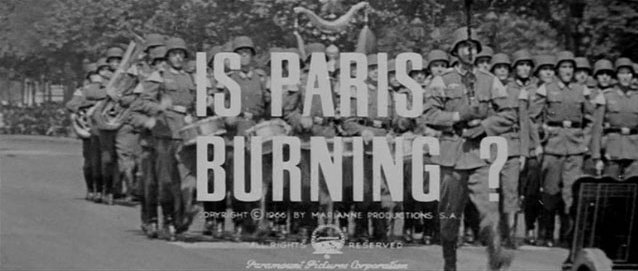
For a war film, Is Paris Burning? has fairly few and rather small action scenes, no big battle, just skirmishes between the French Resistance and the half-hearted Germans. Many plot aspects are muddled, particularly the political division and infighting among the various factions of the French Resistance, which can leave a viewer who hasn't read the same-named book upon which the film was based a little bewildered at who all these people are. Finally, the film is simply too long and moves slowly towards the final reel, never quite growing as tense or exciting as it should. The final third or so builds a little more momentum, but the film overall rambles somewhat, and many things are left inadequately explained. Along the way, the film is saved from collapse by a number of striking highlights- the briefly-seen but eerily believable Hitler cameo, Gallois' plea to the Allies, the Gestapo gunning down a group of rebellious students, Allied tanks proceeding through throngs of ecstatic crowds, and a scene at German headquarters as the French Resistance and the Allies overrun the city and Choltitz suddenly finds himself sitting alone at the dinner table, his guests having deemed it a good time to make themselves scarce. He stoically lights up a cigarette and calmly waits for the Allies. Frobe hits perhaps his finest moment as General Jodl demands that he explain why he hasn't carried out demolitions yet, and Choltitz, having had enough of his assignment, simply hangs up the phone. The film does an exceptionally skillful job of blending archive footage and scenes filmed for the movie, aided of course by the black-and-white. Maurice Jarre provides a stirring and powerful musical score, from the opening ominous military march set to archive footage of German military parades and occupied Paris to the triumphant, cheerful waltz which concludes the film. The climax, made up mostly of actual footage of the liberation, the streets filled with cheering French crowds, the bells of Notre Dame ringing, and the closing overhead of Paris' many famous landmarks cannot help but leave you feeling uplifted, and the joyous conclusion can lead you to forgive some of the film's shortcomings. All in all, Is Paris Burning? bit off more than it chewed, and falls short of the war epics it seeks to emulate, but it's still worth at least one viewing for WWII film buffs, especially those interested in the specific subject.
**1/2
Back To Jester's Movie Reviews