
DIRECTOR: James Cameron
CAST:
Sam Worthington, Zoë Saldana, Sigourney Weaver, Stephen Lang, Giovanni Ribisi, Michelle Rodriguez, Joel David Moore, CCH Pounder, Wes Studi, Laz Alonso
REVIEW:
It's possible to experience a little of the same thrill watching Avatar that audiences felt in 1977 watching the original Star Wars for the first time. It's not surprising that it has gone on to seize the title of all-time box office champion; its appeal lies across a broad spectrum. It embodies the feeling of wonder and being transported to another world that an elite few films truly evoke. It is quite possibly the the most technically amazing motion picture yet to hit the screen. It provides such beautifully detailed eye candy that it demands repeat viewings on that score alone...that it is also by turns thrilling, romantic, poignant, and uplifting is the icing on the cake. Like The Last of the Mohicans
or The Lord of the Rings, Avatar is not just a movie; it is an experience that connects on a visceral level, serving up spectacular visual effects extravaganza without losing sight of emotion or character and not only an eye-popping spectacle or enthralling entertainment (although it is both), but quite possibly the feather in writer-director James Cameron's cap.
It is the year 2154, and with the Earth depleted, the RDA- Resources Developmental Administration- has set up camp on the distant moon of Pandora mining a precious mineral called Unobtainium (apparently in Cameron’s idea of a witty in-joke). The biggest deposit lies squarely beneath home base of the local clan of Pandora’s natives, towering slender blue-skinned beings called the Na’vi, who live a tribal existence in harmony with nature, but they are viewed as savages and a primitive nuisance by RDA administrator Parker Selfridge (Giovanni Ribisi), who needs them to relocate for his mining operation to move forward. Standing by to enforce this is a security contingent of former military turned RDA hired guns headed by Colonel Quaritch (Stephen Lang), a beefy, battle-scarred hardass with an itchy trigger finger. There’s no love lost between the Selfridge-Quaritch faction among the humans on Pandora, and the other, a team of scientists led by Dr. Grace Augustine (Sigourney Weaver), operating remotely-controlled bodies called avatars to study the planet. Genetically engineered to look identical to Na’vi, the avatars are operated via a linkup with their human counterpart’s mind; the human’s body lies in a dreamlike state back at base while their temporarily transplanted consciousness “drives” the avatar, exploring Pandora and mingling with the natives. Jake Sully (Sam Worthington) winds up on this team as a fluke. His scientist identical twin brother has died suddenly, leaving Jake, a paraplegic ex-Marine who doesn’t know a thing about Pandora, as the only person who can link to his avatar. Grace isn’t happy about this, but Quaritch gives Jake the job of double agent, gaining inside intel about the Na’vi to help clear the clan off the land Selfridge wants to mine. In exchange, he promises to get Jake back the use of his legs, a proposition Jake is initially eager to accept. Jake soon meets native Neytiri (Zoë Saldana, providing the voice and motion capture for an entirely CGI character), who comes to his rescue when he’s separated from the other avatars and stranded in the forest. Neytiri becomes his mentor in Na'vi ways, and although initially viewed with suspicion, Jake is eventually accepted as a member of the clan, placing him in an ideal position to report back to Quaritch. But the more time Jake spends among the Na’vi, the more he’s drawn to Pandora’s natural wonder, the Na’vi’s deep connection to their world, and Neytiri, and finds his allegiances and his own identity blurred.
.
Of course, the main talking point of Avatar is the special effects. James Cameron, who had written the story in 1995 and waited ever since for technology to catch up (The Lord of the Rings' Gollum, using the same motion-capture technology that Cameron would use here, convinced him the time had come), poured reportedly between $250 and $300 million (surpassing Cameron's own Titanic
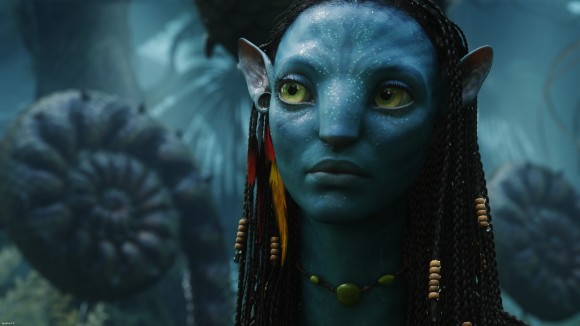
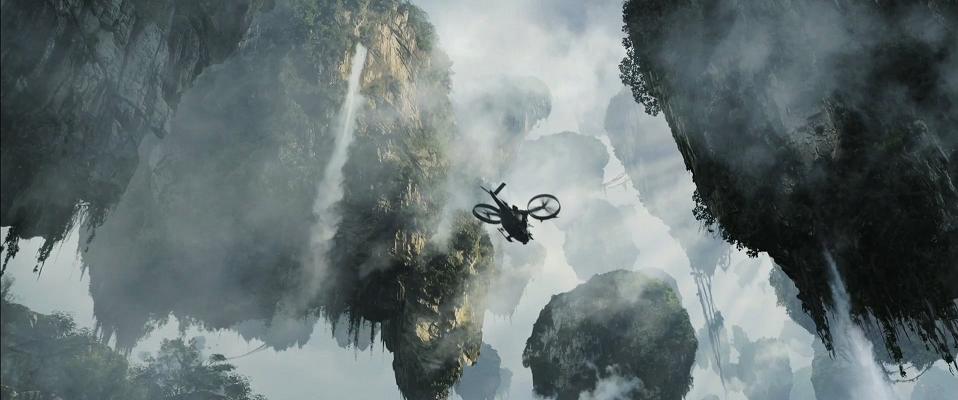
as one of the most expensive movies ever made) into bringing the world of Pandora to life, and every cent is visible up on the screen. A significant part of what makes Avatar thrilling is the endless sense of discovery, as we marvel at rhinoceros-like herd creatures with heads like hammerhead sharks, a fearsome predator that looks like a cross between a panther and a lizard, flying dragon-like “banshees” who form lifelong bonds with their Na’vi riders, frog-like creatures that spin into the air like helicopters when touched, cackling jackal-like creatures who lurk in packs at night with glowing eyes, floating mountains, grass that lights up when stepped on, and huge mushrooms that seem to glow. Only the Star Wars prequels have comparable levels of special effects; there is always something to look at. And then, of course, there are the Na’vi themselves. Twelve feet tall, with blue skin speckled with spots that glimmer like constellations, scantily-clad, with tails that connect to other beings, or trees, or the earth itself like a USB port, the Na’vi are astonishingly real, from the trickle of tears down a cheek to the flicker of life in their eyes, subtle nuances of facial expressions, the moist sheen of their skin. And, like Gollum in The Lord of the Rings, the most key accomplishment of the Na’vi is that within a few minutes we stop viewing them as special effects creations. Avatar is no hollow special effects showcase. All of the principal Na’vi are distinct individual characters we have no trouble telling apart, who project as much emotion as the humans. And, in another very crucial accomplishment considering Jake in particular spends as much or more time in his avatar body than his human one, we never lose sight of the characters as they switch back and forth between themselves and their avatars. Not only are Sam Worthington’s and Sigourney Weaver’s voices on display, their performances (along with Zoë Saldana’s) were motion-captured, a breakthrough technique perfected with Andy Serkis as Gollum in The Lord of the Rings, meaning all of the actors fully physically performed their scenes and were replaced afterwards with CGI creations copied 100% from their expressions and movements (it also helps that the avatars vaguely resemble their human models). Jake is Jake, whether he's in his wheelchair-bound human body or running through the woods as a Na’vi. We can empathize with Jake's heady rush of exhilaration the first time he enters his avatar and is able to walk and run again, and at times, the depth of the emotions the Na'vi project are heart-tugging, particularly when the clan is dealt a devastating blow and their grief is entirely convincing. The scene in which Neytiri introduces Jake to his first flight with his Banshee not only palpably conveys the thrill of flying, but also an obvious romantic undertone: Jake is falling in love in more ways than one. The difference between Avatar and, say, Transformers is deeply marked. Both may be special effects extravaganzas, but while Transformers splattered flashy special effects all over the place without giving us a single character worth giving a damn about, Avatar has a heart and a soul. The general plot has been compared to Dances With Wolves in space, with aliens in place of Native Americans, and that’s basically the gist of it. The Na'vi are very obviously modeled after Native Americans (it’s probably no coincidence that the Na’vi chief and Neytiri’s father is played by Cherokee actor Wes Studi), and Sam Worthington’s Sully goes through a similar journey to Kevin Costner’s Dunbar.
In keeping with James Cameron’s skill at balancing epic spectacle and character, the actors uniformly keep themselves from being overshadowed by the special effects, which is the central reason the effects serve the story as opposed to overwhelming it. Sam Worthington is solid- if not spectacular- as Jake, with a straightforward everyman demeanor that suits him as our entry point into the world of Pandora, and his American accent has improved (if not been perfected) from Terminator Salvation
. Also, the fact that Worthington is a relative newcomer might make it easier to just see him as a blank canvas for the character to be projected on, without the baggage or preconceptions a more familiar face might have brought with them (producers reportedly wanted to headline with more established stars Matt Damon or Jake Gyllenhaal, but Cameron stuck with his original preference Worthington). Reunited with Cameron from 1986’s Aliens
, Sigourney Weaver is her usual feisty self (albeit in a supporting role this time), giving Grace an acid tongue and a strong backbone. She makes a prickly first impression but later shows more heart. Cameron’s movies are noted for their strong female characters, and Avatar has several. Joining the ranks of formidable Cameron heroines is Zoë Saldana, whose Neytiri is both a female warrior as fierce as any man, and so beguiling that it's not hard to buy that Jake falls in love with her. Saldana, given a more central role in her second big sci-fi film (following her young Uhura in Star Trek
), imbues Neytiri with spirit, depth, and heart, an all the more noteworthy accomplishment especially considering, unlike Worthington or Weaver, she never appears "in the flesh". In fact, while I would say Gollum is overall more complex, Neytiri is easily the second most emotionally expressive and striking CGI character yet to appear onscreen, a captivating blend of performance and state-of-the-art wizardry, and while the effects team deserves every laurel they will receive, Saldana's work should not be overlooked. Of the actors whose real faces are onscreen for the entirety of their screen time, Giovanni Ribisi does a good job being obnoxious, but he doesn’t play Selfridge as “evil”, just cynical and ignorant, not understanding a thing about the Na’vi and not interested in learning, focused on his profit showings. The real bad guy of Avatar is Stephen Lang as the ferociously gung-ho Colonel Quaritch, who considers the Na’vi savages and Pandora a hellhole, and seems to be itching for an excuse to raze the entire jungle. We can easily imagine Lang’s Quaritch saying Robert Duvall’s iconic line from Apocalypse Now: “I love the smell of napalm in the morning”. Saldana might have the most striking role, but Lang gets the most opportunity to chew the scenery, snarling over-the-top lines with a swaggering gusto and proving almost as indestructible as The Terminator. Also, while Quaritch is ruthless and callous, like Selfridge he's not really "evil", and unlike Selfridge, it's possible to admire him at least a little bit for what a hardass he is. In smaller roles, Michelle Rodriguez rounds out the tough women contingent as a ballsy pilot who sides with Jake and the Na'vi, and CCH Pounder and Wes Studi generate commanding presences as the clan leaders and Neytiri's parents, although only their voices are present onscreen (Studi’s voice is instantly recognizable, even if his features aren't).
 And behind it all, there is an unseen star of Avatar: James Cameron. Starting with 1984’s The Terminator
, Cameron has always been on the cutting edge of visual effects technology, and despite only having directed a handful of films (he went a dozen years between Titanic and Avatar), all with the exception of 1989’s The Abyss have been massive hits. Cameron has a notorious reputation in Hollywood as a demanding and temperamental taskmaster, but however hard he may push his cast and crew, the results speak for themselves. It's worth pointing out that there is a group of "Cameron regulars" including Michael Biehn (The Terminator, a deleted cameo in Terminator 2
, Aliens, and The Abyss) and Bill Paxton (The Terminator, Aliens, True Lies, and Titanic), and Avatar reunites him with his Aliens star Sigourney Weaver, proving there are actors who support his directing style (Biehn was considered for the role of Colonel Quaritch, but Cameron felt reuniting Weaver and Biehn would remind viewers too much of Aliens). Avatar has a lot of familiar Cameron ingredients. Like the Terminator films and Aliens, it's another entry in the sci-fi genre, and like Aliens it visits an alien world. Its rapacious corporation backed up by Marines bears more than a passing resemblance to the omnipresent "company" in the Alien series. Where The Terminator's couple was separated by decades in time, and Titanic's lovers were divided by social class, Avatar's don't even share the same species (Cameron's fondness for seemingly impossible romances indicates that there's a wide romantic streak laying beneath his hard-nosed perfectionism). But while some of the elements bring previous Cameron entries to mind, not even Titanic was painted on anywhere near this epic and ambitious a canvas, providing the most fleshed-out and eye-poppingly detailed depiction of an alien world ever brought to the screen.
And behind it all, there is an unseen star of Avatar: James Cameron. Starting with 1984’s The Terminator
, Cameron has always been on the cutting edge of visual effects technology, and despite only having directed a handful of films (he went a dozen years between Titanic and Avatar), all with the exception of 1989’s The Abyss have been massive hits. Cameron has a notorious reputation in Hollywood as a demanding and temperamental taskmaster, but however hard he may push his cast and crew, the results speak for themselves. It's worth pointing out that there is a group of "Cameron regulars" including Michael Biehn (The Terminator, a deleted cameo in Terminator 2
, Aliens, and The Abyss) and Bill Paxton (The Terminator, Aliens, True Lies, and Titanic), and Avatar reunites him with his Aliens star Sigourney Weaver, proving there are actors who support his directing style (Biehn was considered for the role of Colonel Quaritch, but Cameron felt reuniting Weaver and Biehn would remind viewers too much of Aliens). Avatar has a lot of familiar Cameron ingredients. Like the Terminator films and Aliens, it's another entry in the sci-fi genre, and like Aliens it visits an alien world. Its rapacious corporation backed up by Marines bears more than a passing resemblance to the omnipresent "company" in the Alien series. Where The Terminator's couple was separated by decades in time, and Titanic's lovers were divided by social class, Avatar's don't even share the same species (Cameron's fondness for seemingly impossible romances indicates that there's a wide romantic streak laying beneath his hard-nosed perfectionism). But while some of the elements bring previous Cameron entries to mind, not even Titanic was painted on anywhere near this epic and ambitious a canvas, providing the most fleshed-out and eye-poppingly detailed depiction of an alien world ever brought to the screen.
 Avatar is such a triumphant accomplishment that mentioning its minor flaws feel like nitpicking, but I will mention them for completeness’ sake. Avatar has a few derivative elements. James Horner’s score, while effective, frequently recycles his own work for Aliens, Titanic, Enemy at the Gates, and Glory
. The creature designs are original but some of their sounds are not; one sounds like Jurassic Park’s T-Rex, another like its Velociraptors. There's some corny dialogue scattered around, with Sam Worthington saddled with the the clunkiest of it, although Stephen Lang gets his share. Characterizations are a bit stereotypical, especially of the baddies; while there's nothing wrong with the performances of Giovanni Ribisi or Stephen Lang, the characters as written border on caricatures. Selfridge is introduced playing golf in his office in movie character development shorthand for "corporate jerk", while Quaritch contentedly drinks coffee while watching his gunships assault a Na'vi sacred site in a touch that would require him to laugh evilly and twirl his moustache to outdo it for unsubtlety. Between the Na'vi whooping like Apache, "Unobtainium", and Quaritch saying things like "shock and awe", and "we will fight terror with terror", subtlety isn't Cameron's strong suit, and those rankled by his thinly-veiled political statements may take issue with aspects of Avatar. While it’s one of the most visually inventive films ever made, the basic story is hardly original- as mentioned earlier, it’s basically Dances With Wolves reinterpreted with a sci-fi twist (and a dash of Pocahontas)- and the major points are predictable. Does anyone really not see the romantic angle between Jake and Neytiri coming? After the first scene between Jake and Colonel Quaritch, does anyone really have much doubt that these two will end up on opposite sides in a climactic mano-a-mano? A climactic plot element is telegraphed ahead of time with all the subtlety of a flashing neon sign. And whether you find SPOILER WARNING the planet itself rising up against the human invaders in the climactic battle thrilling or corny depends on how swept up you are by everything that's come before.
Avatar is such a triumphant accomplishment that mentioning its minor flaws feel like nitpicking, but I will mention them for completeness’ sake. Avatar has a few derivative elements. James Horner’s score, while effective, frequently recycles his own work for Aliens, Titanic, Enemy at the Gates, and Glory
. The creature designs are original but some of their sounds are not; one sounds like Jurassic Park’s T-Rex, another like its Velociraptors. There's some corny dialogue scattered around, with Sam Worthington saddled with the the clunkiest of it, although Stephen Lang gets his share. Characterizations are a bit stereotypical, especially of the baddies; while there's nothing wrong with the performances of Giovanni Ribisi or Stephen Lang, the characters as written border on caricatures. Selfridge is introduced playing golf in his office in movie character development shorthand for "corporate jerk", while Quaritch contentedly drinks coffee while watching his gunships assault a Na'vi sacred site in a touch that would require him to laugh evilly and twirl his moustache to outdo it for unsubtlety. Between the Na'vi whooping like Apache, "Unobtainium", and Quaritch saying things like "shock and awe", and "we will fight terror with terror", subtlety isn't Cameron's strong suit, and those rankled by his thinly-veiled political statements may take issue with aspects of Avatar. While it’s one of the most visually inventive films ever made, the basic story is hardly original- as mentioned earlier, it’s basically Dances With Wolves reinterpreted with a sci-fi twist (and a dash of Pocahontas)- and the major points are predictable. Does anyone really not see the romantic angle between Jake and Neytiri coming? After the first scene between Jake and Colonel Quaritch, does anyone really have much doubt that these two will end up on opposite sides in a climactic mano-a-mano? A climactic plot element is telegraphed ahead of time with all the subtlety of a flashing neon sign. And whether you find SPOILER WARNING the planet itself rising up against the human invaders in the climactic battle thrilling or corny depends on how swept up you are by everything that's come before.
But Avatar is not brainless; in fact, quite the opposite. It has a flat-out environmental message, with unsubtle parallels with the US government's historical treatment of Native Americans and commentary about corporatization of the military thrown in. Like Dances With Wolves (or Ferngully, for that matter), its heroes live in balance with nature, while its villains exploit and destroy it without regard. However simple and even predictable his story might be, Cameron knows how to make an emotional connection, and not only gives us an invested rooting interest in hundreds of CGI characters, but also manages to make a love story between a human and a ten-foot tall blue alien not only manage to avoid being ridiculous, but even be heartfelt and affecting. Though it takes place between CGI blue people with tails, the love affair between Jake and Neytiri has a simple sincerity that was missing from Jack and Rose in Titanic. We buy their relationship, which is important, since a case could very easily be made that Avatar's core is an unconventional love story. Cameron also gets a couple moments of suspense out of the avatar operators' body-swapping; whichever body their mind is "in" at any given time, they're either leaving their avatar a lifeless shell, or their human body unconscious and helplessly oblivious. Of course, their human bodies are perfectly safe back at headquarters....theoretically. Avatar might tell a relatively simple story, albeit visually spectacularly, but Cameron assembles the pieces of the puzzle masterfully, spending the bulk of the film immersing Jake (and us) in the Na'vi culture, so that by the point we finally come down to epic battle scenes, we are invested to the level that the clash has weight and importance. And when the battle does come, it's in spectacular fashion surpassed only in the sci/fantasy genre by Star Wars or The Lord of the Rings. There's something in human nature that compels us to root for underdogs in desperate fights against overwhelming forces, and at its core, beyond the dazzling visuals and epic battles, that's what makes Avatar a rousing film experience.
****
Back to Jester's Movie Reviews