
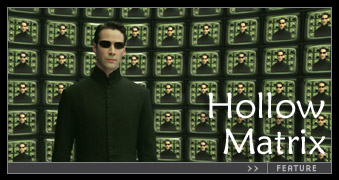
Hollow Matrix
by Roberto Rivera Carlo (take from Focus On The Family Website)<
Warning: Contains spoilers.
Let me cut to the chase: The Matrix Reloaded is a disappointment. It’s entertaining in spots and, as disappointments go, it doesn’t begin to compare to The Phantom Menace. But as I sat in the theater on opening day, I found myself looking at my watch — something that I never thought to do when I saw the first film four years ago.
As expected, the special effects and fight sequences were more elaborate than those in the original. Still, they brought to mind something that my grandmother used to tell my brother when we were kids: lo poquito divierte, lo mucho enfada. (A little entertains, a lot annoys.) When I wasn’t looking at my watch, I was thinking “OK, I get it. Neo has really cool powers. He really must be the One.”
What’s true of the action sequences is doubly or triply so when it comes to the film’s attempts at philosophizing. While the first film’s speculation about the nature of reality, what constitutes knowledge, and the possibility of human freedom, etc., were, as I argued in Boundless, ultimately incoherent, they were fun and served the story by offering an explanation for what it was we were seeing. This time around, these musings — that’s the most charitable characterization I could come up with — aren’t in service of the story; they are the story. And that’s where Reloaded really misfires. So much so that I’m reminded of yet another epigram, one attributed to movie mogul Samuel Goldwyn: if you want to send a message, call Western Union. Or, in this case, if you want to understand the meaning of life, read books and go to church, not the movies.
But I’m getting ahead of myself. In Reloaded, free humanity’s last redoubt, the suitably named Zion, is under siege by the machines. Those charged with the city’s defense disagree as to what should be done. One party believes that humanity’s only chance lies in an all-out assault against the machines boring down toward Zion. The other party, led by Morpheus, believe that humanity’s best, indeed only, chance lies with the prophecies that have foretold the coming of the One and deliverance from the their cybernetic oppressors.
This division of opinion and exhortation to faith brought to mind another instance of a Zion under siege and facing a choice between relying upon a military solution or trusting in what it had been promised by a mysterious Other: the siege of Jerusalem, a.k.a., Zion, by the Assyrian king in Isaiah. Playing the role of Morpheus, the eponymous prophet told the people, “woe to those . . . who trust in chariots because they are many and in horsemen because they are very strong, but do not look to the Holy One of Israel or consult the Lord!” Substitute “prophecies” and “Oracle” for “Holy One of Israel” and “Lord” and the prophet would’ve gotten a partial screenwriting credit.
The object, or least embodiment, of this hope, Neo, isn’t nearly as sure as his commander-turned-acolyte. He’s having trouble sleeping and as he tells his lover, Trinity, he doesn’t know what he should do. After the enigmatic Oracle makes contact, Neo re-enters the Matrix is search of answers. (Just how much religious and philosophical musings drive the film is shown in Neo’s vestment of choice inside the Matrix. It’s, well, a vestment: what Catholics and Anglicans will immediately recognize as a cassock, the black ankle-length garment worn by priests. All that’s missing is the Roman collar to complete the effect.)
This time, the question being asked isn’t the as straightforward as the one that drove Neo in the original film: What is the Matrix? Reloaded is trying to answer far more ambitious questions: choice and free will versus determinism, as well as the nature of reality. Stated bluntly, it seems that four years of adulation and countless articles — including, I must admit, mine — about the “meaning” of the The Matrix have convinced the Wachowskis that they really are metaphysicians capable of tackling the “big questions.” As a result, Reloaded borders on the impenetrable. As Alex Wainer, who teaches film at Georgia State University, puts it, the film piles “one metaphysical concept on top of another.”
The Oracle, who we learn is an “old program,” goes from being a mysterious but benign, grandmotherly type to — take your pick — a Gnostic demi-urge, an Ur-mutter or even a goddess — a sort of Isis to the Architect’s (more about him in a minute) Osiris. An equally “old program” called the Merovingian subjects Neo and the audience to a discourse about the inescapability of causation. What we believe is freedom and indeterminacy is actually an illusion; Neo and the rest of us are simply following instructions. (The name “Merovingian” is yet another bit of metaphysical mumbo-jumbo. While it historically refers to the dynasty of Frankish kings that produced Clovis and Charlemagne, among others, it is also associated with neo-Gnostic and Rosicrucian ideas about the Holy Grail and secret knowledge.)
The aforementioned Architect pulls the rug from underneath Neo — and the audience — by telling him, among other things, that the Matrix has been around for longer that he imagines; that he is the sixth Neo to undertake this same journey/quest; and that Zion has been destroyed five times before. The implication is clear: Zion and the rest of the “real world” is a part of the Matrix. Neo may think that he’s free to act, but it’s a delusion, just like the human capacity for hope.
This piling on of philosophical concepts and religious imagery not only confuses the audience, it leaves us without insight into or understanding of the protagonist’s actions. Obviously, Neo isn’t going to give up. He will continue to act as if his choices made a difference, even when he’s convinced that they don’t. The question is: why? Nothing in the story tells us why Neo or anyone else would continue to struggle under these circumstances. At best, it’s a case of “blind hopes,” the kind that Prometheus gave mortals as an antidote to despair. In other words, a delusion.
But true hope, which is a Christian virtue, isn’t wishful thinking. On the contrary, it looks reality squarely in the eye. But it avoids despair because it believes that history has a telos — an end or purpose that will make sense of our stories and the actions that comprise these stories. It proceeds from the assumption that certain things are true and not subject to revocation. Matrix Revolutions may conclude the story but its “Strawberry Fields Forever” world can’t provide us with that telos.
If it seems that I’m landing hard on what, after all, is only a movie, it was the filmmakers who raised the stakes. It’s also that I saw Reloaded as I was reading The Beginning of Wisdom: Reading Genesis. In it, Leon Kass of the University of Chicago — who’s also chairman of the President’s Council on Bioethics, which deals with cloning among other issues — tells us how the first book of the Bible handles some of the same questions tackled by Reloaded. As Kass puts it, the stories in Genesis “cast powerful light . . . on the problematic character of human reason, speech, freedom, ual desire . . . shame, guilt, anger and man’s response to mortality,” among other things. They’re able to cast this light, in significant part, because we recognize ourselves in them. The character’s actions ring true to our experience, which makes us open to what the stories have to teach us.
This is true even if, as Kass tells us, the reader doesn’t come to the text with an a priori belief in the divine inspiration of scripture or any other belief in the Bible’s authority. In addition, this impact is rendered with an economy of expression that leaves the reader wanting more, not looking at his watch. For instance, Genesis 4 — the story of Cain and Abel — “presents for examination” the family, human passions, crime and punishment and, if that were not enough, the emergence of agriculture, art and human cities. It does this all in 26 verses and approximately 630 words.
It may seem ridiculous to compare Reloaded to the Bible and it is. But that’s the playing field Reloaded and its acolytes seems to want to play on. Not content to tell an entertaining story with great special effects, the film tries to be a modern parable of sorts and fails, dragging the story part down with it. Which is why The Matrix is ultimately hollow.
Copyright © 2003 Roberto Rivera y Carlo. All rights reserved. International copyright secured.
Visuals save the day for 'Matrix'
By Mike Clark, USA TODAY The Matrix Reloaded needs a system upgrade. And to its credit, it eventually gets one.
But for all the predictably fancy footwork, the heavy-handed opening hour will prove trying to all but the most forgiving fans of this alternative universe.
Keanu Reeves' Neo has been deemed "The One" savior by Morpheus (Laurence Fishburne), a rebel leader in Zion, the last outpost of humanity. It's under attack by The Machines' "sentinel" subordinates, which aim to take it over to inherit the universe. Will this make any sense to anyone who hasn't seen the original? No.
But as creators and brothers Larry and Andy Wachowski tell it, Zion is an interior world of computer hacking, ponderous pontificating (put a sock in it, Morpheus) and deliriously odd rave-club dancing with visuals that recall the orgiastic sidelights in Oliver Stone's The Doors and, before that, Cecil B. De Mille's The Ten Commandments.
Displaying even less emotion than body fat, Reeves is vapid as Neo — who, in the movie's silliest scene, battles multiclones of Agent Smith (ever-cool Hugo Weaving), thought to have been disposed of in The Matrix. Mid- brawl, Neo suddenly zooms off into the sky, à la Superman, as if to say, "I've had my morning workout and am done with you fools."
But Neo's search for a mysterious "keymaker" transforms the movie. Suddenly, there's an edgy, y and even witty restaurant scene laced with, of all things, marital tension. And Carrie-Anne Moss' Trinity, a plus throughout, puts her own chiseled frame on a motorcycle and achieves the near-impossible: putting a fresh spin — spin being the operative word — on the movie car chase.
Salvaged by its rally, Reloaded seems less tired than X2, its current sequel rival. But since its creators have said it's only half of a movie, we won't really know until The Matrix Revolutions arrives Nov. 5 whether this chunk is fizzle or sizzle.
A Word From Aaron
The reason I’ve included these two reviews and not one of my own is to ask you a question. What do YOU think? I’d like you to compare what the secular columnist and Christian columnist have said, and draw your own conclusion. Another reason I didn’t critique this movie is because I have not yet seen it. Upon hearing that the “R” rating, in this case, is not just for violence, but also for explicit content I decided that no movie is worth putting such images in my mind, and I’m waiting to see this film until I get more reliable information. Now I’d like you to hit the message board and tell me what you think.
