|
| Introduction
to the World Wide Web Programming |
Mr.
Rodelio P. Barcenas
Computer Engineering Department
Don Bosco Technical College
The first method computers communicate with one another is through the
bulletin board system or simply known as BBS. Computers communicate
from point A to point B and vice versa. One computer is the server waiting
for dial-in clients. Anybody can download, upload , share and post messages
or files to the system.
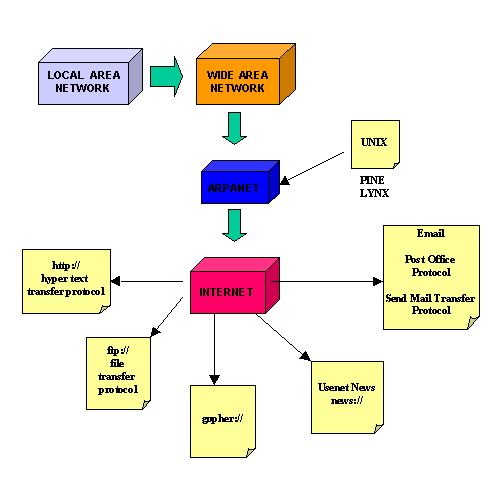
The development of
Local Area Network made it possible for a group of computers to communicate.
Routers and Bridges links communication levels between two or more LAN
system to become a Wide Area Network.
In the 1960s, the
Defense Department was interested in creating a nonhierarchical, geographically
dispersed communications system that would allow the military to communicate
even if one or more key links were destroyed during a nuclear war.
At that time, no standard
computer operating system existed; thus, computers generally could not
communicate with one another. Academic computer scientists were hired
to develop the network, which was launched in 1969 with four nodes, or
sites: the University of California at Los Angeles; the University
of California, Santa Barbara; Stanford Research Institute;
and the University of Utah. By 1971, ARPANET had expanded to 23
sites; by 1981, to over 200. Although the original purpose of ARPANET
was restricted to Defense Department projects, it quickly became a way
for academics to communicate on a myriad of nondefense topics. Scientists
without Defense Department clearance were denied access to ARPANET, so
in 1979 an academic network, Usenet News, began; its nodes eventually
connected with those of ARPANET.
How where they
able to make computers communicate at that time?
UNIX is a computer
OPERATING SYSTEM designed to run on a wide variety of computers, from
MICROCOMPUTERS to MAINFRAMES. It is multiuser, designed to connect WORKSTATIONS
to a bigger, more powerful computer. It also is multitasking, allowing
a computer to run several programs at once. Written in the high-level
programming language C, UNIX has long been a favorite among software developers.
It is modular--that is, a program can be assembled like building blocks--as
well as flexible and logical.
UNIX dominates the
workstation market and is the world's most widely used multiuser operating
system. It was developed at Bell Laboratories in the late 1960s and was
introduced in 1971 for DEC PDP-11 minicomputers. Its history has been
complex, with many engineers and students contributing to its evolution.
Dozens of versions have been created; unfortunately, many versions are
incompatible with one another, which means that programs designed to run
under one version may not run under another. (Grolier 1996 Encyclopedia)
UNIX already offers
the following software system
- http:// (HyperText
Transfer Protocol) this is already web pages in text mode. Hyperlinks
are already been utilized. This service can be accessed using the LYNX
command.
- ftp:// (File Transfer
Protocol)
- gopher://
- Usenet
- Email
|

http://www.cern.ch
|
|
|
|
For the Record
Nearly
seven years after it was invented at CERN*, the World-Wide Web has
woven its way into every corner of the Internet. On Saturday, 17
February, the inventors of the Web, Tim Berners-Lee, now at Massachusetts
Institute of Technology (MIT), and Robert Cailliau of CERN's Electronics
and Computing for Physics (ECP) Division, will be honoured with
one of computing's highest distinctions: the Association for Computing
(ACM) Software System Award 1995. They share this prize with Marc
Andreessen and Eric Bina, inventors of the Web browser "Mosaic".
ACM is an international scientific and academic organisation, founded
in 1947, to promote the art, science, engineering, and application
of information technology.
In
the space of a few years, the Web has become a social phenomenon.
Having started life as a system designed for the small community
of high-energy physicists, the Web, has opened up the Internet to
the general public. The catalyst for this breakthrough was CERN
researchers' need to communicate with colleagues working in universities
and institutes all over the world.
It
all began in 1989, when Tim Berners-Lee, then working at CERN, proposed
a distributed information system for the Laboratory, based on 'hypertext',
a way of linking related pieces of information stored on computers.
By hiding network addresses behind highlighted items on the screen,
information could be linked between several computers. Tim Berners-Lee
was then joined by Robert Cailliau who concentrated more on the
initial goals of providing tools for the physics community, whilst
Berners-Lee continued broader Web development work. The first browser
and server were introduced. The Web had arrived, with the world
as its library. The system then spread like wildfire throughout
the scientific community, for whom it became indispensable.
|
|
A further
crucial step came in 1993 when the "Mosaic" navigator was developed
by two scientists at the National Center for Supercomputing Applications
(NCSA), Marc Andreessen and Eric Bina. Since then, the Web has grown
exponentially and spread far beyond the scientific community, bringing
the Internet to the general public. The Web currently comprises
hundreds of thousands of servers through which millions of users
are now surfing, learning, playing and communicating at the click
of a mouse. Rarely has a new technology developed by fundamental
research produced such a rapid and spectacular spin-off.
Tim
Berners-Lee read physics at Queen's College Oxford before joining
CERN in 1984. He moved to the Massachusetts Institute of Technology
late in 1994 and today runs the World-Wide Web Consortium. Robert
Cailliau, holder of Master of Science Degrees from the Universities
of Ghent and Michigan, joined CERN in 1974. He plays the leading
role in CERN's WWW service. He founded the series of international
WWW conferences and participates in the work of the Consortium.
|
|


