Float charging
a lead-acid battery with temperature compensated, regulated DC voltage
is almost fool-proof. A fully discharged battery will draw a large
amount of charging current that will decrease as battery becomes fully
charged. One problem however is that the battery to be charged fully,
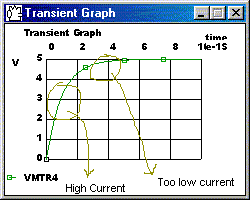
can take a very long time. As you can see the charging current is
large at start compared to the current approaching the full charge.
Below is a graph comparing the charging of battery to a charging capacitor.
If you are supposed
to analyze the graph, the startup current is too high, while as the
voltage continues to rise,the current starts to decrease. The rapid
inrush of current to a depleted battery can seriously damage the plates
and charging the battery to its full capacity will take you a longer
time because the charging current at that point is too low.
Dual Level
Battery Chargers
When charging
a discharged battery, the chargers is in its constant-current (bulk)
mode. The battery is charged at the maximum current the charger can
supply. The charger circuit remains in this mode until the battery
voltage reaches the mode-switching voltage (approx. 15V at room temp
for a 12V system). At this point, the battery is between 85% to 95%
fully charged. Then it switches back to constant-voltage (float)
mode, set to battery's float voltage (close to 13.8V at room temperature).
3-Mode Battery
Charger
This method is
similar to the dual mode charger except that after the bulk mode,
a mode called absorption is