by: Mr. Rodelio
P. Barcenas
Faculty Computer Engineering
Department
Don Bosco Technical College
 |
The basic block diagram of a microprocessor
consists of four (4) groups of terminals
- Address Lines
- Data Lines
- Control Lines
- Interrupt Lines
Address Lines
- are output lines configured as a bus representing a location
of the memory to be accessed.
|
Data Lines - are bidirectional lines, which means it can
become an input or an output. Data processed comes to and fro in
this lines.
Control Lines- are output lines which controls the memory
unit or peripheral devices the microprocessor communicates with.
It dictates a command to the memory or peripheral devices the direction
of the data flow.
To help you visualize the above definition, here is an example...
I will use a character named joey to help us understand the explanations
above.
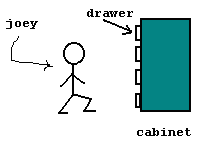 |
Let us say Joey was asked to get a ball from the 3rd drawer
starting from the top.
Joey would then start to approach the cabinet. At this point
in time, joey would be looking where the third drawer will
be found.
|
|
|
After finding where the third drawer
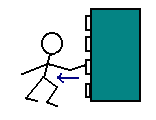
is, Joey tries to pull the drawer using his arm. He gently pulls
the drawer. |
|
|
After pulling the drawer. He now sees the ball and hold it.
What have we learned from here?
|
Joey represents the microprocessor while the cabinet represents
the memory unit. Here is a comparison on the movements of Joey with
a Microprocessor reading data.
| JOEY |
Microprocessor |
| 1. Joey looks where the third drawer
can be found |
1. The microprocessor releases the
address or location of the memory |
| 2. Joey executes the pulling action
on the drawer. |
2. Microprocessor executes a read
function signal using the control lines |
| 3. Joey gets the ball. |
3. Memory device transmits the data
to microprocessor and data was receieved. |

Home 
|