|
Strange that
this place, now so lonely, should once have been a busy centre of human
life. Here in the Middle Ages the monks of the priory were busy studying
the Fathers, copying MSS., engaged in the duties of the cloisters, and
waiting for the preferment in the church. The youthful and aspiring
students once walked here by the river side, or crossed to make an
expedition to Montrose, an ancient town, and then more than now a port
for foreign ships. Here the barons and their retainers gathered weekly
to hear the chaunting and the solemn services of the church. But all are
gone now. No more the bell tolls for the matins and vespers, the
intrigues of churchmen are over, and though the sea still breaks on the
yellow sands, and the river folows on with a never ending stream, the
former haunts of learning have long been deserted. Not a stone of the
buildings is left, and even the traditions respecting those times have
perished, and nothing now remains but - the Auld Kirkyard.
After the darkness of the mediaeval period, the light
of the gospel once more dawned on the world. In this locality there were
not wanting witnesses for the truth. Among these was David de Straton,
brother to the Laird of Lauriston. When worried for payment of tithes,
he ordered his servants to cast every tenth fish into the sea, and told
the priests that if they would have the tithes of fishes, they should go
and get them whence the stock was taken. He had been a turbulent and
violent man, but on being instructed by that eminent Reformer, Erskine
of Dun, he shewed that he ahd received the gospel in its power by his
heavenly life. Such a man could not escape the fiery trial. He was taken
to Edinburgh, and notwithstanding the offers made him to recant, he
firmly adhered to the truth, and gave great encouragement to Norman
Gourlay, who was burnt with him at the stake in 1534.
From the Reformation in 1560, and for seventy
years afterwards, things were greatly changed in this spot beside the N.
Esk. The old ritual had been abolished, and now the parishioners were
summoned by the Sabbath bell to hear the word of life. Here was the
simple pastor, the manse, and the little church. In 1632, however, the
church was removed to its present site on the commanding height, the
edge of which forms the braes; and the name of the parish has also been
changed from Ecclesgreig to St Cyrus. There is no music of the Sabbath
bells in the old place to summon the simple worshippers to the house of
prayer, though the place itself has a perpetual Sabbath; there are no
gatherings on fast days, and no communion seasons here now; there is no
church and no manse; all is gone, and nothing now remains but - the Auld
Kirkyard.
Within the Kirkyard there are several old roofless
buildings, which are used as burying places. One of them belongs to the
ministers of St Cyrus, and bears a Latin inscription on the lintel, with
the date 1673. The stone at the back of this one is marked with an older
date of 1647. There is a beautiful recent monument to one of the
Stratons, and beside it an old decayed tumulus to another of them, which
bears the date of 1646. Among the tombs in the churchyard, there is date
older than 1687, on a flat stone, and 1693 on a raised tumulus. The
oldest standing stone is marked 1729. We may feel surprised that in so
ancient a churchyard there should be no older tombstones; but this
arises from the tombs of the rich having perished, and the headstones of
the poor at an earlier date had no inscription.
The monument of deepest interest is near the south-east corner. It is
the tomb of George Beattie. The pathos of its simple inscription accords
well with his touching story. A wild honeysuckle, which has grown up in
the enclosure, entwines its branches with the railings, and hangs its
clusters of fragrant blossoms over the tomb of one who was loved in life
and is not forgotten in death.
George Beattie of Montrose
by A S MtCyrus
1890
|
|
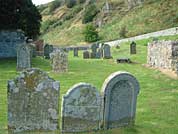
Some of the gravestones seen today
in St Cyrus Nether Kirkyard
|




