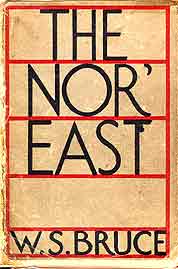
The Nor' East contains some of
the finest types of the true Scot. They smell of their soil; the
smoke of the peat is about them. A very large part of the national
drink is brewed in Banffshire. The two counties of Banff and
Aberdeen contain a fair proportion of the old-fashioned people, among
whom popular traditions linger long and the customs of the forefathers
are conserved and continued; while in Buchan the purest Doric is still
spoken, and every parish possesses its Braeside and its Drumsheugh.
The people are somewhat shy and reticent. When you meet them
the speech at first is of the weather. They hide themselves, as
every real man does, in their ordinary intercourse. It is only in
confidential moments that they drop the mask and show their soul.
And it is he who can catch the psychological moment that will get the
flavour of the native wine and the humour of the native point of view.
The said point of view may be that of the fisher, or the farmer, or
the crofter. The first of these has a very distinct and settled place of
his own around the north-east corner. He is an asset of large
monetary value to-day. And he knows his worth. When
Professor Cossar Ewart came to this quarter to lecture on the habits of
herring, the Banffshire fisher thought the thing superfluous. A
big fellow at the first lecture, with his lips perhaps loosened with a
drop of drink, rose and walked out, exclaiming, "Wha sent ye here
to tell hus aboot herrin'?"
And the cottar too has his point of view. He is the backbone of
the counties and of the kirks. The following talk with one of my
crofters, at the time of Mr Chamberlains's famous proposals, will set if
forth: "It's nae joke, sir, to be a crafter nooadays. Ye
canna wirk a craft wi' yer feet on the fender, I asseer ye. It
tak's a' yer time and yer tent to mak' ends meet." "But
are not three acres and a cow," I asked, "the ideal of a
crofter's life?" "Oh ay, ye like yer joke, I see.
But Chaumerlain didna ken muckle aboot crafts when he gaed that
gate. Ae awcre and three coos, or three awcres and ae coo, it wad
be a' the same to him. He kent mony things, but nae muckle aboot
Scotch crafts. In fac', naebody kens aboot craft to ken its
Possibeelities. Ilka bit field hes its ain wye o' growin' girss.
There's a hantle o' learnin', sir, to be got frae a craft."
In both cases the natural Conservatism of the Nor' East is
remarkable. Its very Liberalism is conservative. It stands
by it as its fathers stood. The Nor' East is very slow to
change. Trawling came to Fife and Forfar, but it never was
accepted in the Moray Firth. Even the steam-drifter took many a
day to win the hearts of the Banffshire fishermen from the old scaffie
and the zulu boat. Slowly among the farmers the new and useful
binder is superseding the older customs. Forty years ago I can
remember the hook and the scythe on all the crofts....
The Nor' East
by W S Bruce
1915