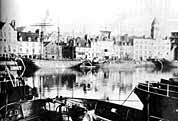
Let us take our stand in imagination in the year 1865 at the south end of
Regent Bridge (that is the old man-handled bridge then in use) for the purposes
of comparing the docks and the shipping in them with what may be seen today. The
difference regards shipping is striking. In 1865 there were about 220 sailing
vessels registered at the port, of which 109 were less than 200 tons, 127 of
less than 300 tons, and 137 of less than 400 tons. Of the 83 vessels that
exceeded 400 tons a large proportion belonged to George Thompson, Junior, & Co.,
and other owners of foreign-going craft that seldom or never re-entered the
port. The maritime transport of Aberdeen was, therefore, carried on mainly by
small vessels, which often lay alongside two or even three deep, awaiting their
turn of quay space. Moreover, quay space in the Upper Dock was more limited than
today, for Jamieson's Quay had not been formed, and the whole south side of the
Upper Dock was occupied by shipbuilding yards. The owners of these yards were,
reckoning from east to west, William Duthie, John Humphrey & Co., and Richard
Connon. The launch of the Strathnaver from the yard of William Duthie is the
last launch that I remember to have seen take place in the Upper Dock. At the
south-east corner of this Dock was moored HMS Winchester, for the training of
the Royal Naval Reserve. She was approached by a floating gangway which ran
westward from Regent Bridge. When a launch took place the Winchester had
sometimes to be moved to make way for it. In the corner between this gangway and
the Bridge was laid up in winter the smack Cock of the North, of 48 tons, built
at Aberdeen in 1835, which belonged to Messrs. Hogarth and was employed to bring
to Aberdeen via the Pentland Firth the salmon caught on their net fishings at
Gairloch and elsewhere on the west coast. In the Moray Firth Messrs. Hogarth had
another smack, called the Dora. They employed smacksmen from East Anglia to
command their little vessels, and so brought to the port not a few fine seamen
who took root there, and subsequently were promoted to command the steamers of
the Aberdeen Steam Navigation Co., of which my very staunch friend Mr A P
Hogarth was chairman. I knew well some of these fine seamen, all now passed on,
among them Captain Dowman, Captain Andrews, and lately, Captain Howe. They had a
breezy, hearty English Address, which made a special appeal to their Scottish
friends.
Among the front of the building yards in the Upper Dock was ranged a
line - known as Rotten Row - of melancholy brigs and schooners, worn
out, disused, or for sale. A broom at the masthead indicated that the
owner had not quite abandoned hope of a buyer, failing which, break-up
or employment as a hulk - say at Newburgh - was the vessel's ultimate
destination. Rotten Row had an increasing number of tenants after steam
began to replace sail for coastal traffic. This displacement began in
the early 'seventies, when the ss. Hayle and the ss. Courier were
acquired by Messrs. Adam & Co. to carry coal. From that time onwards the
coasting brigs and schooners became fewer and fewer, and ultimately
disappeared. The brig Ploughman, of 168 tons, built in 1867 by Walter
Hood & Co., was the last of this class that I remember
to have seen launched at Aberdeen. The voyage between London and
Aberdeen has lost much of its picturesqueness by the passing of the
sailing craft, large and small; for not even a lover of the sea can work
up romantic interest in the steamers that have displaced them. There are
now no sailing vessels registered at the port of Aberdeen, and the
shipping so registered consists of 28 screw steamers ranging in size
from 1648 tons (gross) in the case of the Aberdonian to 87 tons (gross)
in the case of the Ich Dien. But, of course, much of the local trade is
borne by vessels not registered at Aberdeen, and the figures are
informing only as illustrating the completeness of the turn-over from
sail to steam.
At the Cross Quay - now South Market Street - a cargo of slates (as
today) was often discharged, and the boy-cook of one clean, smart Welsh
schooner, called the Grampus, was my special friend. His name was
"Owen," and I remember a deal with him in which I, when a small boy,
traded a conical lead-pencil sharpener - then a novelty, which had cost
me a penny - in exchange for two ship biscuits. I was permitted to haul
on the warp when the vessel shifted her berth, and the boyish pleasure
of being for the first time on a ship in motion is still remembered.
At the north-west of this dock was a most unsavoury corner, when the
Den Burn discharged its polluted waters into the dock. A cross-berth had
been formed in the angle, where, when there was congestion, and
unfortunate vessel might have to lie in a stench wellnigh intolerable.
That evil was cured many years ago, and no sewer now discharges into the
dock.
At Trinity Quay were often discharged cargoes of apples (known
locally as "chippit apples") from the Channel Islands. These had been
dumped in bulk in the hold, and were now shovelled with wooded spades
into the hoisting tubs. They, no doubt, found buyers; but nothing more
primitive or dirty in the handling of fruit for human consumption could
well be conceived. The onion boy from Brittany is a later arrival at the
harbour, and his ropes of clean, brown onions appeal fro themselves to
housewife customers. One of them in pre-War days who came from Roscoff
used to sit as model for my artist daughter, and would chat while he
enjoyed his cigarette and cup of coffee. Open drunkenness at this time
was a flagrant evil in the City, much too lightly thought of by certain
types of folk, but now, without doubt, much diminished or less apparent.
I asked the lad one day if he had ever seen anything worse in this
respect than Market Street, and he said, "Yes. It was worse at Dundee."
"Well then," I said, "have you anywhere seen it worse than at Dundee?"
He hesitated for a moment, then smiled, and replied, "Yes, in Brittany."
An honest lad, and truthful witness!
The steamers plying regularly at Aberdeen in the 'sixties were mostly
paddle steamers; but the screw was fast ousting the paddle, and no
paddle steamer was added to the register of the port in the 'sixties.
Foremost in size and appearance was the City of London, of 1116 tons and
231 feet in length, built for the Aberdeen Steam Navigation Co in 1844.
She was one of the few transports that weathered the great gale at
Balaclava Harbour during the Crimea War. Her beam of 52 feet 6 inches
across paddle boxes was so great that she had little more than room to
get through the dock entrance. She could make the run between London and
Aberdeen in three tides on a huge expenditure of coal. She was described
in the Illustrated London News of 27th July, 1844, as a
"stupendous vessel, ... and with the exception of the Great Britain,
which has not yet been to sea, she is the largest iron steamship
afloat." The Princess Alice, of the Newcastle and Hull Steam Co., was a
vessel of 286 tons built in 1843. Her engines had the peculiarity that
the upper part of the pistons rose and fell in casings fixed on and
above the level of the navigating bridge, so that their up-and-down
movement was visible to anyone on the quay who stood forward of
amidships. The Vanguard, Earl of Aberdeen, Pharos, and Prince Consort
were still doing duty. Among the screw steamers the St. Clair of the
Leith and Clyde Shipping Co. deserves special mention, since, built in
1868, she is still in service after being under fire during the Great
War. I remember seeing the Prince Consort aground in 1863 on the south
platform of the North Pier, also in 1867 the schooner Mercury and the
brig Agricola ashore at the same time and close together on the north
side of the pier. The Mercury, I understand, was the first iron vessel
built in Aberdeen for coastal service. All the vessels were got off, but
the Prince Consort finished her career in 1869, when she was wrecked two
miles south of Aberdeen....
Recollections of an Old Lawyer
by Lachlan Mackinnon
1935