|
In the
North-East of Scotland there was probably no man with such a wealth of
lore regarding lords and lairds, large farmers, and "crofter-bodies,"
dealers, drovers and Aberdeen-Angus men of a past generation, as George J
Walker, Portlethen. From his father, who was one of the great improvers of
the Aberdeen-Angus breed, he had garnered an immense amount regarding a
most interesting section of the past, for "Old Robert," as the Mearns and
Aberdeen veterans of pre-war days still named him, was a man of strong
practical sagacity, a judge of human beings, a supreme judge of "nowte,"
and one who could put pith in his comments. George Walker, passing away,
at a ripe old age, had added vastly to the unwritten history of his race
and countryside. Gifted with keen observation, he had a well-balanced,
cultivated mind, and a flavouring of the pawky, just sufficient for
day-by-day use, in a part of the country not much given to display of
mental and moral wares in front windows. George Walker was always fit to
sum up his own range of men and affairs with great accuracy in leading
essentials. To his credit let it also be said that he either missed or
left entirely unrecorded many small things with a twist in them or with
suggestions of over-acidity in their nature. Normally he was a man who
went by the main lines and footings and who always kept a healthy
look-out. Of Hugh Watson, Wm. Crombie,
Alexander Bowie, Paterson, Mulben; Brown, Westertown; Hannay, Gavenwood;
James Skinner, Thomas Ferguson, James Scott, Charles Grant, Hector,
Fernyflatt; the Taylers of Rothiemay and Glenbarry; Farquharson, East
Town; Reid, Greystone; James A Pierson of the Guynd, and many others who
had taken prominent positions under the old Aberdeen-Angus banner, George
Walker had recollections grave and gay, characteristic anecdotes,
illuminative sayings, notes of doings, and oddments, all adding to the
homely charm of the narrative. It was only at widely-spread intervals, and
in the company of a very few trusty friends, that he took to certain
reviews of the Aberdeen-Angus past. His best was not to be had in a
throng.
The Portlethen of the past generation has not been
prominently before the public. It has lived to a larger extent on the fame
of old Robert Walker, who made even Wm. McCombie tremble at times when
exhibiting ambition was strong on "Tillyfour." George Walker, a most
tasteful, sensible and conscientious judge, was too busy as a professional
man to give his own herd the close personal attention which is required
when prize winning and general forward moving are regular aims. He had no
pedigree fads, however, and it could be said that he kept correct models
in his eye when judging. Portlethen itself is an exceedingly exposed
holding - a testing spot for even the old-fashioned hairy-lugged, strong
jawed doddies of other days, and something harder for thier more refined
looking descendants bred outside the place. For many a day also it had one
of the worst steadings in the Mearns.
George Walker had now and then as judging colleague
his old and completely dissimilar friend, the late Robert Walker, Altyre.
George, slightly stooping, always courteous and judicially deliberative,
with dark eyes, latterly grizzly beard and moustache, and spectacles far
down his nose, could not be hurried along by the immensely alive, abrupt,
forcible Robert, with his flat-topped hat set at a horsey angle,
clean-shaven, mobile-lipped, dominating face, natty tie, riding breeches,
bunch of Cairngorms and seals, and shiny yellow leggings. As Robert
commanded or thrust an insinuating arm in the crook of his friend's, and
pursed his lips into a half-impatient and wholly strong willed Yea or Nay,
the hat being set the while at a bear-witness tilt, to emphasise a
genially extraneous verdict of "devilish near the best ane," George smoked
his favourite briar all the more intensely, set his eyes the more keenly
on the niceties at issue, and generally refused to be hustled. Robert,
patrolling alone, was apt to "come down" on a manoeuvring cattleman in
charge of a "slack-backit beast" - "D---- it, can ye no stand still!"; or
"Div ye want men to pit ye oot o' the ring?"
When he was in good health "Portlethen" could always
be trusted to do very sound work as a judge, and in many respects the best
was got out of him when he acted singly, as at the "Royal" of 1903 at Park
Royal, where the soft clay rather suited the half-tender feet of the great
bull Maramere, which then defeated Darlington, one of the most tasteful
males of the breed seen in the South for many years. The late Thomas
Smith, of the results at the Edinburgh Centenary Show of the Highland
Society in 1884. At that Show "Powrie" exhibited a remarkable group of
Mays for the family prize. Those Mays traced back through the Easter
Tulloch Mayflowers to old Portlethen stock. Smith's cattle stood out by
themselves. One of the judges, a staunch Angus man, promptly made up his
mind in favour of the Mays, then filled his pipe and waited for the other
two, "Portlethen" hesitated and ultimately sided with the third colleague
in preferring a more massive group of less uniformity, but on a calm
review next day he confessed that the "odd man" had been right.
Let such things be remembered to the credit of one
who strove to be just. All in all, George Walker thoroughly deserved the
friendship and trust of untold numbers, and the respect of those who
differed from him.
Life-Portraits and Fancies
by James Cameron
1928
|
|
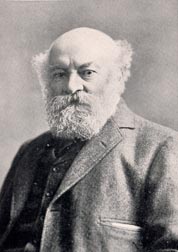
George J Walker
of Portlethen
|




