The
fishtown of Footdee, towards the conclusion of the American war, was
certainly not one of those "green spots on which memory delights to
dwell," and yet it has kept hold of mine with all the tenacity of a first
impression.
The town consisted of several rows of low thatched
cottages, running from east to west between the high road and the
harbour, or, as it was called, the "tide," which at high water came up
even to the ends of the houses. Nothing could be more apparently
comfortless than the exterior of these dwellings, each fronting the back
of the opposite neighbour, and the narrow space between forming a line
of dunghills, crossed over with supported spars, from whence hung lines,
bladders, and buoys, intermixed with dried skated and dogfish.
The prospect within was not more alluring to a
stranger, and yet the inhabitants seemed quite contented. The earthen
floor, dirty and uneven - the smoky roof, whose only ceiling was a few
old oars and pieces of drift wood - with the bare rough walls,
unconscious of any washing save what the sooty drops afforded, were
objects far from pleasing.
The furniture in every way corresponding. Two
clumsy black bedsteads were placed under the two small windows, of which
there was one on each side of the door; and a small table, tow or three
chairs, and some low seats or sunkies, with the requisites of the
fishing occupation, viz., lines, creels, sculls, murlans, etc., formed
all the rest of the visible moveables. There was no press or
keeping-place whatever, except a chest or locker in which the Sunday
clothes and any stores were kept, and the saut-backet suspended in the
chimney.
The fishermen were in general hardy and
industrious, but ignorant in an incredible degree on all subjects
unconnected with their own business. Few of them could read, and none of
the grown up people could write. The elderly men wore broad bonnets,
blue jackets, and canvas kilts or short trousers. The younger men were
rather good-looking, smarter in their dress, and more good-humoured; but
going to sea in the night, and taking their repose by day, was not
favourable for the development of the social faculties, and there was
scarcely an instance of intellectual talent or a tendency to any art or
science among them. They were indeed fond of music, in as far as having
a fiddle at their merry meetings, and a few of the lads could sing but a
little, but their collection of songs was not extensive...
The females of this small community laboured under
great disadvantages, both moral and physical; their incessant toils left
no time for mental improvement, and their constant exposure to the
weather without any sort of bonnet, together with their frequent
immersion in salt water, gave a hardness to their features and
coarseness to the skin, with a far-from-pleasing expression of
countenance. The figure also became early bent from the weight of the
creel. The middle-aged women wore a stuff gown with a large flowered
calico wrapper or short gown over it, the young girls a stuff wrapper
and petticoat, with the hair in a most unbecoming fashion, either thrown
back with a large comb which reached from ear to ear, or put up in a
very slovenly manner, with a "head lace" of red worsted tape. The boys
under fifteen were the worst clothed; they ran about in a very tattered
condition in old garments of their fathers', "a very world too wide,"
and seemed to be kept waiting until their strength could enable them to
gain a decent covering. The little children were the most comfortable,
those of both sexes being clad in a simple dress of white plaiding,
called a "wallicoat," which, with their white curly heads and rosy
countenances made them look very pretty as they puddled with their mimic
boats in the pools of water...
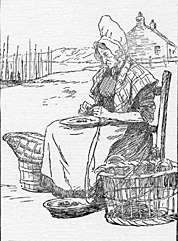
There was still another class, who, though fewer
in number, formed rather an interesting part of the society. In several
of the families there was, in addition to the husband, wife, and
children, an old man or woman, known by the appellation of Lucky-daddy
or Lucky-minnie - the grandfather or grandmother of the family. These,
when unable to work for themselves, went to live in the houses of their
sons or daughters, and seemed to be kindly treated by them. Some of the
men were very old, born in a former century, and appeared to take little
interest in what was passing, sitting in a chair in the sun outside the
door, or led about by one of the children. The grandmother had her place
by the fire, and assisted in many of the lighter domestic labours. Her
dress was somewhat peculiar; she always wore a blue cloth hood or "trotcosie,"
and a man's coat over the rest of her attire, with a large pouch or
pocket by her side. These old women were often skilled in the medical
art, and their advice sought in preference to doctors; but some
individuals of them were also dreaded as being an "unlucky foot," and
possessing other powers which made it dangerous to offend them...
Footdee in the 18th Century
By A D Allardyce
1918