Ships
associated with Capt. Edward White Sr.
|
|
| HomePort |
|
Ships
associated with Capt. Edward White Sr.
|
|
|
 White used larger ships in the 70-85 foot range with the
largest being a 115 foot brig named Bertha. With a mercantile
firm based in St. John's called E. White & Sons on Water St., his
ships traded from Brazil to Labrador. All his early ships
were brigantines
White used larger ships in the 70-85 foot range with the
largest being a 115 foot brig named Bertha. With a mercantile
firm based in St. John's called E. White & Sons on Water St., his
ships traded from Brazil to Labrador. All his early ships
were brigantines  with the characteristic square sails on the forward mast
and angular aft sails. The rigging could best be called half
schooner half brig -
it was a successful combination for many ships in that period. Brig
Bertha
had square sails on both
with the characteristic square sails on the forward mast
and angular aft sails. The rigging could best be called half
schooner half brig -
it was a successful combination for many ships in that period. Brig
Bertha
had square sails on both  masts and was huge in comparison - twice as
long as the Jasper I, her gross tonnage would be four times that of
White's first ship. She would
be his last and only brig, built in Tatamagouche N.S. she was lost at
sea
near Ingonish off Cape Breton in 1872 after eight years service.
masts and was huge in comparison - twice as
long as the Jasper I, her gross tonnage would be four times that of
White's first ship. She would
be his last and only brig, built in Tatamagouche N.S. she was lost at
sea
near Ingonish off Cape Breton in 1872 after eight years service. Diana an
85 foot brigantine built in Wheatley River, Prince Edward Island in
1852 appears to have been sold quickly as registration data indicated
it was transferred to a new port in 1853. Brig
Bertha, had a length of 115 feet. She was lost at sea in 1872 off
Ingonish.
Diana an
85 foot brigantine built in Wheatley River, Prince Edward Island in
1852 appears to have been sold quickly as registration data indicated
it was transferred to a new port in 1853. Brig
Bertha, had a length of 115 feet. She was lost at sea in 1872 off
Ingonish.  at the shipyards
of Alexander Stephen & Sons
in Dundee, Scotland. White brought her
to the ice in 1871-72 for
Job Brothers & Co.
Before turning the wheel over to the capable Capt. William
Knight.
Little did he know that their grandchildren would one day marry.
Hector
would soon return to White's command, in 1877. Edward White Sr.
took one trip before turning it over to his son Capt. Edward White Jr.
who
for the next ten years would navigate her through the icefields.
Refitted and renamed the Diana in 1891, she operated as a whaler, and a
mail boat in Newfoundland and
Labrador,
before she became jammed
in ice in 1922 and lost her tail shaft. She was abandoned on
March 27 that year, and sank
while burning, after 52 years service.
at the shipyards
of Alexander Stephen & Sons
in Dundee, Scotland. White brought her
to the ice in 1871-72 for
Job Brothers & Co.
Before turning the wheel over to the capable Capt. William
Knight.
Little did he know that their grandchildren would one day marry.
Hector
would soon return to White's command, in 1877. Edward White Sr.
took one trip before turning it over to his son Capt. Edward White Jr.
who
for the next ten years would navigate her through the icefields.
Refitted and renamed the Diana in 1891, she operated as a whaler, and a
mail boat in Newfoundland and
Labrador,
before she became jammed
in ice in 1922 and lost her tail shaft. She was abandoned on
March 27 that year, and sank
while burning, after 52 years service. Nimrod, was built for the Newfoundland
seal fishery. The 136 foot ship was constructed at Dundee, Scotland for
the firm of Job Brothers under the supervision of Capt. Edward White
Sr. White brought Nimrod to St. John's in February of 1867
and to the ice for the next four years. Nimrod continued as a
trading vessel and went to
the ice under a number of skippers, including Henry, Moses and Robert
"Capt. Bob" Bartlett. In 1907 the vessel was sold to be used in
an Antarctic voyage by British explorer Ernest H. Shackleton.
was built for the Newfoundland
seal fishery. The 136 foot ship was constructed at Dundee, Scotland for
the firm of Job Brothers under the supervision of Capt. Edward White
Sr. White brought Nimrod to St. John's in February of 1867
and to the ice for the next four years. Nimrod continued as a
trading vessel and went to
the ice under a number of skippers, including Henry, Moses and Robert
"Capt. Bob" Bartlett. In 1907 the vessel was sold to be used in
an Antarctic voyage by British explorer Ernest H. Shackleton.
Shackleton's voyage of 1907-1910,
with the Nimrod, would establish a new British record in the quest for
the South Pole.
Shackleton's choice of the
Nimrod,
a  nimble ship built for ice navigation, is credited
partly with the success of the expedition. Shackleton was the first to
find the south magneti
nimble ship built for ice navigation, is credited
partly with the success of the expedition. Shackleton was the first to
find the south magneti c pole, and to reach within 1:77 degrees of the
90th parallel breaking all records set by forty-three expeditions in
the previous 160 years. After planting the Union Jack, Shackleton
returned to the Nimrod which would get him safely home to receive a
knighthood. His record would not stand long. Both
Ronald Amundsen and Robert
F. Scott would reach the South Pole within 34 days of each other with
Amundsen planting the Norwegian flag first and returning to
safety. Scott, with whom Shackleton apprenticed a decade before,
died with his comrades in his Antarctic camp.
c pole, and to reach within 1:77 degrees of the
90th parallel breaking all records set by forty-three expeditions in
the previous 160 years. After planting the Union Jack, Shackleton
returned to the Nimrod which would get him safely home to receive a
knighthood. His record would not stand long. Both
Ronald Amundsen and Robert
F. Scott would reach the South Pole within 34 days of each other with
Amundsen planting the Norwegian flag first and returning to
safety. Scott, with whom Shackleton apprenticed a decade before,
died with his comrades in his Antarctic camp.
Shackleton returned in the Endurance
in 1914-16. When she became locked in the ice for eight months she was
eventually squeezed to the breaking point and sank leaving the crew on
the open ice with
only a three small boat life boats from which they eventually reached
safety
to tell their epic tale of survival.
The Canadian government
chartered the
ship in 1884 as part of a proposal for a railway from the
prairies to Hudson's Bay to open a new route for grain exports. The
expedition set up ice observation posts and sought a potential railway
terminus. In 1887, the government chartered Neptune again for the
winter mail run to Prince Edward Island. The scheme failed because
although the vessel could withstand ice pressure she simply wasn't built as an
icebreaker.
The Neptune, like the rest of her breed, the ‘wooden walls’ of Newfoundland, which were built in Dundee, was a stout old ship, but she was built for survival in the ice rather than for punching through it, and she, in turn, was withdrawn from a service for which she had never been designed,Charted as a government survey ship by the Canadian government in 1903-04, the DGS Neptune conducted the first Canadian scientific survey of the Arctic. Under Capt. Samuel W. Bartlett, scientific explorers documented their voyage in The Cruise of the Neptune, by A.P. Low with over 150 illustrations and 350 pages. The crew overwintering in the ice at Fullerton Harbour with the ship frozen in place along with several Inuit families who built large snow huts beside the ship. The crew completed two years of research in fields as broad as anthropology and botany. Going north to Ellesmere Island, the expedition formally claimed it and Southampton Island as part of Canada, along with several other islands to ensure sovereignty in the far north.
Neptune eventually returned to sealing and in 1921 carried the spotter plane Baby Avro. Wind and weather conditions prevented the plane from being used, but over 10,000 pelts were taken anyway. Four years later, Neptune's second trip to the ice that season brought its total take to over one million. In recognition of this achievement, each man received, in addition to his regular pay, a cash bonus and a framed picture of the ship.
Ownership passed to the Ungava Steamship Company in 1934. Neptune went to the ice for the last time in 1941. Job Brothers bought back the ship at a public auction in February 1943 for use hauling coal. In March, SS Neptune sank near St. John's, with all hands surviving.
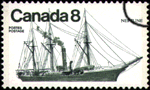
Neptune, a wooden ship,
went to the ice as a sealer for 67 years with twelve different
captains. Post cards
of the day called her the "King
of Sealers" and writer Andrew
Horwood
called her the "Queen of the
sealing fleet." A legend
beyond
gender, Neptune had a regal career and earned a place in Canadian and
Newfoundland
history.

| HomePort Quick Finder | White@HomePort | Search HomePort | Send e-mail to: HomePort |