

Key Processes of E-Commerce Project Management
With an overall function of program management established, multiple e-Commerce projects may be undertaken simultaneously, in parallel. Four key processes are involved in project management: engineer customer processes; engineer value-chain processes; engineer internal business processes; and incrementally develop e-Commerce applications.
1. Engineer Customer Processes.
The task of engineering customer processes is paramount, and can only be done with the full and direct participation of customers themselves. After all, in business engineering terms, the customer is the process owner. Through a process of outside-in design, customer processes become the requirements specifications for value-chain process engineering. Customer processes are expressed in terms of the services they require. Each customer will want to customize those services and subsets of them to optimize their information and buying activities.In business-to-consumer applications, customers will increasingly seek total solutions to their buying needs. For example, buying a car involves financial, legal and insurance services. Customer processes must have access to all the information and all the services needed to form a total solution. In business-to-business applications the customer's internal business processes must interact with those on the e-Commerce boundary. For example, a typical purchasing application will require internal requisitioning workflows, approvals and processes as well as those related to the external e-Commerce transaction.
2. Engineer Value-chain Processes.
Process integration between and among actors in the value chain is the essence of inter-enterprise process engineering and business-to-business e-Commerce. As shown in Figure 8.3, e-Commerce process integration can be measured at three levels: data handoffs, process handoffs and shared real-time processes.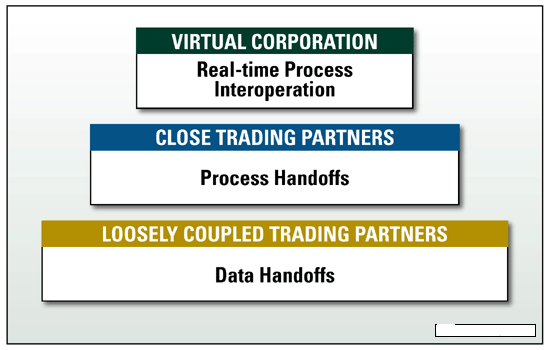
Inter-enterprise Process Integration Levels
Without process integration, simple data handoffs occur between participants in e-Commerce transactions. At this level of integration, e-Commerce is simply a media replacement for paper. At the next level, e-Commerce transactions trigger the processes in the systems of other participants. For example, an order processing system of a retailer may trigger inventory status processes within a supplier's system - the processes in the e-Commerce transaction are aligned via process handoffs. At the highest level of inter-enterprise process integration, processes in the e-Commerce space are jointly owned and interoperate in real-time. The user of such systems cannot tell which sub processes are running on whose internal systems - the user is interacting with and consuming ubiquitous e-Services. Full process integration gives each player in a value-chain full access to information and services, both up and downstream in the value-chain. For example customer information is available throughout the value-chain, not just to the "seller." Such information sharing can allow each participant in the value-chain to optimize its performance. These fundamentals are essential in value-chain to value-chain competition.
As open markets continue to emerge, a combination of these three process arrangements need to be supported simultaneously in a given ecosystem. Players in a value-chain will have differing technological capabilities and readiness for process sharing. For example, a mom-n-pop specialty manufacturer of components may not have a computer but can participate in an e-Commerce a value chain by fax, just like in the traditional world of commerce. Others in the same value-chain may participate only by email, while yet other participants are connected in real-time, 7x24. New Web standards for data and document sharing, such as the eXtensible Markup Language (XML) will ease the interoperation challenges and bring the benefits of traditional EDI systems to all businesses, big or small.
In addition to the internal business processes that are the object of traditional business engineering of a company, inter-enterprise processes add new dimensions of functionality and new players that must be addressed. Some of the key new processes that come into play beyond the boundary of a given company are shown in Figure 8.4. One of the challenges of inter-enterprise process engineering is the mapping of the processes to trading partners whose processes are integrated at various levels, from data handoffs to fully integrated processes. Inter-enterprise process engineering adds new dimensions to traditional business engineering because we are modeling business ecosystems, not just a single company.
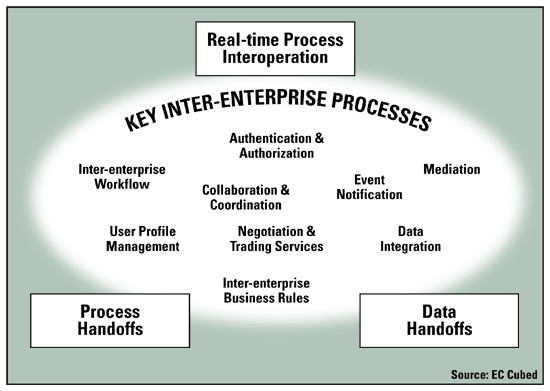
Key Inter-Enterprise Processes
3. Engineer Internal Business Processes.
Internal business processes must be adapted in order to participate in e-Commerce. With a component-based development approach "wrappers" are developed for legacy information systems that implement internal business processes. In addition, new e-Commerce processes for which there are no legacy implementations will require data to be integrated from legacy systems directly into the e-Commerce applications.4. Pilot, Deploy and Iterate.
Building ultimate, all encompassing e-Commerce systems does not happen in one big step or one big project. These systems are too large and complex and, when doing business at Internet-time, time is short. The goal is to deliver fast and often. Using a minimalist approach, incremental delivery is the key to sustainable development. The minimal functional business requirements should be developed, piloted to manage risk, and deployed as "Release 1." Business requirements determine the functionality to be delivered in Releases 2 to ...n. Release 1 embodies the key business process innovation, Releases 2 to ... n represent continuous process improvement. In the battle for competitive advantage in the digital economy, e-Commerce development never ends. Each iteration of development must raise the bar for competitors.

