
This page is dedicated to the real ships, and the ones from Star
Trek and ACTD, that have proudly served their fleets with
distinction, a trait which the current U.S.S. Huron still carries out.
Although the name "Huron" has not been used on a
motored vessel in the United States in almost 30 years, the name
'Huron' has served the Royal Canadian Navy with honors and has been a
prominent fixture on the Canadian Naval Roster for over 5 decades,
and 2 Ships.
In 2288, the name "Huron" became a prominent fixture in
the Starfleet ship registry. Three of the Federation's ships have
been named Huron through the years, continuing to serve a tradition
started out by her Maritime Counterparts.
Sit back, relax and enjoy the History of the USS Huron.
We, the crew, hope that you enjoy reading it as much as we have
enjoyed putting it together. Much of this information is courtesy of
the Canadian
Tribal Class Association. , Dictionary
of American Naval Fighting Ships, Lightship
Huron Museum. These are very good websites to get more
detailed information on the history of the famous Ships named "Huron".
"Huron" is a name derived from a French word
which was first applied by the European settlers in 1534 to a tribe
of Indians who resided in the St. Lawrence River Valley and the
Simcoe Regions. The Huron were settled in agricultural villages where
they raised tobacco for barter. Despite sharing a common language,
the Huron were bitter enemies of the five nation Iroquois League.
This rivalry finally culminated in a bloody conflict in 1648, when
the Iroquois, equipped with modern European rifles, destroyed a Huron
nation already decimated by disease.
|
|
Registry Number |
Class |
Type |
Fleet |
|
|
Unknown |
Unknown |
Steamer |
United States Navy |
|
|
Unknown |
Unknown |
Iron Clad |
United States Navy |
|
|
Unknown |
Unknown |
Unknown |
United States Navy |
|
|
WAL-526 |
Lightship |
Lightship |
US Lighthouse Service |
|
|
ACR-9 |
Pennsylvania |
Armored Cruiser |
United States Navy |
|
|
DDE-216 |
Tribal |
Destroyer |
Royal Canadian Navy |
|
|
PF-19 |
Tacoma |
Patrol Frigate |
United States Navy |
|
|
DDH-281 |
Iroquois |
Destroyer |
Royal Canadian Navy |
|
|
NCC-2048 |
Miranda |
Light Cruiser |
Federation Starfleet |
|
|
NCC-20281 |
Excelsior |
Cruiser |
Federation Starfleet |
|
|
NCC-61245 |
New Orleans |
Frigate |
Federation Starfleet |
The first ship to bear the name
|
Builders: |
Boston Navy Yard |
|
Launched: |
21 September 1861 |
|
Commissioned: |
8 January 1862 |
|
Length: |
158' |
|
Beam: |
28' |
|
Draft: |
12' |
|
Decommissioned: |
14 June 1869 |
The first Huron, a schooner-rigged screw steamer, was launched on September 21, 1861 by Paul Curtis, Boston under Navy contract; and commissioned on January 8, 1862 at Boston Navy Yard, Lt. John Downes in command.
This Huron joined the South Atlantic Blockading Squadron in February to take part in Union strangulation of Confederate commerce, and steamed off the coasts of Georgia and Florida. Back on regular blockade duty, she captured schooner Aquilla.
During the ironclad attack on the forts in Charleston Harbor on April 7, 1863, the ship formed part of a reserve squadron outside the bar. Five days later, while patrolling with flag, she detected blockade-running steamer Stonewall Jackson attempting to dash into Charleston. The two union ships opened fire immediately, so damaging the blockade runner that she was forced to run aground and destroy her cargo, which included vitally needed Army artillery and shoes.
Huron took part in the bombardment which was to cover the storming by Army troops. This first assault aborted, but preparations were quickly made for a second joint operation in January 1865. Again Huron provided a part of the devastating naval bombardment. Then, during the final months of the war, Huron took part in combined operations against the city itself, bombarding Forts Anderson and St Philip.
After Appomattox, responding to the attempted escape of President Davis of the Confederate States, Huron steamed to Key West in an effort to capture Confederate officials bound for Havana or Mexico by water. She arrived on May 2, but Davis was captured near Iwinville, Ga., on May 10, 1865.
Huron served on South American station after the Civil War returning to New York and decommissioning on October 8, 1868. She was sold at New York on June 14, 1869.
(excerpt - Dictionary of American Naval Fighting Ships)
The second ship to bear the name
|
Builders: |
Chester, Pennsylvania |
|
Commissioned: |
1875 |
|
Length: |
175' |
|
Length: |
32' |
|
Beam: |
13' |
|
Crew: |
16 officers, 118 enlisted men |
|
Sunk: |
24 November1877 |
Built a decade after the Civil War, the USS Huron was constructed during a period of transition between the old and new navy. The Huron and her two sisterships were the last American naval vessels to be built of iron rather than steel and to be equipped with sails to supplement their steam engines.
During her brief career (1875-1877), the Huron visited ports in Mexico, Venezuela, Columbia, Key West, Mobile, Charleston, Norfolk, Boston, New York, and Washington, DC However, it was the tragedy of the Huron's sinking on November 24, 1877, that brought the ship to national attention.
The third ship to bear the name
At time of Publication, No information was available to publish about this ship. We do know that she served in the United States Navy and presumably sailed between 1880 and 1918.
The fourth ship to bear the name
GENERAL INFORMATION
|
Keel Laid: |
1918 |
|
Commissioned: |
1920 |
|
Length: |
97 feet |
|
Beam: |
24 feet |
|
Draft: |
9'-6" |
|
Displacement: |
310 TONS (Fresh water) |
|
Mast Height: |
Lantern: 52'-6" Main Mast: 42'-9" |
|
Crew: |
12 |
|
Decommissioned |
1970 |
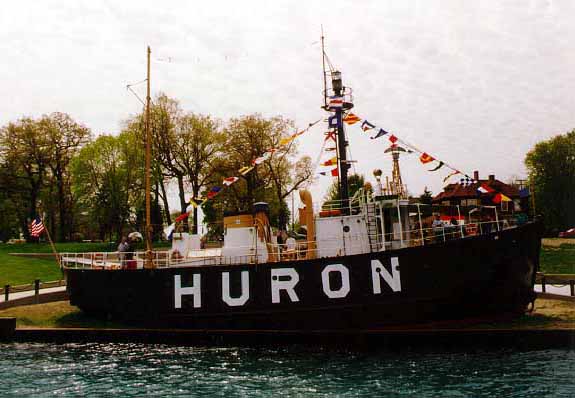
The Lightship Huron built in 1920 at a contract price of $147,428 by the Consolidated Shipbuilding Corp., Morris Heights, NY (No Hull Number assigned). Keel laid on June 5, 1918 and launched on May 1, 1920 as a) Lightship for the U.S. Lighthouse Service. Commissioned on December 22, 1920, her hull originally was painted red with the lettering "RELIEF" on her sides. Lightships are officially designated by their number, however they bear the name of their current station, or duty, on their sides. Lightship 103 completed her sea trials on December 4, 1920 and was delivered to the 12th District Headquarters at Milwaukee, WI on June 9, 1921 to begin her Great Lakes career.
Lightship 103 replaced the previous Corsica Shoal stationed lightship at the Lake Huron cut beginning in 1936, a station that had been established since 1897. Her hull was painted black with the white lettering "HURON" on both sides of her hull since she was assigned the black buoy side of the entrance to the Lake Huron Cut. The Lighthouse Service merged with the U.S. Coast Guard in 1939. From 1945 onward, she was the only lightship in service with a black hull. She usually wintered at the Coast Guard Station at the foot of Mt. Elliot in Detroit. In 1949, Lightship 103 was extensively rebuilt at a cost of $168,000 and converted to diesel power.
In November 1952, the lightship at Gros Cap Reef in Whitefish Bay was withdrawn from service leaving Lightship 103 as the last lightship on the Great Lakes. Lightship 103 was withdrawn from service on August 20, 1970 as the oldest lightship in the Coast Guard. Five days later she was decommissioned and laid up in the Black River at Port Huron, MI. On June 5, 1971 the lightship was acquired by the City of Port Huron. On August 2, 1990 the lightship was dedicated as a National Historic Landmark.
(Excerpt from the Lightship Huron Museum)
Pennsylvania Class - The fifth ship to bear the name

|
Builders: |
Union Ironworks, San. Fran. USA |
|
Launched |
21 July 1904 |
|
Commissioned |
27 January 1908 (As U.S.S. South Dakota) |
|
Re-Named Huron |
7 June 1920 |
|
Pennant Number |
ACR-9 |
|
Length |
503'-11" |
|
Beam |
69'-7" |
|
Draft |
26'-1" |
|
Decommissioned |
17 June 1927 |
Assigned to the Armored Cruiser Squadron, Pacific Fleet, South Dakota cruised off the west coast of the United States through August 1908. On August 24, she departed San Francisco for a cruise to Samoa and headed eastward in September to operate in Central and South American waters. The force called at ports in the Admiralty Islands, the Philippines, Japan, and China, before returning to Honolulu on 31 January 1910.
South Dakota was used in a Special Service Squadron, was sent to the Hawaiian Islands, the Marianas, the Philippines, and Japan. She was reverted to reserve status a couple of times. In 1915, she was the flagship of the Reserve Force, Pacific Fleet. She remained in reduced commission through 1916; and on 5 April 1917, she was again placed in full commission. She was transferred to the Atlantic after the United States entered World War I, South Dakota departed Bremerton on 12 April. South Dakota proceeded to the South Atlantic for patrol duty operating from Brazilian ports, she also escorted troop convoys from the east coast to the mid-Atlantic rendez-vous point where British cruisers joined the convoy. Following the Armistice, South Dakota made two voyages from Brest, France, to New York, returning troops to the United States.
In the summer of 1919, South Dakota was ordered back to the Pacific to serve as flagship of the Asiatic Fleet, arriving at Manila on 27 October 1919. South Dakota was renamed Huron on 7 June 1920 and was designated CA-9 on 17 July 1920.
She served in the Asiatic Fleet for the next seven years, operating in Philippine waters during the winter and out of Shanghai and Chefoo during the summer. Ordered home, Huron departed Manila on the last day of 1926 and arrived at the Puget Sound Navy Yard on 3 March 1927. She was decommissioned on 17 June 1927 and remained in reserve until she was struck from the Navy list on 15 November 1929. She was sold on 11 February 1930 for scrapping in accordance with the provisions of the London Treaty for the limitation and reduction of naval armament.
(excerpt - Dictionary of American Naval Fighting Ships)
Tribal Class - The sixth ship to bear the name
|
Builders: |
Vickers-Armstrong, High Walker Yard, Newcastle-on- Tyne; England |
|
Ordered |
April 1941 |
|
Laid Down |
15 July, 1941 |
|
Launched |
25 June, 1942 (Christened by the Countess of Minto) |
|
Commissioned |
19 July, 1943 |
|
Pennant Numbers |
G24 June 1943 - December 1949; DDE 216 January 1950 - August 1965 |
|
Radio Call Sign |
CGXY |
|
Voice Call Sign |
Jersey Bounce |
|
Decommissioned |
1965 in La Spezia Italy |
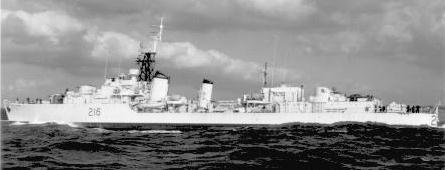
Huron served Canada honourably during the latter part of the Second World War. Commissioned 19th July 1943, at Newcastle-on-Tyne, she was assigned to the 3rd Destroyer Flotilla of the British Home Fleet.
Huron was used to carry technical personnel and special naval stores during some special operations to Murmansk. She was also used to escort convoys as far as North Russia. In February 1944, after one more trip to Murmansk, she joined the 10th Flotilla at Plymouth for pre-invasion duties spending the next seven months in the Channel, and the Bay of Biscay.
Huron was involved in a "scrap" with German Elbing class destroyers in the English Channel. After the action, she and the Ashanti collided and the results damaged Huron's port hull and the main bulkhead . The port cutter and its davits were smashed, the guard rails and stanchions bent inwards and the torpedo-davit damaged. Huron managed to return safely to Plymouth and repairs were completed on 7th May, just in time for D-Day operations.
Once she was reparied, Huron was sent to escort in defferent places around the world. After sharing in the liberation of Scandinavia, she returned to Halifax in preparation for service in the Pacific. Her refit was suspended in August and Huron was placed in reserve. She was paid off 9th March 1946.
Huron was recommissioned at Halifax for training purposes in 1950, but sailed in Korean waters. On her return from Korea, she reverted to her peacetime role until she was finally paid off on 30th April 1963 at Halifax. Huron was broken up at La Spezia, Italy in 1965.
(excerpt - Canadian Tribal Class Association)

|
Commissioned |
7 September, 1944 |
|
Length: |
303'-1" |
|
Beam |
37'-6" |
|
Draft |
13'-8" |
|
Pennant Number: |
PF-19 |
|
Builders: |
American Shipbuilding Co. |
|
Decommissioned: |
19 April 1946 |
The Huron was launched under Maritime Commission contract by American Shipbuilding Co., Cleveland, Ohio 3 July 1943 ; sponsored by Mrs. J. S. Tschetter, wife of the mayor of Huron, South Dakota. Acquired and commissioned 7 September 1944, Lt. Cmdr. W. W. Collins, USCG, in command.
This Huron was used for training in Bermuda and sailed with covoys that were sent in North Africa. While bringing together merchant ships which had become separated during the night, Huron was rammed by SS James Fenimore Cooper shortly after midnight 8 December. Though the engine room flooded rapidly, the ship's damage control work was timely and skillful, keeping her afloat. After temporary repairs, Huron was towed through rough weather by Choctaw, arriving Bermuda 15 December 1944. From there she was taken to Charleston for conversion to a sonar-training ship.
Huron arrived Key West 22 February 1945 for training operations at the Fleet Sonar School. She spent the remainder of the war providing both technical and tactical antisubmarine training for officers and men. Huron departed Key West for Norfolk 19 March 1946 and decommissioned there 19 April 1946. She was sold to United Dock Corp. 15 May 1947.
(excerpt - Dictionary of American Naval Fighting Ships)

|
Laid Down: |
June 1969 |
|
Launched: |
9 April 1971 |
|
Commissioned: |
16 December 1972 |
|
Modernized: |
1994 |
|
Pennant: |
DDH-281 |
|
Builder: |
Marine Industries, Sorel, Quebec, Canada |
|
Speed: |
30 Knots |
|
Displacement: |
4700 tons (slightly less than her three sisters) |
|
Crew: |
14 officers; 230 enlisted (pre-TRUMP); 290 total (post-TRUMP) |
|
Length: |
426 feet overall; 398 feet between perpendiculars |
|
Beam: |
50 Feet |
|
Draught: |
15.5 Feet |
|
Radio Call Sign: |
CGXY |
|
Voice Call Sign: |
Warship 281 |
HMCS Huron represented Canada at the Silver Jubilee naval review at Spithead on June 28, 1977 and in 1981 carried Governor-General Edward Schreyer on a tour of five Scandanavian ports. She also served as the test bed for the VLS installed in the Trump'ed Tribals and the Canadian Patrol Frigates. Huron was transferred to the west coast in July 1987 and in February 1991, sailed to relieve Athabaskan in the Persian Gulf. After that tour of duty, she sailed to Sorel, Quebec to undergo her TRUMP refit and was the last of her class to do so. In October of 1993, Huron relieved Algonquin which was on patrol in the Adriatic sea.
"Ready the Brave" Huron's motto was suggested by the wife of the first Commanding Officer and reflects both the role of Maritime Command and the Tribal nature of this class of ship.
(excerpt - Canadian Tribal Class Association)
Miranda Class - The ninth ship to bear the name
|
Builders: |
San Fransisco Fleet Yards, Earth |
|
Launched: |
08 February 2288 |
|
Commissioned |
14 June, 2288 |
|
Pennant Number |
NCC-2048 |
|
Length |
277 Meters |
|
Beam |
174 Meres |
|
Decks |
12 |
|
Destroyed |
19 August 2308 |
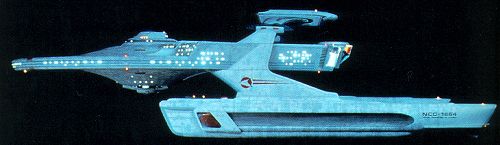
The USS Huron was a Miranda Class Starship commissioned at the San Fransisco Fleet Yards orbiting Earth in 2288. The Huron was assigned as a Cutter in the area of Starbase 12. Huron was one of the few Miranda Class Ships brought in to replace the similarly configured Soyuz Class for this specific duty. Huron served along the Klingon Border with distinction, and was known for her excellence in service as a border cutter.
After serving on 4 tours of Duty in the Klingon Neutral Zone, the Huron was commissioned as a training vessel at Starfleet Academy, where she served as a cadet training ship for over 8 years. during this time, she was refitted with low power phasers and used as a Combat Training vehicle. The USS Huron was then converted back into her original configuration and was supposed to return to patrol duties along the Klingon Border. However, this was not to be as a malfunction in the forward torpedo bay of the ship caused a chain reaction, and subsequently destroyed the ship with all hands aboard.
Excelsior Class - The tenth ship to bear the name

|
Builders: |
SOL-3 Ship Yards, Earth |
|
Launched: |
23 April 2308 (as U.S.S. Trois Rivieres) |
|
Commissioned: |
15 December 2308 (as U.S.S. Huron) |
|
Pennant Number: |
NCC-20281 |
|
Length: |
511 Meters |
|
Beam: |
196 Meters |
|
Decks: |
25 |
|
Presumed Lost: |
17 January 2332 |
| Rediscovered: | 14 October, 2377 |
| Renamed: | Nov 1, 2377 (As USS Trois Rivieres) |
This USS Huron is the Second Federation Starship to bear the name. The Huron was designated as a deep space exploratory vessel and commissioned in 2308 shortly after her predecessor was destroyed. The USS Huron was originally slated to be named the USS Trois Rivieres, but Starfleet decided that the Huron name would be carried on instead.
The Huron was assigned on a 20 year extended deep space exploration mission, and like many of her sister ships, made First Contact with 12 new civilizations. After this tour of duty, the Huron spent 2 consecutive tours of duty cataloguing star systems in Beta Quadrant. The Huron was last seen in Beta Quadrant cataloguing a very large nebula. The ship was lost without a trace.
In 2377, the Huron was rediscovered by the USS Huron (NCC-61245) while cataloguing a gaseous Nebula. The Huron was later renamed to the USS Trois Rivieres, and serves out of Starbase 233.
New Orleans Class - The eleventh ship to bear the name

|
Builders: |
Earth Station McKinley (Orbiting Earth) |
|
Frame Construction Phase 1: |
01 November 2359 |
|
Frame Construction Halted: |
14 May, 2360 |
|
Construction Recommence: |
December 20, 2372 |
|
Launched: |
August 19, 2373 |
|
Commissioned |
17 October, 2373 |
|
Pennant Number |
NCC-61245 |
|
Length |
425 Meters |
|
Beam |
225 Meters |
|
Decks |
18 |
Pressed into service as a result of the Dominion War in 2373, Spaceframe 61245 sat abandoned in storage until a shortage of Starships warranted it's completion. Work on spaceframe 61245 was resumed at Earth Station McKinley and the ship was eventually named the USS Huron, in honor of the ship lost while exploring the Beta Quadrant. At the time of her fitting, she was fitted to Type 5-A Standards, which were the most advanced for a starship of her class at the time.
Upon completion, the USS Huron was sent to Patrol the back lines of the Dominion War, acting as a convoy escort ship. The Huron recieved one Battlestar during the war when she destroyed a Jem Hadar Assault Ship attacking a Convoy.
On another occasion, the Huron was badly damaged, but deemed salvagable after she was attacked and subsequently rammed off the Klingon Boarder during the closing days of the War. The Ship was so badly damaged that if Starfleet was not so short of Starships at the time, she would have been deemed a total writeoff. After the completion of the war, the Huron was sent to the Delta V Ship yards in Sector Zed Omega for an extensive refit and repair.
Sighting Federation interests in the area, the Huron remained in Zed Omega Sector which is along the Federation's Border of the Romulan and Gorn Empires, in an area known as the Fringe. The Huron still protects this area of space and serves as it's Flag ship. The Huron's Home Port is Starbase 71.
