
Nurse's Role in Observing and Recording Vital Sign Data
Steven Ringer, MD, Ph.D., Director of Newborn Services, Brigham and Women's Hospital, Harvard Medical School, Boston MA
Judith A. Azok, RN, MSN, Assistant Professor of Adult Health Nursing
Marjorie L Icenogle, Ph.D., Assistant Professor of Management
Steven M. Zimmerman, Ph.D., Professor of Quality and Systems Management University of South Alabama, Mobile, Alabama
Abstract
Current clinical monitoring methods and procedures have evolved under pressures from changing: technology; paradigms; litigation; caregiver training; and patient expectations. The current standard procedure for vital sign monitoring is: one manual observation and recording each hour, plus an alarm system based on individual observations. The responsibility for making the monitoring system work is on the caregiver who is responsible for minute-to-minute care, usually the nurse.
This paper's objective is to compare the oxygen saturation values of ICU newborns recorded using current practice against a computerized beat-to-beat record of oxygen saturation. Comparisons of the two records led to the following conclusions: 1) nurses accurately observe and record data; 2) current procedures record only a fraction of the information available from today's monitors; 3) the value of vital sign data collected using current procedures for clinical decision making is limited by the current data collection practices; 4) computers can record and analyze data faster, more accurately, and at a lower cost (i.e., it is inefficient use of nurse skills and time to use a nurse for recording data when a nurses should be making clinical decisions based on analyzed output, not recording and analyzing data in their heads); and 5) vital sign records may become legal documents during litigation; therefore, the more complete and accurate the record, the stronger the caregivers' defense.
Introduction
No one person or group is responsible for designing the current national standards for observing and recording vital sign data. Interviews with experienced nurses indicate that few changes have occurred in observing and recording vital sign data, although technology and objectives for data collection have changed. Specifically, in the ICU for newborns, the nurses manually collect and record infants' vital sign data following the current national standards.
Presently, recorded vital sign data may be used for: 1) selecting treatments; 2) allocating resources by patient need, triage; 3) providing legal records; or 4) data may not be used at all. Patient data generation rates are as fast as heart-beat to heart-beat, while manual data collection rates maybe as slow as once per hour. For many purposes, the observation and recording of one sample per hour from 3,000 to 12,000 heart beats plus is inadequate.
The manner in which vital sign data are used is limited by the training of caregivers. Many caregivers use the last number recorded as the representation of the parameter measured, that is, the current condition of the patient. From a statistical point of view this does not provide an adequate representation of the patient's condition. There is no way to select a single number that represents many vital sign parameters for an entire hour. Caregivers owe their patients the best clinical decisions possible which are based on the most accurate data available, and analyzed using the best methods.
The current procedure for observing and recording vital sign data is: 1) vital sign monitors produce data; 2) a caregiver reads and records one observation once each hour; and 3) between observations, monitor alarms sound when vital signs go beyond specification limits. Depending on the potential use of the data, once an hour observations may be of limited value.
Experimental Design
Vital sign data are recorded on a patient's worksheet along with other clinical information. Since the objective was to compare current practice with data produced by the monitor and recorded in a database, no changes were made in the nurse's sampling and recording of data onto worksheets. A computer was connected to the clinical monitor using the serial communication port (available on most medical monitors). The data from the serial port were captured and recorded by the computer. This electronic record was then compared to the worksheets.
Data were collected for over 30 patients (newborns). Since over 15 megabytes of electronic data were collected for patient #27, this patient was selected as the test case. The data were collected over six days, starting on August 10, 1995 and ending August 15th. There were some gaps in patient #27 data; however, this patient's record provided the longest and most complete data set available.
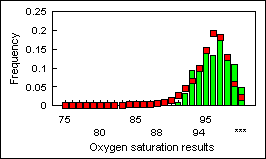
Figure 1 is a histogram which includes all electronic data plus the nurse recorded data. A frequency scale was used so that the shape of the two data sets could be compared. The shape of the two distributions are similar. Based on this visual comparison, it appears that the nurse data (bos) were an accurate random sample selected from the universe of data as represented by the electronic recorded data (bar).
Figure 1 Visual Goodness of Fit Test - Nurse recorded data versus computer recorded
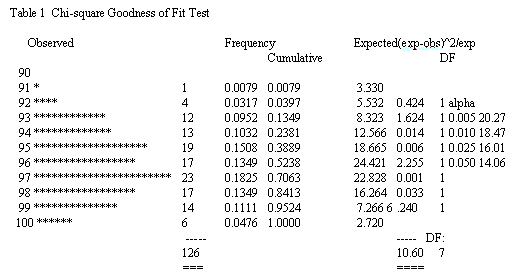
The Chi-square goodness of fit test may be used to compare frequency distributions of the nurse data to the electronic data (the universe). There were eight cells included in the test. The test Chi-square statistic was 10.60. For alpha equal to 0.05, (95 percent confidence level), the critical value is 14.06. In statistical terms, there is no numerical evidence to reject the hypothesis that the nurse data were a random sample taken from the universe of data as represented by the electronic data. Based on the visual and Chi-square test, our conclusion is that current practice (nurse recorded data) is a good-representative random sample of the electronic universe.
The monitors used in this study produced (heart) beat-to-beat output. Newborn (premature) babies hearts may beat 3 times per second, therefore, in one hour 10,800 data values may be generated. experience indicates that the number of heart-beats per hour is near 8,000 for most premature babies. Premature babies can breath as often as 200 plus times per minute. In comparison, adults breath approximately once per second or 3,600 times per hour. According to current monitoring procedures, the nurse records one observation per hour. Figure 2 illustrates the electronically collected oxygen saturation data compared to the single nurse recorded value for hour 13. Similarly, Figures 3 and 4 compare the single nurse recorded value of oxygen saturation to the electronic data for hours 14, and 17, respectively.
Figure 2 Patient #27 hour 13

Figure 3 Patient #27 hour 14
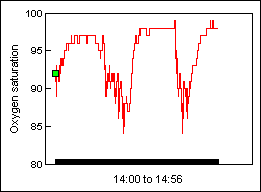
In Figures 2 through 4, the solid line that goes up and down (sometimes in steps) represents the individual observations. The box represents the nurse observation. The box is placed at the beginning of the hour, although there is no way to know at what time during the hour the nurse made the observation. The steps observed in the electronic data are possibly due to:
1) sampling speed, the computer may be sampling faster than the body changes, or
2) lack of precision in measurement instrument, in other words the precision of measurement is not great enough to pick up bodily changes.
Figure 4 Patient #27 hour 17

Auto-correlation is a mathematical measurement of the degree to which an observation is influenced by the prior observation. Clinical homeostasis is the condition when a patient’s system is in balance. The clinical concept of homeostasis is related to the mathematical concept of auto-correlation; however, we do not yet know enough to draw conclusions about this relationship. Most patients in our study showed various levels of auto-correlation at different times in their oxygen saturation measurements. The researchers believe that this is an issue relative to understanding the meaning of these data.
Oxygen saturation is measured to the nearest whole percent. As oxygen saturation approaches 100 percent saturation, the measurement preciseness seems to effect the data behavior. Without replicating this work using a more precise measurement tool, there is no way to answer the question, "what is the effect of poor precision?" Examination of Figures 2 through 4 leads to only one conclusion, that a single sample per hour is not an adequate representation of the patient's vital signs during throughout the hour. Current procedure provides only a fraction of the information available from today's monitors.
Figure 5 illustrates the relationship between the nurse recorded data and average electronic data for patient #27. The electronic data varied in a range from 90 to 100 percent. The nurse also recorded numbers within this range, yet, the correlation coefficient between the value the nurse recorded and the electronically recorded data is 0.2603, that is an r2 of 0.0677. In non-statistical terms the relationship is weak.
Human Data Filtering
Whenever there is a human in the observation and recording loop, the danger of human filtration of data exists. Generally, human filtering consists of not seeing extremely low or high values. Human filtering is not a dishonest act, but is rather human nature. For example, a clinical observer walks over to a monitor and sees that it is registering zero. They rub their eyes and wait for the next number. Usually, a zero means a break down in communication between the patient and the monitor, or between the monitor and the computer. Such an event has no clinical significance unless it continues and requires reconnection of the probes. One advantage of electronic recording is that the computer detects and records extreme values. The researchers have not seen extreme values of this nature recorded by nurses.
The researchers know of no situations where the human filtering of data has had any clinical significance; however, when electric data collection replaces human recorded data these jumps are more readily observed, noticed, and must be addressed. Jumps are not the only information that is not utilized by current practitioners. Our hypothesis is that vital sign data behavior has a significant amount of information to tell us about patients. There will be a learning period as the best methods for analysis are selected and patient conditions are tracked to learn what information is available.
Figure 5 Nurse recorded data versus electronic data

Nurse Utilization and Data Collection Costs
Nursing skills are expensive; therefore, it is an inefficient use of the nurses' time to record data, when a computer can capture and record data more accurately and efficiently. In addition, nurses have little or no statistical training. Nurses could be more effectively used to performing care giving, that is taking care of patients.
Among the costs of vital sign data collection are the use of expensive equipment, training clinicians, setup costs, possible patient discomfort, and in the case of invasive sampling, some potential health hazards. As patients, the researchers would be disturbed, if clinicians failed to utilize data available from the sampling process. The collection of vital sign data is costly in terms of dollars and discomfort for the patient and all available information contained in the data should be utilized to diagnose patient's conditions and prescribe treatment.
Data Are Not Information
Some clinical decision makers tend to discount the information available from vital sign monitoring for clinical decision making, because current practice provides little information compared to what is available. Current caregivers' paradigms are often based on the following assumptions:
1) vital sign behavior is only important when output is beyond the population limits
2) monitoring is not a clinical issue
3) recording data is not part of caregiving
4) recorded vital sign values are of little clinical value
5) recorded vital sign values are not used by physicians
6) recorded vital sign values are a legal record only
The researchers agree with caregivers that current practices of observing and recording data once an hour reduces the value of vital sign data. Also agreed is that one observation, which may not be representative of the patient's vital signs, is of marginal value for caregiving decision making. Electronically collected data may be analyzed to provide information in a more timely manner. More importantly, good data is a clinical tool rather than simply a weapon that may be used when a problem occurs.
Although most caregivers do accurately observe and record data at a point in time, manual data may not reflect the true facts, while computer recorded monitoring provides a detailed account of the exact performance of a patient's vital signs. The researchers also agree that data collected manually, according to existing procedures will be used by lawyers to make good caregivers look incompetent. Complete and accurate monitoring records are more useful in determining exactly what transpired with the patient. In our judgment, honest physicians are better off with accurate and complete data when fighting malpractice cases.
Conclusions
Nurses accurately observe and record data; however, current monitoring procedures limit the value of these data by providing only a fraction of the information available from today's monitors. Some human data filtering appears to be present; however, we cannot identify any clinical significance due to filtering. Current manual monitoring procedures appear to be an inefficient use of nurse skills and time, when a computer can record and analyze data faster, more accurately, and at a lower cost.
The collection of vital sign data is costly in terms of dollars and discomfort for the patient, therefore, it is wrong not to get the maximum benefit from the process. The value of vital sign data for clinical decision making is limited by the current practice. We believe that there is a lot of information in the data, but a significant amount of research is needed to identify the information. Vital records may become legal documents in the case of litigation. The more complete and accurate the record, the more useful the data are as an aid in determining exactly what occurred. In our opinion, clinicians do a good honest job and will get the most benefit from good accurate records that truly reflect the vital signs of the patient.
References
