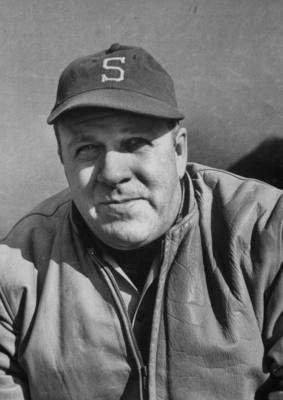
Clarence Lester "Biggie" Munn (September 11, 1908 – March 18, 1975) was an American football player, coach, and college athletics administrator in the United States. He was the head football coach at Albright College (1935–1936), Syracuse University (1946), and most notably Michigan State College (1947–1953), where his 1952 squad won a national championship. Munn retired from coaching in 1953 to assume duties as Michigan State's athletic director, a position he held until 1971. Each year, the Michigan State Spartans football team hands out the "Biggie Munn Award" to the team's most motivational player. MSU's Munn Ice Arena, built in 1974, is named in his honor. Munn was inducted into the College Football Hall of Fame as a coach in 1959, and, in 1961, he became Michigan State's first inductee into the Michigan Sports Hall of Fame. He authored the coaching textbook Michigan State Multiple Offense in 1953.
Munn was born in the former Grow Township, now known as Andover, Minnesota. A 1932 graduate of the University of Minnesota, he played guard and fullback for the Golden Gophers under head coach Fritz Crisler.
Early coaching career Three years after his playing career ended, Munn got his first head coaching job at Albright College in Reading, Pennsylvania, where he stayed for two seasons (1935–1936). From 1938 to 1945, he was an assistant football coach at the University of Michigan, once again under Crisler. Munn served as head coach at Syracuse University for one season in 1946 before leaving for Michigan State. One of Munn's assistants at Syracuse was former Orangeman standout Duffy Daugherty, who followed Munn to Michigan State and assisted him there for seven seasons before succeeding Munn as head coach. Munn is one of the few people to have coached at both Michigan State and its archrival Michigan.
In 1947, Munn and the Michigan State administration, led by university president John A. Hannah, approached Notre Dame president Father Cavanaugh to have his Fighting Irish play the Spartans for the first time since 1921. MSU initially offered to let Notre Dame take 80 percent of the gate, but Cavanaugh insisted they split the receipts down the middle. Munn was the only coach to beat Notre Dame head coach Frank Leahy three years in a row (1950–1952).
Munn developed the "Wingback Deep" formation of his formula "Michigan State Multiple Offense." The play featured a shifting back and forth between a T-formation and a single-wing formation with a direct snap to the tailback between a T-formation quarterback's legs.
On the Michigan State dressing room wall, Munn hung a statement on fundamentals that his players were required to read before every home game: "Do not cheat your team or your teammates. Know your plays. Block. Protect. Add to what we are trying to do. [signed] Biggie."
During the latter part of his coaching career, Munn developed the talents of Willie Thrower, the Big Ten's first black quarterback.
In 1952, Munn was named the AFCA Coach of the Year, coaching MSU to 9–0 record and a national championship. In 1953, Michigan State's first year of conference play in the Big Ten, the Spartans shared the conference title with Illinois and went to the Rose Bowl, where they beat UCLA, 28–20.
Shortly after the Rose Bowl victory, MSU's athletic director, Ralph Young retired. Munn stepped down from coaching to assume duties as athletic director and remained in that position until 1971. Munn named his assistant, Duffy Daugherty, as his to successor to helm the football team.
During his tenure as Michigan State's head football coach, Munn tutored 17 All-Americans. His teams have retained the school's top four season marks for rushing-yards-per-game: 1948 (304.5 yards/game), 1951 (293.9 yards), 1952 (272.4), and 1950 (269.3).
Munn was inducted into the College Football Hall of Fame in 1959. Syracuse University enshrined him in its hall of fame in 1973. Munn was inducted into Minnesota's "M" Club in 1993.
Munn married the former Vera Jane Wattles (January 21, 1905 – January 4, 2004) in June 1935. The couple adopted two children: Michael and Jane Austin. Clarence Munn died on March 18, 1975 in Lansing, Michigan at the age of 66.
Taken from Wikipedia