
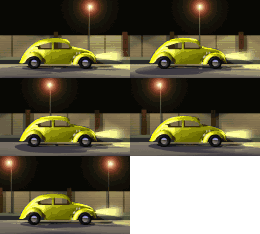
The basic idea of the people's car followed a list of specifications which Hitler had prepared. The car had to be capable of reaching 62 mph (100 km/h) while getting the equivalent of 42 mpg, carry two adults and three children, and cost less than 1000 Reichmarks ($150). He also wanted it powered by an air-cooled engine.
Despite possessing only rudimentary knowledge of automobile design theory, Hitler sketched a drawing of the rounded front end that he desired for the car after he had seen some early designs.
Apparently, Ferdinand Porsche did not willingly accept this government request but ultimately agreed to the project. The concept was in a fact a "ghost" of his Zundapp Type 12 and the defunct NSU Type 32 concepts. Therefore, developing his new project was, for Porsche, rather simple. His only problem was the lack of a reliable air-cooled engine.
Several air-cooled engines were built and discarded but, in 1934, Franz Xavier Reimspeiss joined Porsche's design team. Reimspeiss, a mechanical engineer, produced a design for a horizontally opposed four-cylinder that drew as much from the motorcycle design as it did from automobile engineering. It was quickly apparent that this four-cylinder engine was far superior to the two-cylinder prototypes on which Porsche had been working.
By 1936, a handful of prototypes had ben built and a handful of cars had been tested by the German Automobile Manufacturer's Association. However, the cast iron crankshafts failed early in testing. The problem was solved within a short term when they converted to a forged crankshaft ordered from Daimler-Benz.
With this and other design problems solved, the German government took over the car in 1937 as a state funded, German Labour Front project. The thirty prototypes were then built by Daimler-Benz for further testing. These Type 60 units had no back window and a large louvered panel covered the engine.
Edwin Komenda was then handed the project to complete the design. His job was to refine and simplify the styling. During the winter of 1937, the Reutter coach builders assembled a new version with a split rear oval window and a smaller trunklid. Daimler-Benz was asked to build another series of forty-four prototypes for testing and display.
Hitler apparently liked what he saw, and ordered the construction for a new factory in 1938 on the banks of the Mitterland Canal about fifty miles east of Hannover, Germany. Much to the disgust of Ferdinand Porsche, Hitler named the car "Kraft durch Freude: KdF-Wagen" which is German for "Strength through Joy". The factory town, called Town of Strength through Joy Cars", was renamed "Wolfsburg" by the British.
In order to finance the building of the factory, the Labour Front party began a program whereby individuals could purchase a Wagen by making deposits in a savings book. When the full purchase price had been deposited, the buyer could take delivery. Needless to say, the program did not have the buyer's best interests in mind.
Not a single pre-war Volkswagen was delivered to a citizen as Hitler invaded Poland at the end of 1939, before the plant got into production. France and Britain, in honouring their treaties, declared war on Germany.
previous page  |
 |
